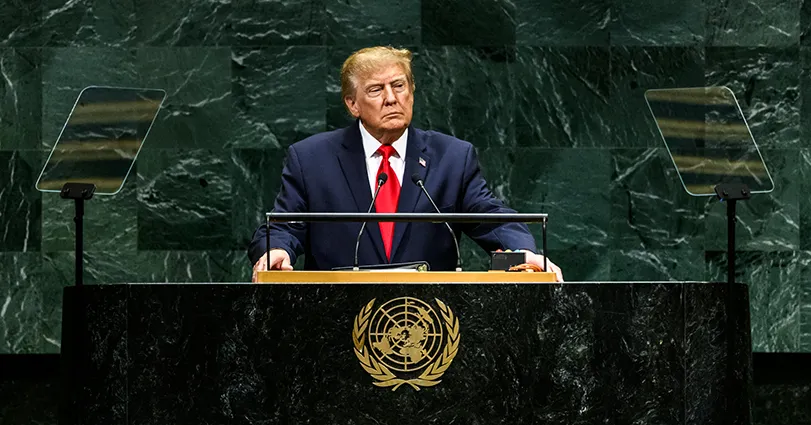
Trump Uses UN General Debate to Tout Economy, Press Iran on Deal

President Donald J. Trump addressed the general debate of the United Nations General Assembly on Tuesday, Sept. 22, highlighting what he described as international and domestic triumphs, including the economy and U.S. actions in Iran. NPR
NPR published its report on the address on September 23, 2026. Trump spoke during High-level Week for the 81st session of the General Assembly. United Nations
On Iran, Trump defended recent U.S. military action against Iran, according to contemporaneous U.N. coverage of the address. U.N. News
He warned he could 'annihilate' Iran and called on other nations to join the United States in isolating Iran economically to force it to the negotiating table. Reuters
In the same address, he said the United States and Iran had been talking and that he thinks the two countries will reach a deal at some point. Reuters He also told the Assembly that a deal with Iran is possible after the midterm elections. CNN
Archival records distinguish this 81st-session address from last year's appearance. U.N. audiovisual records show Donald J. Trump, President of the United States of America, addressed the general debate of the 80th Session on 23 September 2025. U.N. Audiovisual Library The White House dates those remarks to September 23, 2025. White House It published a 2025 release titled "At UN, President Trump Champions Sovereignty, Rejects Globalism" about that address. White House
The broader context here is the venue itself. The general debate is not a negotiating session. It is a set-piece for public positioning. It gives a president two audiences at once. Delegates sit in the hall. Voters hear the account at home. Trump used both registers in one speech. The message was two-sided.
Looking at what this means for Iran policy, the speech paired coercive language with an open channel. Economic isolation was presented as a path to talks. Talks were presented as ongoing. A future settlement was presented as likely. That combination leaves diplomats with parallel signals to parse. Pressure now. Talks later.
In my view, the reference to the midterm elections will get close attention in Washington. It places a domestic calendar marker on a multilateral offer. Staff who manage sanctions, allied coordination and back-channel contacts will have to align public pressure with private discussion. Allied capitals will weigh whether to add economic measures now or wait for a bilateral opening later.
For Congress and the agencies, the practical questions are narrow. What measures count as isolation. Who joins. What format any talks take. The speech did not settle those details. It set the public terms, and the follow-up will be read in cables, enforcement guidance and meeting schedules.