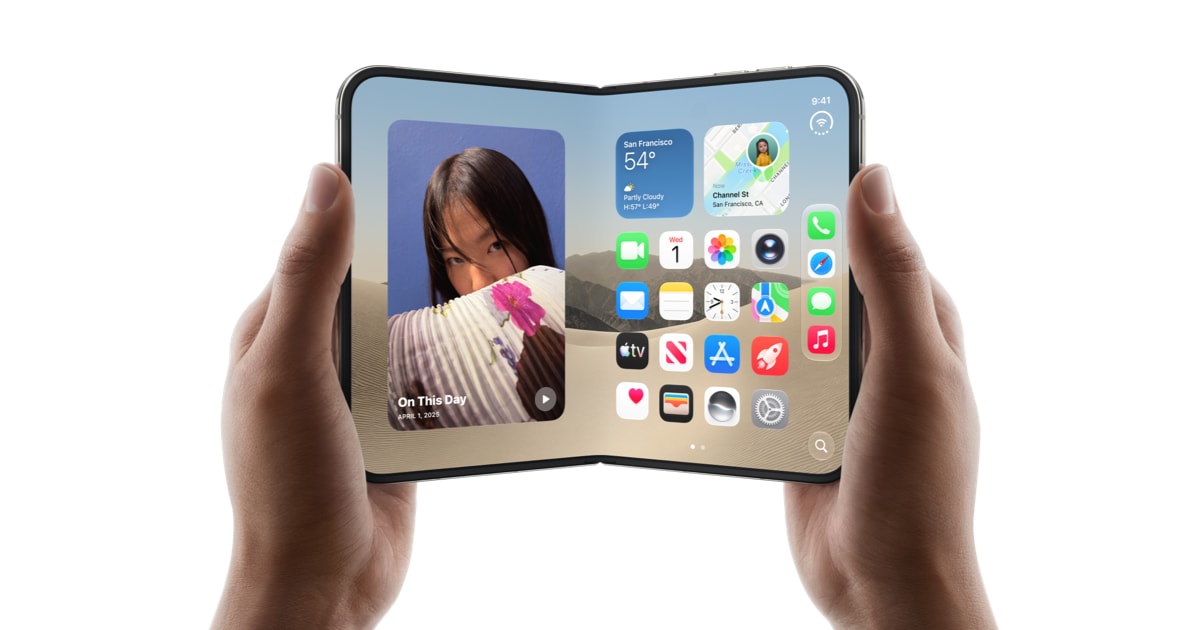
iPhone Duo Crease Is Felt More Than Seen, but Durability Is Unproven

Long-term visibility of the crease in Apple's iPhone Duo will not be established until devices have gone through a long period of repeated folding, because cumulative damage at the fold could make the crease more noticeable over time. In hands-on evaluation, Engadget found the iPhone Duo crease is "easier to feel with your finger than observe with your eyes." Engadget
Early impressions from people who have seen the hardware in person are split. Some say the crease is barely noticeable. Others say it is still visible. The distinction matters. Tactile is not visual.
Apple is addressing the issue optically rather than eliminating the fold mechanically. The iPhone Duo uses a nano-texture display with a matte coating to reduce light reflection and make the screen crease less visible. Apple describes the treatment as a premium nano-texture finish that reduces glare and reflections, and states that the matte nano-texture surface minimizes crease visibility. Apple
Apple unveiled the iPhone Duo in an announcement published on Sept. 9. The device is a horizontally folding iPhone with a 7.6-inch inner display and starts at $1,999. Reuters Apple states it is its thinnest phone when open. The September introduction had been planned alongside the iPhone 18 Pro and Pro Max. Bloomberg
The crease strategy extends to software. The iPhone Duo's software uses hinge awareness to move interactable elements away from the crease when tapping them might be difficult. Engadget That avoids placing small tap targets directly on an area where the surface geometry and finger feel change.
The broader context here is how foldable display engineering balances physics, perception, and interaction design. A foldable OLED stack cannot avoid some deformation at the hinge radius. Diffusion treatments such as nano-texture do not remove that deformation. They scatter specular reflections that would otherwise draw the eye to it under overhead lighting. Shifting controls away from the center line concedes the same point in software.
In my view, that combination is pragmatic for an expert audience to watch. Measuring a crease on day one tells less than profiling how depth, reflectivity, and touch accuracy drift after tens of thousands of cycles, varied temperatures, and pocket debris. Lab photos flatten those variables. Hands and eyes do not.
What this enables if it holds is a foldable where the fold recedes into routine use. Watching my own kids adopt new hardware over the years, the technologies that stuck were rarely the flawless ones. They were the ones where the compromise stopped demanding attention.