Perseid Peak, Total Solar Eclipse, and a Six-Planet Parade Converge August 12–13, 2026
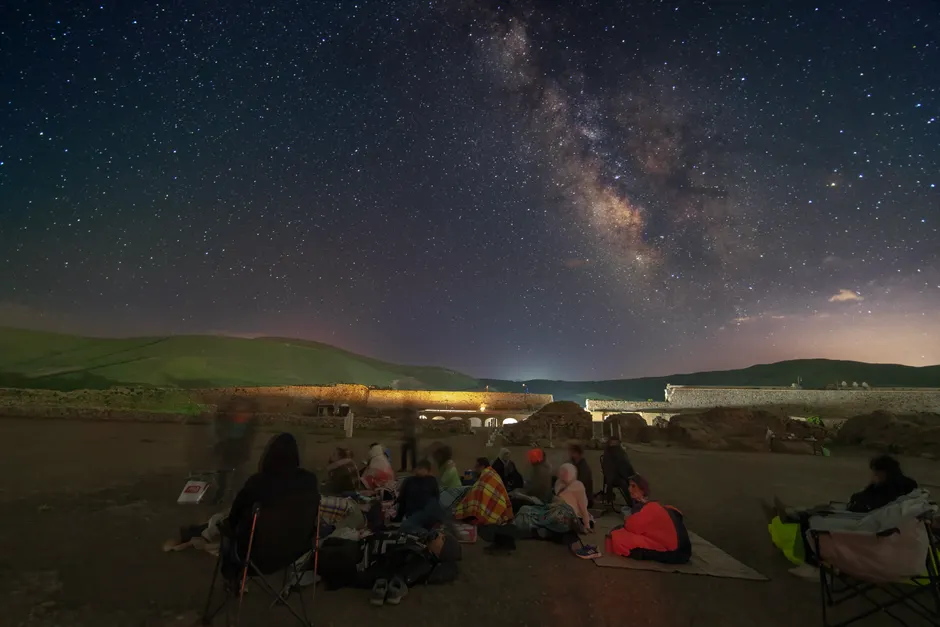
On the night of August 12 into the morning of August 13, 2026, the Perseid meteor shower reaches its peak under unusually favorable conditions, sharing a 48-hour window with a total solar eclipse crossing Greenland, Iceland, Spain, and a sliver of Portugal, as well as a six-planet parade. The convergence is notable for observational astronomy: three independent celestial events, each significant on its own, compressed into a brief interval that spans both daylight and nighttime skies.
The Perseid shower's predicted peak falls at 14:53 UTC on August 13, according to EarthSky. The best visual window for observers runs between midnight and dawn, when the radiant in the constellation Perseus sits high in the northern sky. Under ideal dark-sky conditions, NASA estimates 50 to 100 meteors per hour may be visible, as The Guardian reports. The American Meteor Society offers a more conservative projection of 30 to 50 per hour from rural US locations, while the Planetary Society places the expected rate at 50 to 75 per hour at peak.
A key factor improving 2026 viewing is lunar. The moon will be in its new moon phase during the peak, eliminating moonlight interference that has degraded Perseid displays in recent years. New moon conditions mean the fainter meteors that would otherwise be washed out remain visible, potentially bringing observed rates closer to the upper end of NASA's estimate for observers in genuinely dark locations.
The Perseids originate from debris shed by comet 109P/Swift-Tuttle, a 26-kilometer-class nucleus that orbits the sun on a 133-year period. Swift-Tuttle last reached perihelion in 1992 and is not due to return until 2125. Earth passes through the comet's debris trail annually from July 17 to August 24, with the densest portion of the stream encountered in mid-August. NASA describes the Perseids as the best meteor shower of the year. Observations of the shower date back more than 2,000 years, making it one of the longest-documented astronomical events in human record.
Concurrent with the Perseid peak, a total solar eclipse occurs on August 12, 2026. The path of totality crosses Greenland, Iceland, northern Russia, the Atlantic Ocean, Spain, and a small area of Portugal, as NASA has confirmed. A partial eclipse will be visible across broader regions of the Northern Hemisphere. NASA has announced it will provide coverage of the event and has indicated that some of the best observational vantage points will come from an altitude of 50,000 feet, where atmospheric interference is minimized and the eclipse's shadow geometry can be studied with greater clarity.
The third element of the convergence, a six-planet parade, places multiple planets in a near-aligned configuration visible in the night sky. While planetary parades are not rare in strict orbital terms, the visibility of six simultaneously is uncommon enough to draw observer interest alongside the eclipse and the Perseids.
The broader context here is the rarity of temporal overlap among these phenomena. Meteor showers recur on predictable annual cycles tied to Earth's orbital position. Solar eclipses follow their own saros-driven geometry. Planetary alignments depend on each world's orbital period. That all three fall within the same 48-hour window in 2026 is a function of independent celestial mechanics arriving at a coincidental intersection. The new moon that benefits Perseid viewing is itself a prerequisite condition for the solar eclipse, since eclipses can only occur during a new moon phase when the moon's shadow can reach Earth.
For observers and researchers, the convergence creates a compact but demanding schedule. The total solar eclipse on August 12 dominates daylight hours, particularly for those in or near the path of totality across Greenland, Iceland, and Spain. The Perseid peak follows that night into the pre-dawn hours of August 13, with the predicted 14:53 UTC maximum favoring locations where nighttime coincides with that window. The six-planet parade extends across both intervals, though optimal viewing depends on local horizons and the specific planets involved.
For observers planning fieldwork, the practical constraints are worth noting. The eclipse path of totality and the best Perseid viewing latitudes overlap most favorably in the North Atlantic region, though weather patterns in Greenland and Iceland in August can be volatile. Spain offers a more climactically stable option for eclipse chasers, while the Perseids are broadly visible across the Northern Hemisphere wherever skies are clear and light pollution is low. The 50,000-foot observational platform NASA references likely involves specialized aircraft missions rather than commercially accessible vantage points.
The convergence of a total solar eclipse, the Perseid peak under new moon conditions, and a six-planet parade within a single 48-hour period represents an alignment of independent cycles that is uncommon though not unprecedented in the historical record. What distinguishes the August 2026 event is the quality of the Perseid viewing window: a new moon sky, a shower consistently rated among the year's best, and peak rates that could reach the upper end of the 50-to-100-per-hour range under optimal conditions. For those positioned along the eclipse path, the sequence offers a daylight-to-darkness observational sequence that few calendar years can match.


