A Six-Minute Solar Eclipse Is Coming in 2027 — Here's Where to See It
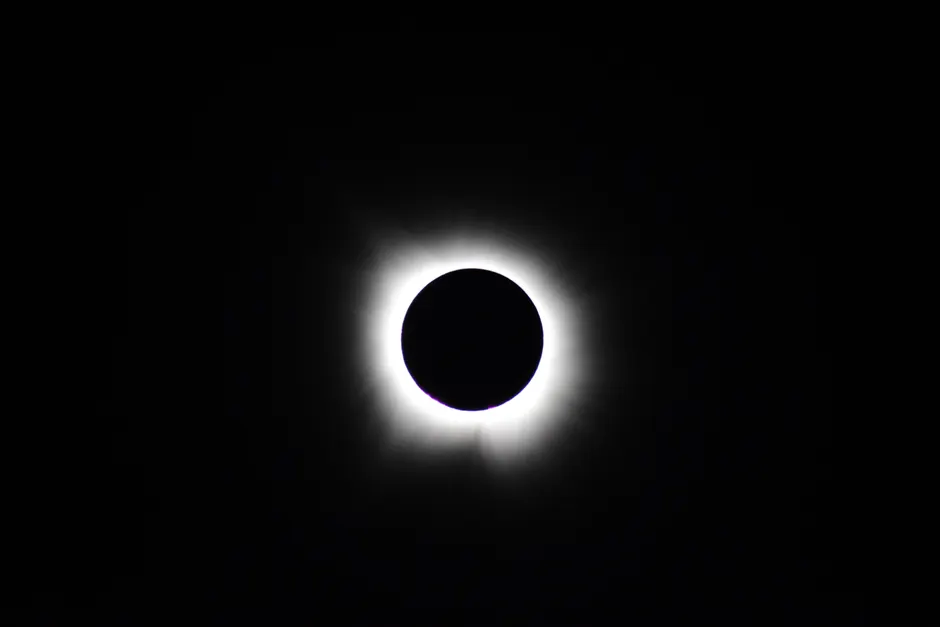
On August 2, 2027, a total solar eclipse will cross parts of Spain, North Africa, and the Middle East. Near Luxor, Egypt, the Moon will fully block the Sun for about six minutes and 23 seconds — one of the longest eclipses this century (USA Today).
A total solar eclipse happens when the Moon passes exactly between the Earth and the Sun, casting a dark shadow on part of our planet. Inside that shadow, daylight turns to twilight, and you can see the Sun's outer atmosphere with your eyes.
NASA's Goddard Space Flight Center has published an interactive Google Map showing exactly where the shadow will fall. On the map, blue lines mark the northern and southern edges of the area where the Sun will be fully blocked. A red line down the middle shows where the eclipse lasts the longest. You can click any spot on the map to see how long the eclipse will last there and when it begins and ends (NASA GSFC).
NASA says the peak moment happens at 10:07 a.m. Universal Time. To figure out exactly where the shadow lands, scientists use something called Delta T — a small time correction that accounts for the fact that Earth's rotation is very gradually slowing down. Without this correction, the predicted path could be off (NASA GSFC).
Interestingly, two slightly different Delta T numbers appear in NASA's files: 71.7 seconds in the path map and 76.0 seconds in the eclipse bulletin. The difference comes from the fact that scientists keep refining their estimate of how much Earth's spin is slowing as they gather more data. This tiny mismatch shifts the predicted path by only a few hundred meters — too small to matter for most people, but useful to know if you're doing very precise mapping (NASA GSFC).
NASA also publishes something called Besselian elements — a set of numbers that describe the size and angle of the Moon's shadow at each moment of the eclipse. With these numbers, anyone with the right software can calculate eclipse times for their own location, no matter how remote (NASA GSFC).
The eclipse starts over Spain, then moves across the Mediterranean into North Africa and the Middle East. The National Solar Observatory confirms that the Luxor area will see the longest totality (NSO).
The broader context here is that most total solar eclipses only give you two or three minutes of full darkness. This one lasts over six minutes because two things line up perfectly: the Moon is close to Earth, so it appears large enough to cover the Sun completely, and the shadow falls on a part of Earth where the Sun is high in the sky.
If you're planning to watch, where you stand matters. People on the red center line get the full six-plus minutes. Move north or south toward the blue edges, and the eclipse gets shorter and shorter until it drops to zero at the boundary.


