Apple Is Changing How It Charges App Makers in Europe — Here's What's Different

Apple will replace its complicated App Store fee system in the European Union with a single, simpler set of rules starting October 1, 2026. The biggest change: Apple is getting rid of a controversial charge that cost app developers money every time their app was installed more than a million times in a year. Instead, Apple will take a percentage of certain sales, with the rate depending on where and how the purchase happens. The Verge
Under the new rules, if a developer sells something inside an app using Apple's own payment system, Apple takes 26 percent. If the developer uses a different payment company inside the app, Apple takes 20 percent. If the app sends you to an outside website to buy something, Apple takes 15 percent. And if an app is sold entirely outside Apple's App Store — through a website or a rival app store — Apple takes 5 percent. Smaller developers and certain types of apps qualify for lower rates.
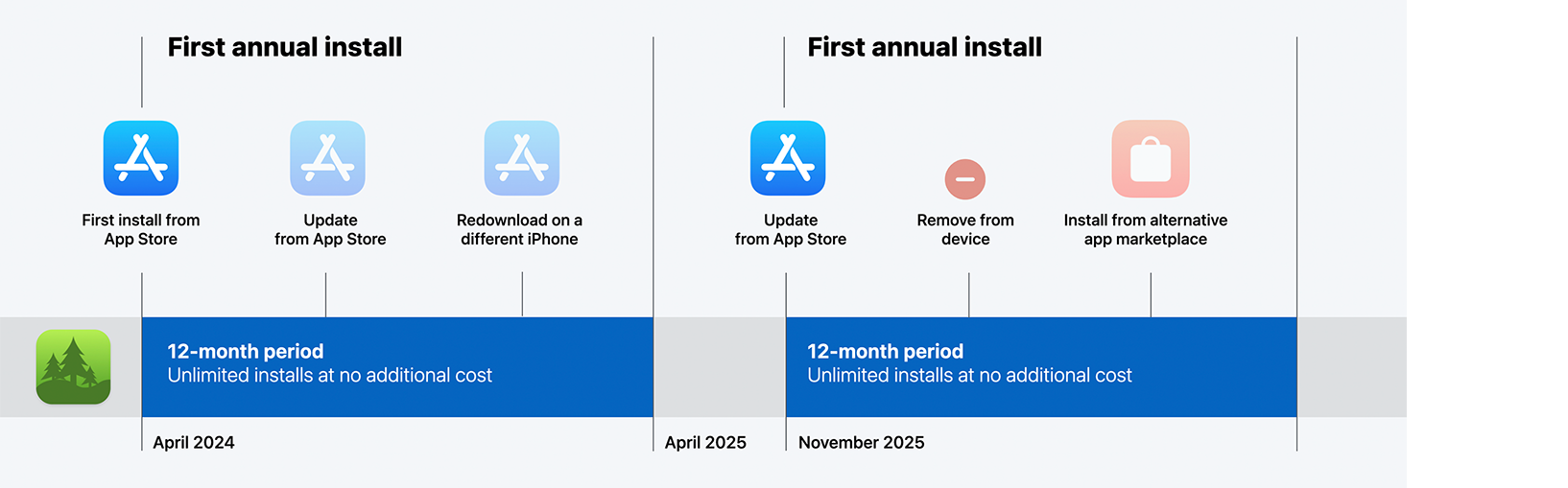
The old fee system had three parts: a commission, a per-install charge (€0.50 for each install over one million per year), and a separate services fee. Apple will no longer charge the per-install fee or the services fee. Apple had said fewer than 1 percent of developers would have paid the per-install charge, but critics — including developers and EU regulators — argued it was unpredictable and could punish popular free apps with lots of downloads. Apple Developer
Developers can now offer Apple's payment system and a competing payment system at the same time inside one app, but once they pick their payment options, they are locked in for 12 months. Selling apps directly through a website is still limited to the EU, and only developers who are publicly traded companies or have passed a financial audit qualify. The Verge
New child safety rules are part of the package. Apps designed for kids cannot include links to outside websites for purchases. Apps cannot link out for purchases when the user is under 13. And users under 18 need a parent or guardian's permission to buy something using a non-Apple payment method inside an app.
This change follows a long regulatory fight. The EU created the Digital Markets Act in 2022 to force large companies like Apple to open up their platforms. Apple first changed its App Store rules in 2024 to comply, but the European Commission fined Apple for still blocking developers from telling users about cheaper payment options elsewhere. Apple also lost a legal bid to keep the App Store and iPhone entirely outside the regulation's reach. In June 2025, Apple said it would switch to a single EU business model by early 2026. The October 1 date delivers on that promise, with revised fees. Apple Newsroom
The old system forced developers to choose between two different sets of rules, and which one was better depended on how many downloads their app got and how they made money. The new system gives everyone the same rulebook. But the new rates are different from what came before — the old standard rate was 30 percent (or 15 percent for small businesses), and the temporary rates Apple introduced in 2024 were lower still.
For developers, the math changes. Someone using Apple's payment system under the old rules paid 15–30 percent. Now it is 26 percent — less than the old standard rate but more than the small business rate. The 5 percent charge on sales entirely outside Apple's store is the lowest Apple has offered on digital goods in the EU, though it still means Apple takes a cut even when it is not hosting or processing the sale. The 12-month lock-in on payment choices is also new: under the old system, developers could switch between rule sets more freely.
Alongside the EU changes, Apple adjusted how much developers earn in six other countries as of August 21. Brazil adds a 3.5 percent financial transaction tax to developer earnings. Canada removes its digital services tax from developer proceeds. Estonia raises its VAT on developer earnings from 22 percent to 24 percent. Romania raises its standard VAT from 19 percent to 21 percent, and its reduced rate for news, books, and audio from 5 percent to 11 percent. The Philippines adds a 12 percent VAT for developers based outside the country. Vietnam has several changes: VAT on developer earnings for organizations outside Vietnam rises from 5 percent to 10 percent; individual developers outside Vietnam now face a 5 percent personal income tax instead of a corporate tax; the 0 percent VAT rate for news and books no longer applies; Vietnamese organizations no longer have Apple pay certain taxes on their behalf but face a 5 percent tax on Apple's commission; individual developers in Vietnam face a 2 percent income tax plus a 5 percent tax on Apple's commission. Apple updated its payment agreements to reflect the Philippines and Vietnam changes. Apple Developer News
App and in-app purchase prices in the Philippines and Vietnam will be updated September 8 for developers who did not choose those countries as their base. Prices stay the same where the Philippines or Vietnam is the base, for auto-renewing subscriptions everywhere, and in countries where developers set prices manually instead of using Apple's automated pricing.
Apple's App Store changes go beyond the EU. The company announced changes in Brazil in June 2026 following an agreement with the Brazilian competition regulator CADE. In Japan, most App Store developers pay a reduced 10 percent commission. But the EU changes are the most significant in structure: they replace a two-track system with one set of rules, remove the fee that drew the most criticism, and set rates that apply the same way whether a developer uses Apple's store and payment system or goes their own way.
The key question going forward is whether the European Commission considers this new system to be fully in line with the Digital Markets Act. The EU settlement removes the per-install fee that caused the most controversy and replaces it with percentage-based charges that work more like the traditional App Store model. Whether regulators see that as enough — or as another interim step — will determine whether October 1 closes this chapter or just turns the page.