Who Controls Congress After 2026? The Map, the Math, and What's at Stake
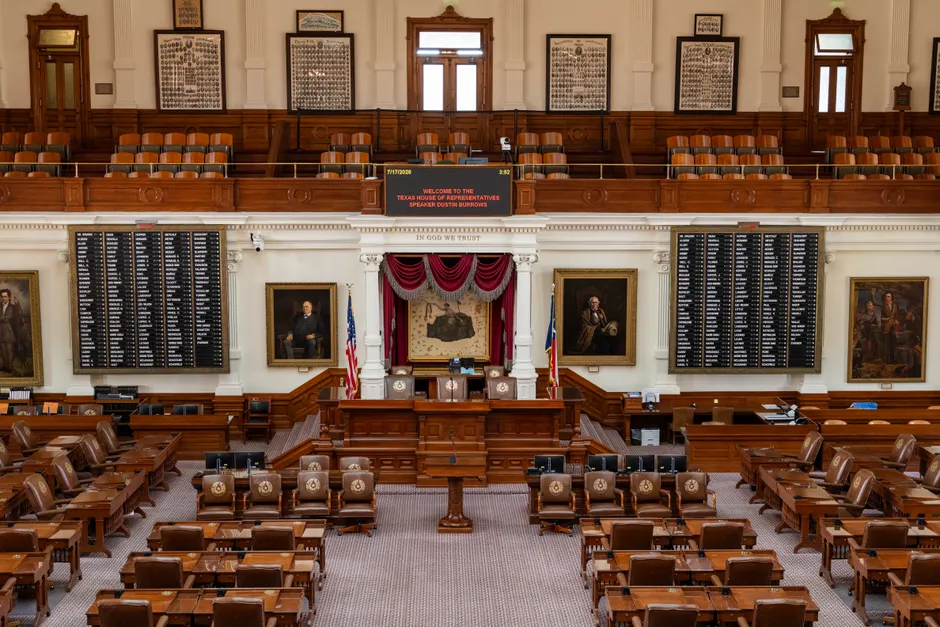
Republicans will defend a slim House majority in November 2026, while Democrats see a real chance to take it back, driven by President Trump's weak approval ratings and a wave of GOP retirements, according to the Wall Street Journal (WSJ, Jan. 12). The midterms, coming about a year into Trump's second term, will decide which party controls both the House and the Senate, plus dozens of governorships and state offices (AP News).
One factor gives Republicans a built-in edge: redistricting. Every ten years, states redraw the lines of their congressional districts, and those new lines can favor one party before any votes are counted. Think of it like a sports league redrawing division boundaries so that some teams start with an easier schedule. The Cook Political Report projects the GOP will pick up about five House seats in 2026 from redistricting alone (WSJ, Aug. 24). Reuters reported in May that the gain could reach twelve seats (Reuters, May 13), but the more recent Cook estimate narrows that number. The Cook Partisan Voting Index, which measures how strongly each district leans toward one party based on recent presidential results, provides the data behind these projections (Cook PVI).
That built-in advantage collides with a well-known pattern. The president's party usually loses seats in midterm elections (Reuters, May 13). Whether Trump's approval ratings and the overall mood of voters can overcome the redistricting cushion will likely decide whether Republicans keep or lose control.
Ballotpedia has identified 46 House districts, about 12% of the chamber, as true battleground races. Democrats currently hold 25 of those seats; Republicans hold 21 (Ballotpedia). That means Democrats have more competitive ground to defend. The Cook Political Report rates all 435 House seats on a 7-point scale, from Solid D (safely Democratic) to Solid R (safely Republican), giving both parties a clear picture of where the races are close (Cook Political Report).
On the Senate side, 35 seats are up in 2026. Nine races look safely Democratic and fourteen safely Republican, leaving twelve that could go either way (WSJ, Aug. 19). The key battlegrounds include North Carolina, Maine, Georgia, and Michigan (WSJ, Jan. 4). The Cook Political Report's Battleground District Project will track both Senate and House races as they develop (Cook Political Report).
Legislative friction has accompanied the electoral jockeying. Despite Republican control of Congress, Trump has been unable to secure enough support to pass a package of election restrictions (Reuters, July 16). That legislative shortfall complicates the party's messaging heading into a cycle where voter turnout and candidate quality in swing districts will matter as much as the partisan tilt of the map.
The redistricting figure is the number to watch. A five-seat gain from the map alone is substantial in a chamber where recent majorities have come down to single digits. If voter sentiment shifts toward Democrats by even two or three points, the redistricting buffer could disappear. If it holds steady or favors Republicans, the map alone may be enough to keep control. The Cook projection of roughly five seats, being the most recent and most detailed estimate available, should be treated as the authoritative figure; the earlier Reuters range of up to twelve reflects a broader scenario analysis rather than a single number.
The Senate map is less fluid. With fourteen safely Republican seats against nine safely Democratic ones among the 35 up for election, the GOP's advantage in the Senate is clearer than in the House. Democrats face a steep climb to take back the Senate, with their path running through states like North Carolina and Maine, where the strength of incumbents and voter turnout will be decisive.
For investors and savers, the stakes are straightforward. A divided Congress would limit new spending and make major legislation harder to pass in either direction. A Republican-controlled Congress with a president unable to pass his own priorities signals gridlock of a different kind. Either outcome carries real consequences for tax policy, government spending, and regulation through 2028.