UK Pay Is Growing More Slowly, and Hiring Is Fading
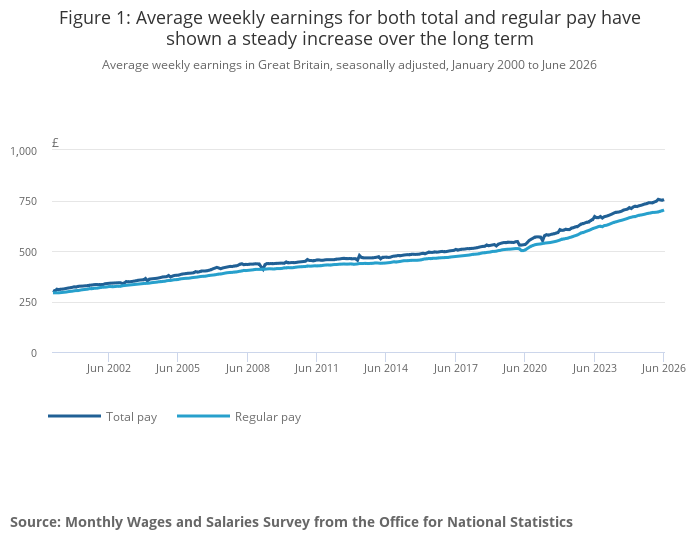
UK pay with bonuses grew 3.9% in the year to July 2026, down from 4.1% in the year to June 2026. The numbers come from the Office for National Statistics, reported on 15 September 2026. The Guardian
Pay without bonuses stayed at 3.5%. Think of wage growth like car speed. Still moving forward, but more slowly. The 3.9% result matched what experts in London expected. Pay data cover Great Britain. The main jobs figures cover the UK.
Unemployment stayed at 4.9%. Fewer people were on company payrolls. Shops and restaurants lost jobs. ONS jobs expert Liz McKeown said open jobs are at their lowest in over ten years, not counting the pandemic.
There were 30.2 million people on payrolls. That number has mostly fallen over two years. It fell again in the three months to July 2026. ONS An early guess for August 2026 shows a fall of 26,000, or 0.1%. ONS said tax records from employers are now the best count of workers.
A household survey looks less weak. It counted 29.8 million workers in May to July 2026, up 111,000 from last year. ONS will explain on 28 September 2026 how the tax records and the survey fit together. The next wider jobs check is due in December 2026.
Pay growth has slowed step by step. In March 2026, pay grew 3.8% without bonuses and 3.9% with bonuses. In May 2026, it was 3.4% without bonuses and 4.1% with bonuses. In private firms, pay without bonuses grew 2.8% in April to June 2026. Reuters Open jobs fell to 707,000 in the three months to July 2026, the lowest since 2021. Before that, regular pay grew 4.7% in the year to August 2025, then the lowest since 2022, when unemployment rose to 4.8% in data reported in October 2025. It was 5.2% in data reported in June 2025, down from 5.5%. In the three months to January 2024, it was 6.1%, down from 6.2%.
Many investors think the Bank of England will leave its main interest rate at 3.75% on Thursday. Bank of England The Bank will share details on 17 September 2026. Oil is now over $107 a barrel. Under the triple lock, the state pension rises each year by the highest of 2.5%, prices, or wages.
The broader context here is a jobs market with two messages. Wage pressure is lower, which keeps future rate cuts possible. But it has not fallen sharply. Hiring is weaker. With 4.9% unemployment, falling payrolls and very low openings, the issue looks like weak demand for workers, not a lack of workers. The 3.9% wage number also matters for pensions, because the triple lock follows wages.
Looking at what happens next, three small questions matter. Will August confirm the 26,000 fall. Will private pay stay near 2.8%. Will higher energy costs push up price fears. The answers will shape talk after 17 September. The ONS work on 28 September will help leaders decide which jobs number to trust most.


