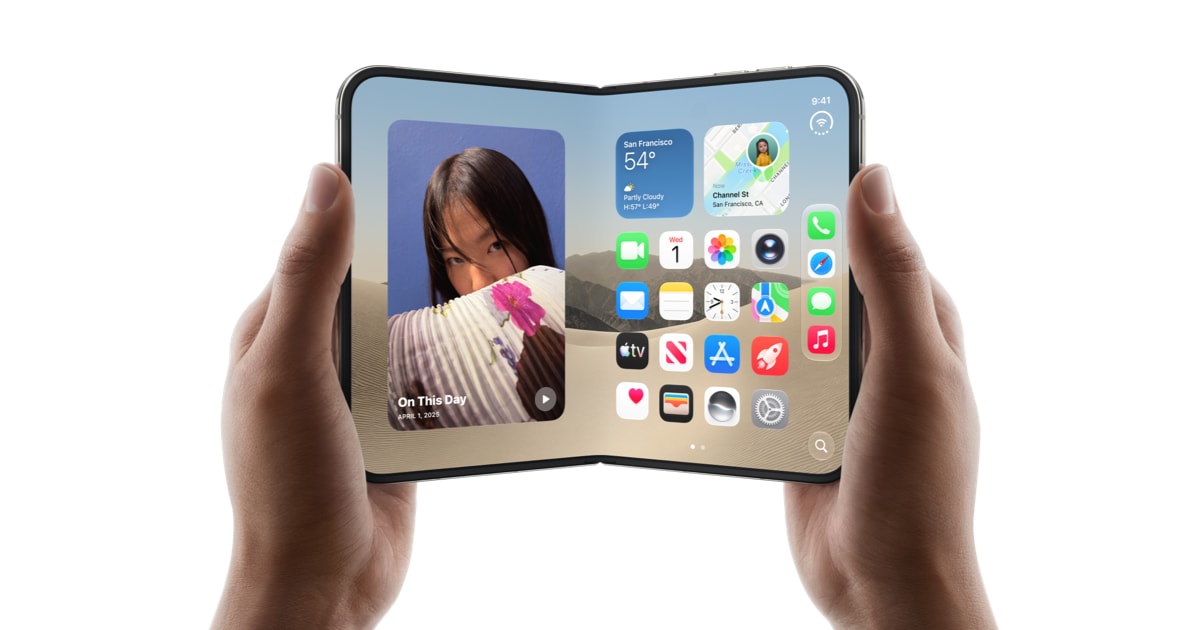
Apple's Folding iPhone Is Coming Oct. 23 for $1,999

Apple's first folding iPhone, the iPhone Duo, goes on sale on October 23, with pre-orders opened on October 16 and U.S. pricing starting at $1,999.
That puts it in shops within six weeks of its September unveiling. The pre-order date comes from Apple's October feature, "Open up to new possibilities with iPhone Duo," while the sale date and price were reported by Reuters. Samsung tried the same $2,000 price in 2019.
Apple says Duo folds open and shut and has two displays, in its Newsroom release "Apple unveils iPhone Duo" Apple. Opened, it gives Apple's biggest iPhone screen yet and is the thinnest iPhone yet. It opens like a small book. Apple also says the folding two-screen design allows camera features not possible on any other iPhone Apple.
Inside, Duo has the A20 Pro chip that runs the phone and a new C2 chip that links it to mobile networks. Apple sold it next to the iPhone 18 Pro and iPhone 18 Pro Max, which came with an advanced pro camera system and improved battery life and performance.
The story starts in 2019. It is told in Engadget's feature, 'From the Royole FlexPai to the iPhone Duo: How the modern foldable phone has evolved' Engadget. Royole showed the FlexPai at CES 2019 as the world's first folding phone you could buy. Samsung followed in February 2019 with its first Galaxy Fold for just under $2,000.
That first Galaxy Fold did not reach buyers as planned. Reviewers peeled off a plastic layer that was meant to stay on, and the screens broke. Samsung delayed the launch and asked for review units back to fix the phone.
It took several new models to get folding phones right. Engadget names the Google Pixel 11 Pro Fold and Samsung Galaxy Z Fold 8 as phones that moved folding technology forward. It says Apple has now entered the folding-phone market with iPhone Duo, and predicts that more people buying folding phones is almost a certainty after iPhone Duo.
The broader context here is that folding phones have gone from easy to break to steady and usable. Early faults were about films, seals and small parts fitting together. Later work fixed the screen layers, the hinge and software that keeps your app open when you fold and unfold. Apple's arrival does not change that work. It gives app makers many more people who carry a large screen in a pocket.
In my view, the questions now are about packing so much into a thin phone. A new Apple network chip with a powerful main chip and two screens in the thinnest iPhone makes battery, heat and signal harder to balance. Those are problems engineers can solve, and the thin design suggests Apple trusts its choices. For work users, the test is whether the big screen can handle long jobs without draining the battery, and whether two-screen cameras are useful each day and not only in demos.
Worth flagging for teams that make iPhone apps: with a folding iPhone, apps must fit two sizes and remember your place when you fold. If sales grow as Engadget expects, testing folded and open will become normal. The same happened when apps had to suit both phones and tablets.