YouTube Drew the Biggest Share of US TV Viewing in August
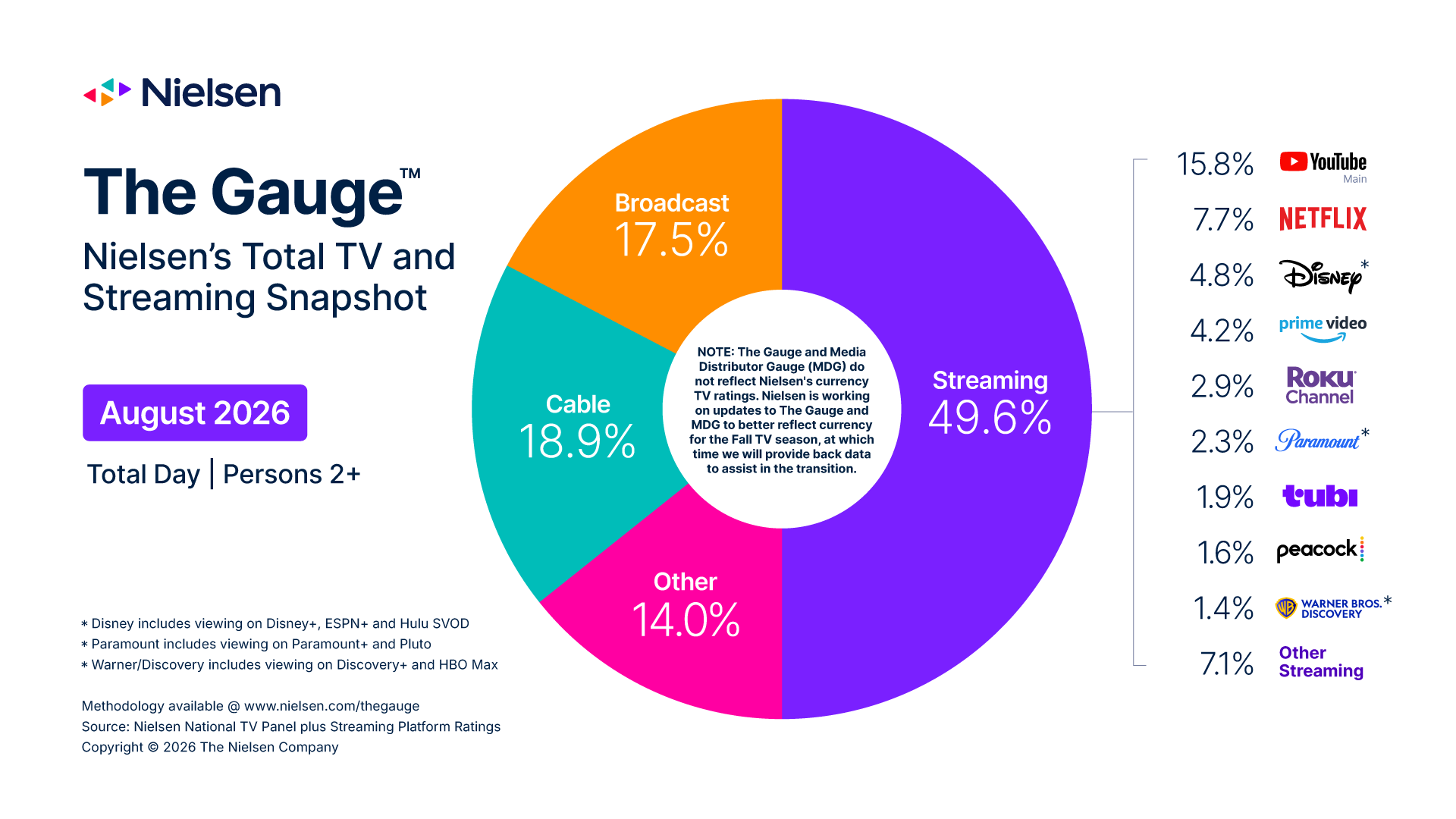
YouTube held 15.8 percent of US TV viewing in August 2026, a record for the platform, according to Nielsen's August Gauge report, published October 22. Its monthly viewing rose 6 percent, and it stayed in first place in the Gauge.
Over the same month, streaming overall fell 3.2 percent. Total TV use fell 4.4 percent.
Nielsen's Gauge measures how much time people spend watching television sets. Think of it as a survey of the living room. It does not measure who pays for what.
A strong July first
July was also a strong month for YouTube. Engadget's July breakdown reports that YouTube took 14.2 percent of US TV viewing that month, the largest share of any platform. Streaming as a whole accounted for 49 percent of all TV time.
Netflix had 7.8 percent. Disney+, Hulu and ESPN+ together had 4.7 percent. Prime Video had 4.2 percent.
Further down the list, The Roku Channel reached 2.9 percent, just ahead of Peacock at 2.6 percent. Paramount's services, including Paramount+ and Pluto TV, reached 2.2 percent. Tubi posted 2.0 percent, ahead of HBO Max and discovery+ at 1.4 percent.
Peacock's viewing time rose 15 percent in July compared with June. Love Island USA logged 4.9 billion viewing minutes in the month.
Grouping by company
The Hollywood Reporter's chart groups viewing by distributor, the company that owns the service, instead of by app. On that basis, YouTube is at 15.8 percent. Paramount and Warner Bros. Discovery combined reach 12.1 percent, Disney 9.3 percent and Netflix 7.7 percent.
This grouping explains two things. Paramount and Warner Bros. Discovery appear together because they are corporate siblings. Disney's total is larger than any single streaming app's share because it adds up several services.
Earlier in the year, YouTube led Nielsen's Media Distributor Gauge in May with 13.8 percent of TV viewing. Nielsen's mid-year streaming rankings, posted in late August, named Stranger Things the top title after the series ended its run.
What the numbers leave out
Nielsen counts time spent watching on TV sets. It does not count subscriber totals, app downloads or viewing on phones. Its streaming figures come from a subset of households with Nielsen's Streaming Meter, a measuring device.
Live channels watched through YouTube TV are counted as broadcast or cable viewing, not as YouTube's streaming share. YouTube TV is a paid service that delivers live channels over the internet. So YouTube's 15.8 percent covers only its on-demand and creator videos on the TV screen.
One caveat matters when reading these numbers. YouTube carries live channels and also hosts a huge library of videos uploaded by its users. That makes it hard to compare directly with Netflix, which offers a catalogue of shows and films. The Gauge shows where attention goes on the television. It does not show how much of that attention was paid for, or how the platform earned money from it.
The bigger picture
The broader context here is a shift in where the living-room screen gets its content. Streaming took nearly half of all TV time in July, and total TV use declined in August. Whether that decline reflects a change in habits or a normal seasonal dip cannot be settled by monthly figures alone.
The next several Gauge releases will show whether YouTube's August gain holds. They will also show whether streaming's share holds as viewing settles into the autumn schedule.