Three Rockets in Two Weeks: How NASA Plans to Test Moon Landers in Orbit
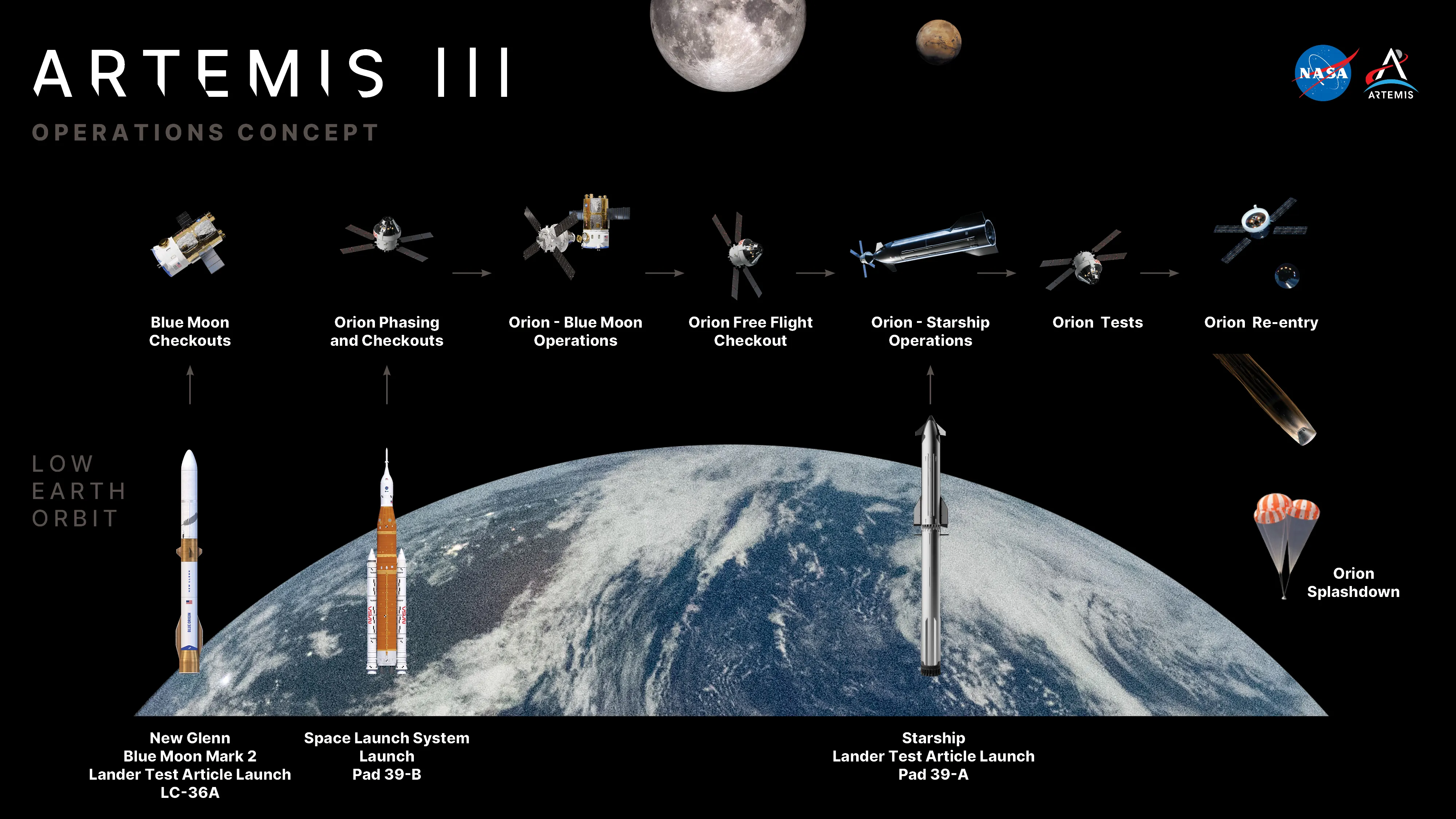
NASA plans to launch three spacecraft from Florida on three different rockets within about two weeks for its Artemis 3 mission. No exact launch date has been set. The best-case target is summer 2027.
This mission will carry astronauts, but it will not land on the Moon. Instead, the crew will test how spacecraft work together in orbit around Earth. That work is a step toward a future landing.
The first launch belongs to Blue Origin's New Glenn rocket. It would carry a test version of the Blue Moon Mark 2 lander into low Earth orbit, a path about 273 miles above the ground.
Next, NASA's Space Launch System, or SLS, would launch the Orion crew capsule. Four astronauts would ride inside: NASA astronauts Randy Bresnik, Frank Rubio and Andre Douglas, and Luca Parmitano from the European Space Agency (ESA). Orion would settle into an orbit about 345 miles up and meet the Blue Moon test lander there. NASA's Artemis III mission description says the mission will send four astronauts to low Earth orbit to test systems needed for future lunar landings.
The last piece is SpaceX's Starship Version 3. It has a docking system mounted on its front end, and it would connect with Orion. The meeting between Starship and Orion is planned to last two hours. The crew would stay inside Orion and would not enter Starship. NASA says the two separate connections will show how Orion links up with two very different commercial lander designs during one mission.
The plan changed because NASA revised its Artemis program. Artemis 3 will test lander operations rather than attempt a crewed Moon landing. The next crewed Moon landing has been pushed to 2028. Artemis II, the first crewed test flight of the SLS rocket and Orion, came before this mission. NASA's Artemis III page states that SLS will launch the four crew members from Kennedy Space Center in Florida. On January 16, 2026, the SLS and Orion were inside the Vehicle Assembly Building at Kennedy.
In my view, the hardest part of this plan is timing, not any single launch. Think of a relay race in which three runners must each pass the baton at the right spot. If one runner is late, the whole team waits. Here, three separate launch efforts, two commercial landers with different shapes, and a crew that stays in one capsule all depend on schedules kept by different companies. If one launch slips, the others feel it. Joining spacecraft built by different groups in orbit is hard enough on its own. Doing it in one mission, with the crew as passengers, adds a layer of coordination the program has not handled in this form before.
The broader context here is that this test puts most of the risk in the handoffs between vehicles, not in a descent to the surface. If the sequence goes as planned, engineers will gain hands-on experience with two commercial landers connected to the same crew capsule before anyone attempts a landing. With the crewed landing now set for 2028, that experience is a practical step forward. The hardware and interface data it produces should matter to everyone building the next phase.


