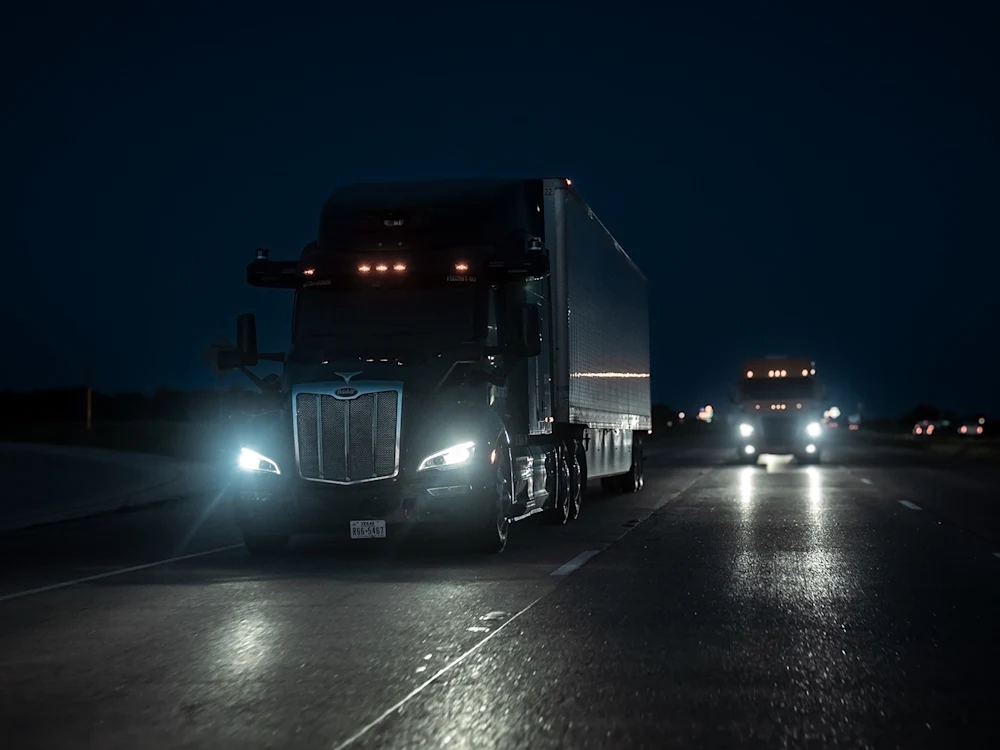
Driverless Trucks Are Heading for Public Highways Under a New Deal
Kodiak AI will supply 75 driverless trucks to DTL Transport starting in 2028. The Mountain View company announced the deal on October 28, 2026. TechCrunch reports that it is Kodiak's first binding commercial contract for driverless big rigs that will run on public highways.
A driverless truck has no person at the wheel. Big rigs are the large tractor-trailers used for long-distance freight.
DTL is also Kodiak's first on-highway Driver-as-a-Service customer.
Under this model, the customer owns and operates the trucks. Kodiak licenses its self-driving technology and charges by the mile. The company says it wants to be an asset-light technology supplier. In other words, it wants to sell its technology rather than own and run trucks itself. The DTL contract is the first on-highway deployment under that structure.
DTL plans to use the trucks first on the route from Dallas to El Paso, Texas, and on Interstate 20 between Dallas and Atlanta.
Earlier this autumn, the two companies completed the first autonomous trucking deliveries under Kodiak's new California DMV permit. In a pilot, they hauled perishable goods, meaning food that spoils quickly, about 225 miles. The route ran along Interstate 5 and California State Route 99, between Fresno and Los Angeles. A human safety operator sat behind the wheel.
Kodiak's own near-term timeline is even sooner. The company plans to start a driverless highway service in December by taking human safety operators out of the cab. It intends to launch that service by carrying goods for Ikea on Interstate 45 between Dallas and Houston.
The dates line up like this. On September 25, 2026, Kodiak named Dallas-Houston as its long-haul driverless launch lane. On September 29, it said it would launch driverless service with IKEA in 2026, following four years of partnership with the retailer. On October 6, the company said it was on track for a year-end driverless long-haul launch, with its own autonomy readiness measure at 96%.
Kodiak's news page also lists an October 8 launch of autonomous trucking between Dallas and Laredo with Charger USA. It lists an October 20 announcement of 64 consecutive days of uptime, meaning days of continuous running, on an unsupervised driverless truck.
Kodiak's existing business is in off-road work. Atlas Energy Solutions is technically the company's first customer under a binding commercial contract. Atlas runs driverless trucks in the Permian Basin, an oil-producing region of West Texas. It currently owns and operates 35 driverless trucks equipped with the Kodiak self-driving system. Kodiak is on track to have as many as 100 driverless trucks in service with Atlas by mid-2027.
The hardware work follows a separate track. In January 2026, Kodiak partnered with Bosch to ramp up manufacturing of autonomous trucking hardware and sensors. Sensors are the cameras and radar that help a vehicle see the road. Kodiak describes its Kodiak Driver as one integrated platform that combines AI, modular hardware and offboard services, which are support functions run outside the truck. On October 1, 2026, Kodiak said it had chosen AWS, Amazon's cloud division, to develop its AI-powered trucking technology ahead of the driverless highway launch.
Kodiak went public in September 2025 and trades on Nasdaq under the ticker KDK. Its shares have fallen 87% from their opening-day price. Don Burnette is the company's founder and CEO.
In my view, the Driver-as-a-Service structure places the cost and risk of each truck with the customer, while Kodiak's revenue grows with miles driven. That is a different risk profile from a fleet the carrier owns outright, and it puts the burden of fleet ownership on companies like DTL. Whether the model works across the 75-truck order will depend on how fast the software moves from supervised pilots to unsupervised operation at scale.
The broader context here is timing. The DTL deliveries begin in 2028, roughly two years after the planned December driverless start. Most of the operational work sits in the gap between a supervised pilot and a contracted fleet. That work includes insurance, maintenance, remote oversight, and regulatory approvals, which vary from state to state.
In my view, the overall picture is still a constructive one. If the December launch and the year-end long-haul target hold, Texas interstates could carry long-haul freight with no one in the cab on a regular schedule for the first time. Kodiak's 64-day uptime figure, if it holds in production, is the kind of data that freight and logistics buyers will want to see before committing capital. The next checkpoints are the December service start and the mid-2027 Atlas milestone.