Democrats Demand Congressional Briefing After Trump Was Secretly Moved Off Air Force One Mid-Flight Operation

Democrats on Capitol Hill are demanding a congressional briefing after revelations that Donald Trump was secretly transferred off Air Force One during an international flight, leaving more than a hundred aides, officials, and reporters aboard the presidential jet without being informed of a credible Iranian assassination threat. The episode, first reported by the Washington Post and the New York Times on August 10, 2026, and subsequently detailed by the Guardian, involved Trump departing Air Force One in a catering truck via a side door of the aircraft before being moved to a C-32A military jet at Ankara, Turkey. Washington Post
The White House had publicly stated that the president would fly to Britain onboard Air Force One. Trump boarded the presidential jet in full view of television cameras before being spirited away minutes later and transferred to the C-32A. Journalists traveling with the president and some White House staff believed Trump remained onboard Air Force One for the duration of the flight. Reporters were instructed to keep their window shades closed. Guardian
US intelligence allegedly found a credible threat that Iran plotted to kill Trump in the month before the flight. According to the Wall Street Journal, the decoy operation was aimed at protecting Trump due to security threats from nearby Iran, including potential missile risks targeting the aircraft. The C-32A carrying Trump flew to RAF Mildenhall in Britain, arriving at approximately 10:20pm. The older Air Force One and the traveling press pool arrived at RAF Mildenhall minutes after the C-32A. WSJ
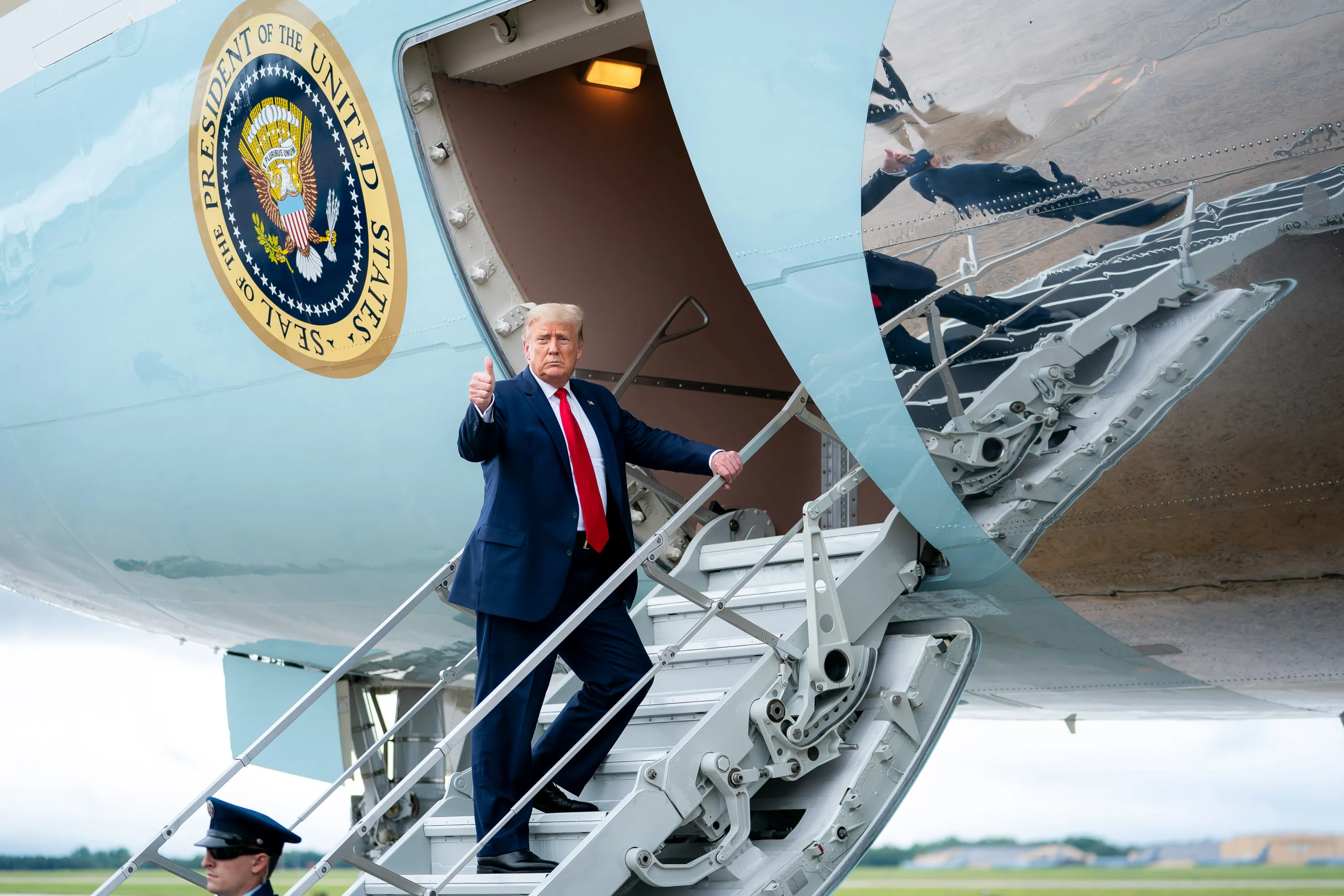
After arriving at Mildenhall, Trump greeted troops at the base before boarding the newly refurbished Boeing 747 donated by Qatar and flying on to Washington. Photographers captured Trump descending from the presidential aircraft after he had been secretly reunited with it on the ground. The staged arrival created the public impression that Trump had traveled conventionally aboard Air Force One throughout. Guardian
Senator Richard Blumenthal of Connecticut called the operation "unprecedented and surreal" and "downright scary" in an appearance on CNN, insisting that a congressional briefing is necessary. Steven Cash, executive director of the Steady State and a former CIA intelligence officer who served as a senior adviser to the Department of Homeland Security's intelligence branch, also criticized the operation. Ned Price, a former deputy to the US ambassador to the UN and ex-special assistant to President Barack Obama on the national security council, accused the administration of perpetrating an "outright lie" and turning reporters into "unwitting conspirators." Guardian
The operation raises several interlocking accountability questions that Congress will likely press. More than a hundred people aboard Air Force One were kept uninformed of a threat to their own lives. The press pool, which functions as the public's surrogate eyes on the president, was actively misled about Trump's location for the duration of a transcontinental flight. And the visual record of Trump descending from Air Force One at Mildenhall was, by the account of the reporting, a manufactured scene rather than documentation of how he actually arrived.
This is not the first time the security of Trump's presidential air transport has drawn scrutiny. In July, Representative Jim Himes of Connecticut called the newly donated Qatar-funded Boeing 747 "a security risk" amid controversy over its level of protective modification. The Hill The decision to use that aircraft for the onward flight from Mildenhall to Washington places it directly in the operational chain of an already controversial security episode.
The Iranian threat backdrop also intersects with a broader policy dispute. In March, sources told Reuters that the Pentagon had informed Congress there was no intelligence indicating Iran was going to attack the US first, a finding that prompted Democratic criticism that Trump was waging a "war of choice." The alleged assassination plot, if confirmed by the briefing Democrats are seeking, would represent a different category of threat than the strategic military assessment the Pentagon conveyed to Congress months earlier, but it also feeds directly into the ongoing political fight over the administration's confrontation with Tehran. Reuters
The decoy operation itself was technically a protective measure, and similar ruses have been used by heads of state facing credible threats. What makes this episode unusual is the scale of the deception, the number of unwitting participants, and the deliberate fabrication of the arrival optics. Whether the Secret Service and military planners had no alternative or whether less disruptive options existed is precisely the question a congressional briefing would be designed to answer. Until that briefing occurs, Democrats are likely to press on two fronts: the operational necessity of the ruse and the decision to keep the press pool uninformed about a threat directed at a target traveling in their immediate proximity.