Wildfires Across England, France, Greece, Croatia, and Germany Coincide with England's Hottest Day of 2026
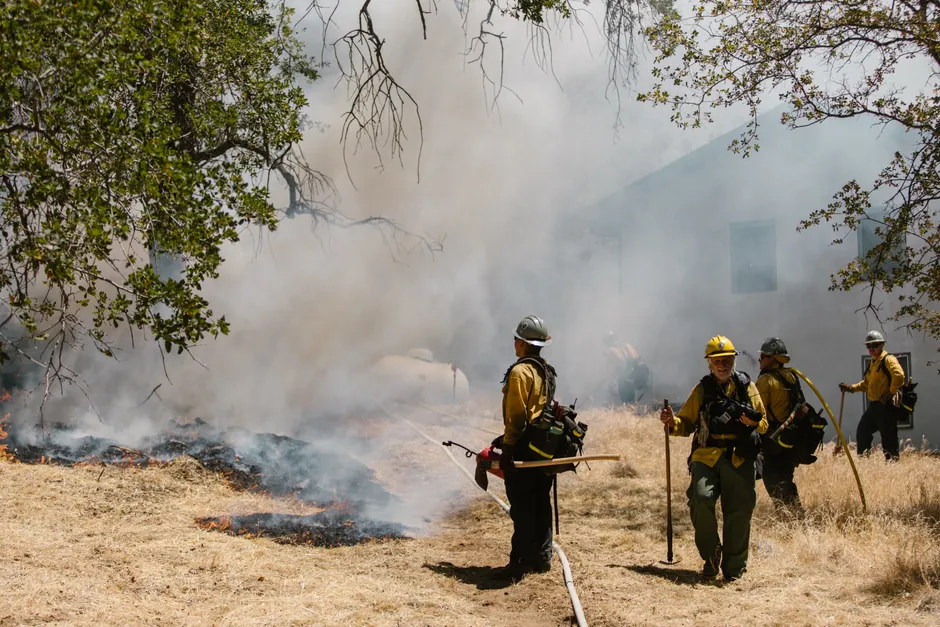
A child and three firefighters were taken to hospital on Friday 14 August 2026 as wildfires tore through Stourbridge in the West Midlands, part of a wave of blazes sweeping across England and continental Europe during an extreme heat event. The Guardian
England recorded its hottest day of the year on Thursday 13 August 2026. Temperatures were expected to ease only marginally on Friday, with lows to mid-30s Celsius forecast across the country. France hit 41C on Thursday and braced for another day of intense heat on Friday. The Guardian
The West Midlands Fire Service reported that 10 people were injured in total across the region's wildfires: a child, three firefighters, and six members of the public. Three firefighters and two members of the public were treated for smoke inhalation, according to The Telegraph. The fire chief said "the devastation is extensive" as multiple fires burned simultaneously, generating thousands of 999 calls. One fire in Stourbridge was described as comparable to a "horror movie." BBC
By Friday, West Midlands Fire Service said crews were making progress tackling the blazes, though the scale of destruction remained substantial. The Irish News
UK Prime Minister Andy Burnham responded to the fires, saying it was "awful" to see the effects and praising firefighters working in "incredibly difficult conditions." His thoughts, he said, were with everyone affected. The Telegraph
The crisis extended well beyond British shores. In southwestern France, more than 500 people were evacuated from the Landes region due to wildfires, following Thursday's 41C peak. In Greece, hundreds of tourists were evacuated from Halkidiki as firefighters battled a large blaze amid gale-force winds. In Croatia, at least 19 people were injured in a wildfire near the tourist town of Omiš, with two requiring hospitalisation in Split. The Guardian
Germany, too, was hit. Around 1,800 people were evacuated overnight from a wildfire near Hürtgenwald in western Germany on the night of 13–14 August 2026. The fire expanded from 25 hectares to 300 hectares by Friday morning, prompting the evacuation of the Gey district. The Guardian
The simultaneous ignition of large wildfires across five countries, from the English Midlands to the Greek peninsula, follows a pattern that European fire agencies have tracked intensifying over recent summers. The geographic breadth of this event is notable: it encompasses regions not traditionally associated with severe wildfire risk, including western Germany and the West Midlands. The Hürtgenwald fire's twelvefold expansion in a matter of hours points to the kind of rapid spread dynamics that overwhelm initial attack capabilities, particularly in landscapes where fuel loads have accumulated under prolonged dry conditions.
What sets this event apart operationally is the simultaneous strain on multiple national firefighting infrastructures. When France, Greece, Croatia, Germany, and the United Kingdom are all conducting large-scale evacuations within the same 24-hour window, mutual aid arrangements between nations become harder to activate, as every partner is drawing down its own resources. The West Midlands Fire Service fielded thousands of emergency calls concurrently, a volume that tests not only personnel and equipment but dispatch triage protocols under live conditions.
The political dimension is also worth noting. Prime Minister Burnham's early public statement, released shortly after the fires broke out, signals an awareness that extreme weather events now carry immediate political weight, particularly when they produce mass evacuations and casualties on the British mainland. The juxtaposition of an English heat record with active fires in Stourbridge brings the continental wildfire paradigm into a domestic context that British policymakers have historically treated as a southern European problem.
Whether Friday's slight temperature decline will be sufficient to give firefighting crews the operational window they need remains the immediate question. The broader pattern, though, is one of concurrent, multi-jurisdictional fire activity across Europe during a peak heat episode, with civil protection systems across the continent engaged simultaneously.


