Shokz Launches OpenFit Air 2 and OpenRun Air 2 at $130 Each, Targeting Lighter Open-Ear Comfort
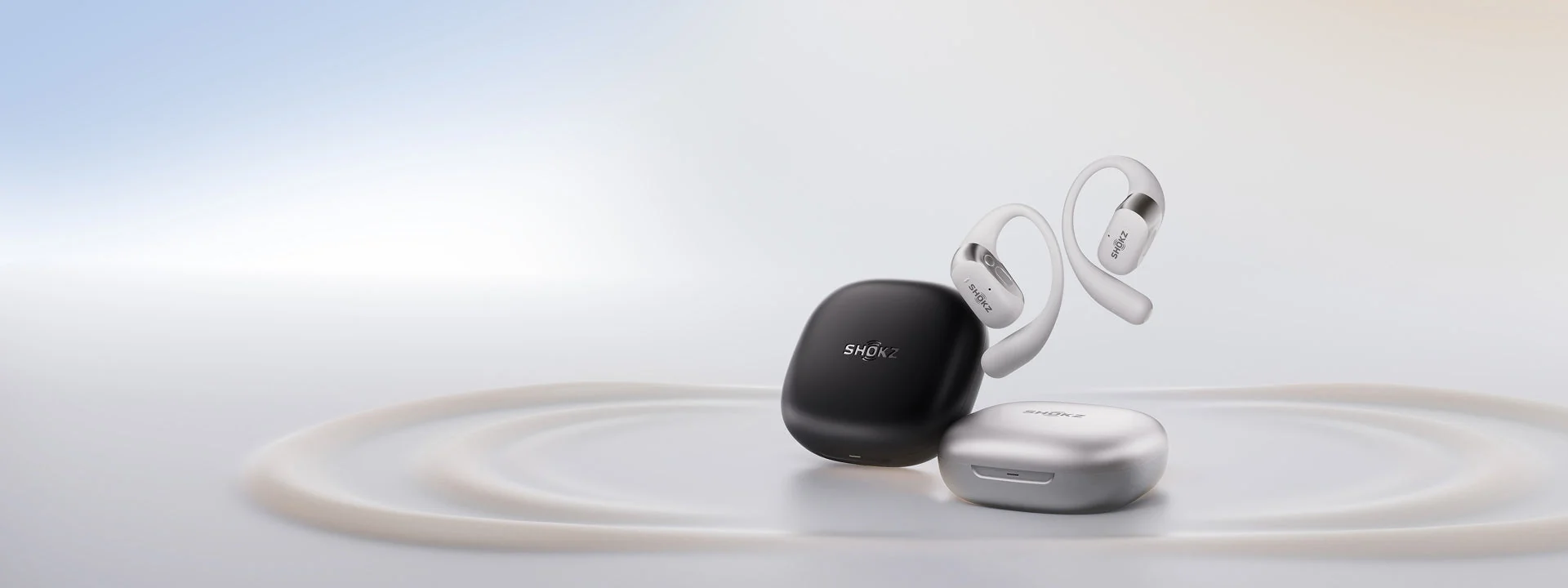
Shokz has introduced the OpenFit Air 2 open-ear earbuds, priced at $130 and available for purchase on August 27. The earbuds weigh 8.7 grams per bud, roughly 17 percent lighter than the previous generation, and retain the company's signature open-ear design that avoids creating a seal in the ear canal, eliminating ear canal pressure and keeping users aware of their surroundings (Engadget).
The OpenFit Air 2 connects via an ear-hook design and uses Shokz's proprietary Bassphere audio driver paired with the OpenBass 2.0 algorithm. An angled speaker directs audio toward the ear canal. Shokz promises "richer bass" and "fuller sound" from this combination, though the open-ear form factor inherently limits low-frequency reproduction compared to sealed in-ear designs. The companion app offers four preset EQ modes and two custom EQ profiles, giving users some latitude to compensate for the physics of open-ear acoustics (Engadget).
Battery life is solid for the category. The OpenFit Air 2 delivers eight hours per charge and up to 36 hours total with the included charging case. A 10-minute quick charge yields three hours of playback. Connectivity runs through Bluetooth 6.1 with multipoint support, allowing simultaneous pairing to two devices (Engadget).
Alongside the OpenFit Air 2, Shokz announced the OpenRun Air 2, a bone conduction model with a wraparound headband design. Shokz says it is lighter than its predecessor and engineered to minimize bounce during activity. The OpenRun Air 2 also connects to the Shokz app for EQ adjustments. Battery life is rated at ten hours per charge, with a five-minute quick charge providing two hours of playback. Like the OpenFit Air 2, it goes on sale August 27 for $130 (Engadget).
Shokz's product lineup has been steadily expanding. The company introduced the OpenFit Pro at CES 2026 on January 6, priced at $249.95 in the U.S. and $329.95 in other regions, positioning it as Shokz's most advanced open-ear earbuds to date with the company's first open-ear noise reduction technology (Shokz). The OpenFit 2 and OpenFit 2+ sit between the Air and Pro tiers, with the 2+ adding Dolby Audio and wireless charging over its predecessor. Both the OpenFit 2 and 2+ offer up to 11 hours per charge and 48 hours total with their charging cases (Shokz).
The Air 2's eight-hour per-charge rating and 36-hour total case life slot it below the OpenFit 2 and 2+ on endurance, consistent with its lower price point. The OpenRun Air 2's ten-hour per-charge rating actually exceeds the Air 2's, which tracks with the different power demands of bone conduction drivers versus air-conduction speaker drivers, and with the wraparound design's larger battery housing.
Looking at the lineup as a whole, Shokz now covers a clear spectrum: the $130 Air 2 and OpenRun Air 2 at the entry tier, the OpenFit 2 and 2+ in the mid-range, and the $249.95 OpenFit Pro at the top. The differentiation is deliberate and largely spec-driven. The Air 2's value proposition is weight reduction and all-day comfort at half the Pro's price, accepting shorter battery life and the absence of open-ear noise reduction. For buyers who prioritize situational awareness during runs, commutes, or extended work sessions, that trade may be sufficient.
The open-ear category remains a practical niche rather than a mainstream default. Sealed in-ear and over-ear designs still dominate for critical listening, active noise cancellation, and bass response. But the use cases that favor open-ear designs, outdoor exercise, office environments where ambient awareness matters, and users who experience ear fatigue from prolonged seal-based wear, continue to drive the segment. Shokz's cadence of iterative updates across three price tiers suggests the company sees durable demand there rather than a fleeting trend.
The simultaneous launch of both the OpenFit Air 2 and OpenRun Air 2 at identical pricing also simplifies the buying decision to a single question: air conduction with ear hooks or bone conduction with a headband. The specs otherwise align closely enough that comfort and personal preference, not feature disparity, will drive the choice.