Someone Booted DOS on a Behringer DDX3216 — and It Actually Makes Sense
Someone Booted DOS on a Behringer DDX3216 — and It Actually Makes Sense
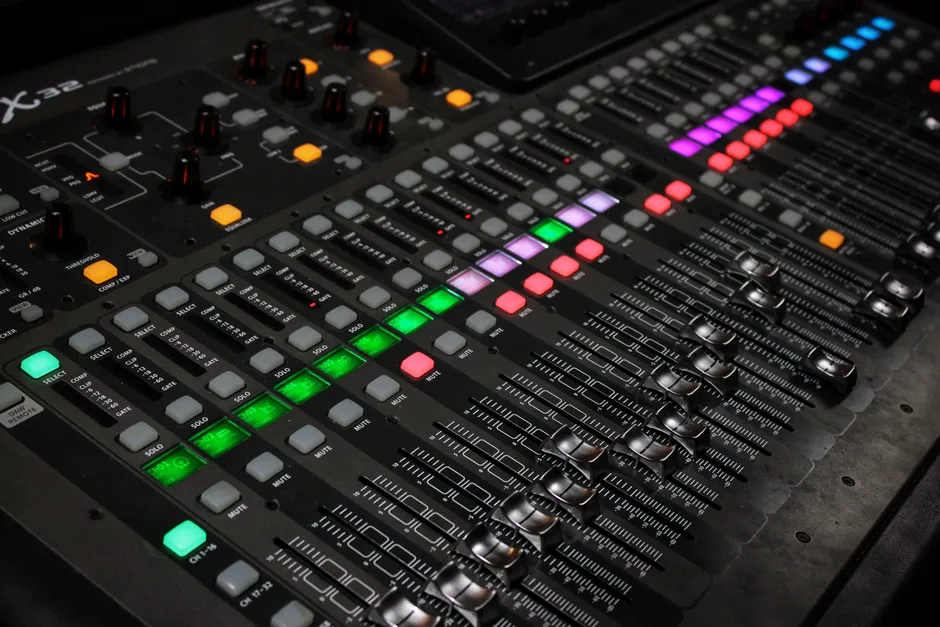
A DIY builder has documented running DOS on a Behringer DDX3216 digital mixing console by replacing the unit's firmware environment with a custom x86 BIOS, as detailed in a blog post published on 8 June 2026. The project sits at the intersection of hardware archaeology and practical curiosity: the DDX3216 is an early-2000s 32-channel digital desk that, it turns out, has always had more computational headroom than its purpose-built interface suggests.
The DDX3216 itself is a capable if long-discontinued platform. It ships with 24-bit A/D and D/A conversion, SMPTE time-code input, and — per Sound On Sound — expansion slots accommodating 16-channel ADAT and TDIF I/O alongside an eight-channel AES-EBU option card. Word-clock input is supported natively, and the desk handles MIDI Time Code in both directions, including MTC generation, which makes it a plausible transport-sync hub even by contemporary standards.
What the builder found, and what makes this worth noting, is that the internal processor is an x86-compatible chip running inside a chassis that gives no outward indication of it. Swapping in a custom BIOS — the project is explicitly DIY, not a vendor-sanctioned modification — exposed a conventional PC-like boot environment. DOS loaded. The system came up.
That is not, on its face, astonishing. Embedded x86 silicon was pervasive in prosumer audio hardware of that era. Manufacturers reached for familiar chipsets because the tooling and driver ecosystem were mature, and because features like SMPTE sync, word-clock arbitration, and multi-channel digital I/O could be handled by off-the-shelf PC peripheral logic rather than bespoke ASICs. The DDX3216 was also marketed — and Sound On Sound confirms it functions — as a DAW controller for software such as Bitwig Studio, a role that implies at minimum a structured communications layer between the desk's CPU and an external host. That layer, it turns out, runs on hardware capable of executing general-purpose x86 instructions.
The practical utility of running DOS on a mixing desk is, charitably, limited. But that framing misses what projects like this actually produce. When someone reverse-engineers the boot path of an embedded system and documents it publicly, they generate the kind of low-level hardware map that enables everything downstream: custom firmware, extended I/O routing, integration with modern DAW environments that the original vendor never envisioned, and long-term preservation of hardware that would otherwise become inoperable as factory service channels close.
Worth flagging here: the DDX3216's digital I/O suite — ADAT, TDIF, AES-EBU, word-clock, MTC — represents a reasonably complete synchronisation and format-conversion stack for a studio built around early-2000s infrastructure. A unit that can be reflashed with community firmware has a longer viable lifespan than one locked to a vendor's discontinued update cycle. That is a concrete, non-trivial outcome for anyone still running this desk in a working room.
The documentation published on 8 June 2026 does not appear to include a full firmware replacement or a production-ready BIOS image — this is a proof-of-concept, not a shipping mod. But the existence of the write-up, with enough detail to reproduce the result, is the point. Hardware of this vintage rarely gets this level of scrutiny unless someone decides to apply it.


