Europe's 2024 Heatwave: Record Temperatures, Red Alerts, and a Warming Baseline

Temperatures surpassed 40°C across parts of Europe during summer 2024, triggering emergency alerts in France, Spain, and Italy in one of the continent's most thermally extreme seasons on record.
France bore some of the sharpest administrative strain. Authorities placed roughly half the country's territory on red alert as temperatures climbed past 40°C in multiple regions, according to ABC News Australia. In parts of France and Spain, readings reached 104°F (40°C), per CBS News. France also moved to ban outdoor drinking in affected zones — an enforcement lever typically reserved for public-order situations but repurposed here as a heat-mitigation measure, limiting alcohol consumption that accelerates dehydration. In Italy, red alerts were issued for multiple cities once local temperatures hit the same 40°C threshold, AFP reported.
The alerts were not precautionary posturing. Red-alert classifications under European meteorological frameworks carry binding operational implications for public health systems, outdoor labor regulations, and emergency services deployment. Their simultaneous activation across three major economies in a single season is logistically significant — it stresses cross-border health infrastructure at the same moment.
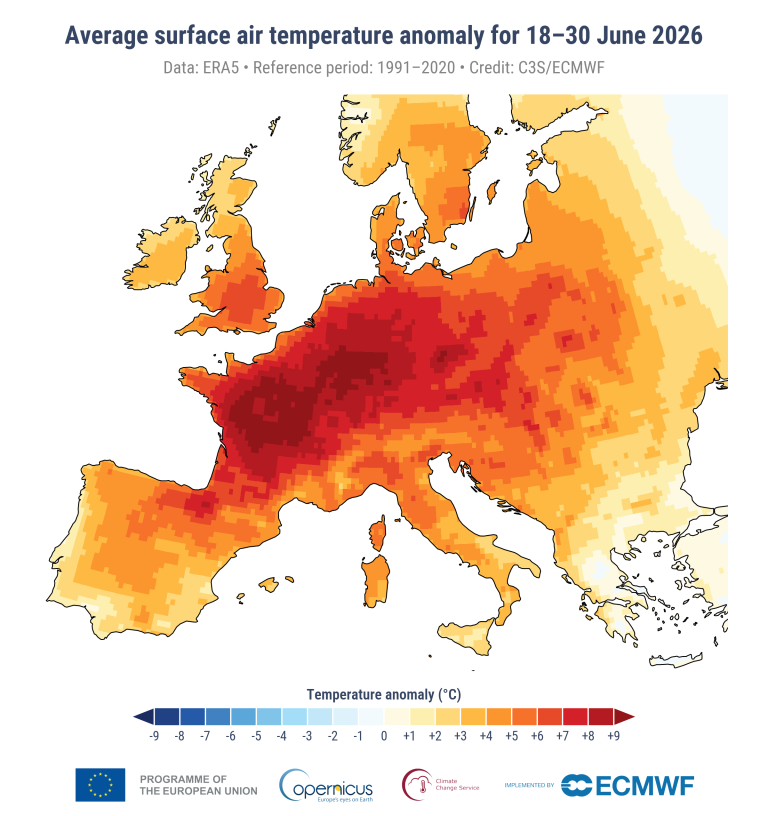
The broader climatological context makes the event harder to bracket as anomalous. The average surface air temperature over European land for June through August 2024 ran 1.54°C above the 1991–2020 climatological baseline — the highest seasonal departure on record for Europe, according to the Copernicus Climate Change Service. The European State of the Climate 2024 report, produced jointly by Copernicus/ECMWF and the World Meteorological Organization, formally designated summer 2024 as the warmest on record for the continent. ECMWF's own seasonal forecasts had flagged warm anomalies of 1–2°C for the period — a range the observed outcome exceeded.
A 1.54°C departure from a 1991–2020 mean is not a marginal exceedance. That baseline already embeds roughly two decades of accelerating warming; the anomaly is measured against an already-elevated reference period, not against pre-industrial norms. The practical consequence is that threshold-based alert systems — calibrated for historical frequency distributions — are being triggered with increasing regularity, and the administrative machinery designed to respond to exceptional events is being asked to operate in a near-persistent mode.
The geographic spread matters, too. Spain, France, and Italy together account for a substantial share of Europe's agricultural output, summer tourism revenue, and outdoor labor force. Sustained temperatures above 40°C carry direct productivity and mortality costs that compound across those sectors simultaneously. France's outdoor drinking bans and the red-alert regimes in Italy point to governments reaching toward behavioral and regulatory tools, rather than purely infrastructure-based responses, because the infrastructure timelines — retrofitting urban heat-island mitigation, expanding grid capacity for cooling demand — run years longer than the season.
What summer 2024 adds to the policy record is a data point that sits well outside previous envelopes and does so across multiple independent measurement and reporting systems simultaneously: national meteorological services, Copernicus satellite-based reanalysis, and the WMO's aggregated assessment all converge on the same characterization. For policymakers working on heat action plans, climate adaptation finance, or labor-market regulation, that convergence is operationally relevant — it forecloses the uncertainty arguments that often slow institutional responses.