Europe's Record Summer of Heat: June 2026 Shatters Benchmarks as Death Toll Mounts
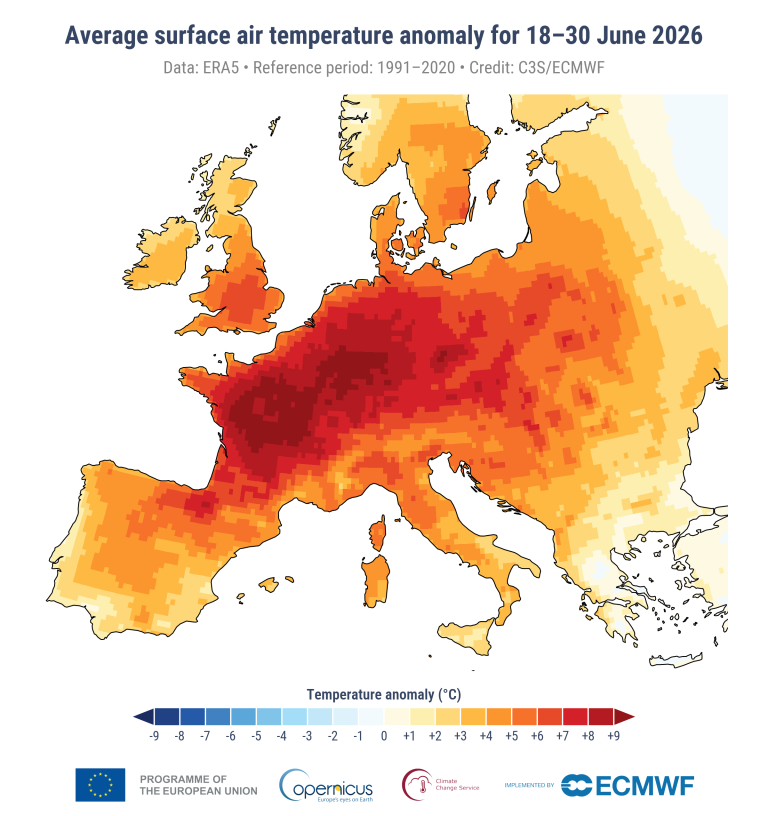
Europe experienced its warmest summer on record in 2026, capped by a June that ranked as the second-hottest for European land and the hottest ever recorded for western Europe, according to data from the Copernicus Climate Change Service and the World Meteorological Organization.
The average temperature over European land in June 2026 reached 19.14°C, which is 1.78°C above the 1991–2020 reference average. For western Europe specifically, the June average climbed to 20.74°C, a departure of 3.05°C above the norm. Both figures were reported on July 9, 2026, by Copernicus and the WMO, respectively. Globally, the June-to-August 2026 period was also the warmest on record, according to Copernicus climate bulletin data.
A primary driver behind the record June temperatures was the highest sea surface temperatures on record for that period, as noted by the World Meteorological Organization. Warm ocean surfaces contribute to elevated humidity and reduced nighttime cooling over adjacent landmasses, compounding the thermal stress experienced inland.
The human cost has been immediate and measurable. Europe recorded an estimated 10,000 excess deaths during a late-June 2026 heatwave, according to Reuters reporting published July 13. Germany alone registered an estimated 5,120 heat-related deaths as of July 9, per data from the Robert Koch Institute cited by Reuters. Tourists and residents across southern Europe were warned to stay indoors during the heat event.
Heat persisted into mid-July. The average high temperature across western Europe was forecast at 29.4°C on July 14, 2026 — 6.3°C above normal — with a subsequent forecast of 27.5°C for July 17. Wildfires raged across France and Spain as prolonged heatwave conditions in June intensified drought, creating fuel beds that accelerated fire spread. By late July, wildfires continued to affect both countries, with conditions worsened by dry soils and vegetation.
This summer's extremes did not emerge from a vacuum. In August 2025, a major heatwave struck southwestern Europe during what was the third-warmest August on record, lasting until August 18. Daily maximum temperatures reached 40°C across much of the region, peaking at 45°C in Portugal, according to Copernicus. That event served as a precursor to the more severe conditions that followed in 2026.
The 2026 heat also pushed northward into Britain, extending the geographic footprint of thermal risk beyond the Mediterranean corridor that has borne the brunt of recent European heatwaves. The expanding reach of these events raises questions about the adequacy of heat-action plans in northern European jurisdictions that have historically faced lower exposure.
Climate scientist Johan Rockström offered a blunt assessment in a National Observer opinion piece published June 29, 2026: "Remember. This is just the beginning. It will get worse, before potentially getting better." Rockström's warning frames the 2026 summer not as an anomaly but as a trajectory — a data point on a curve that climate models have projected for years.
The broader context here is one of compounding extremes layered onto existing institutional and ecological stress. The 10,000 excess deaths figure from late June alone, alongside Germany's 5,120 heat-related fatalities, places 2026 among the deadliest heat years in recent European memory. These numbers also arrive against a backdrop of simultaneous wildfire activity, drought, and infrastructure strain across multiple member states, taxing emergency response capacity at a continental scale.
What sets the 2026 summer apart is the convergence of several record-shattering metrics within a single season: the warmest European summer overall, the hottest June for western Europe, record sea surface temperatures, and a death toll that mounted within weeks of the heat's onset. The Copernicus data, published July 9, confirms that western Europe's June anomaly of 3.05°C above average represents one of the most extreme regional temperature departures recorded for any month in the European dataset.
Looking at what this means for policy and adaptation planning, the 2026 data reinforce a pattern that public health authorities and meteorological services have been tracking with growing urgency: heat is no longer a southern European problem. The northward expansion into Britain, combined with Germany's substantial death toll, suggests that heat-action protocols, urban cooling strategies, and healthcare system surge capacity require reassessment across the entire continent. The gap between the scale of mortality and the speed of institutional response is itself a data point worth monitoring in the months ahead.


