SteelSeries Rival Pro, Sensei Pro Use UWB, Swappable Batteries
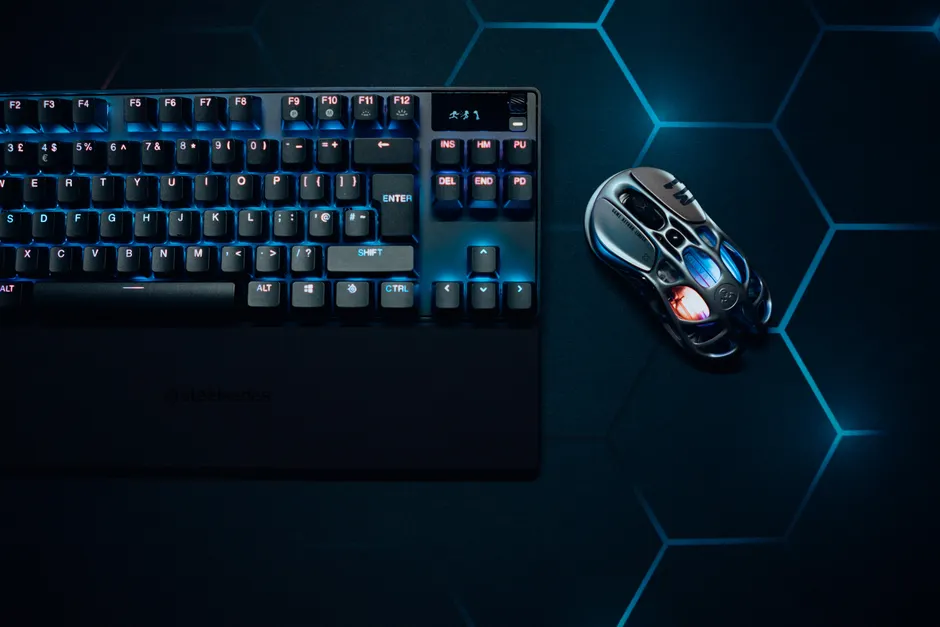
SteelSeries has introduced the Rival Pro and Sensei Pro, two wireless gaming mice built around an ultra-wideband radio link and a swappable-battery power system. The Rival Pro uses an ergonomic shape, the Sensei Pro uses an ambidextrous shape, and both cost $179 each. They are available to preorder now and ship on October 13, according to The Verge.
Weight is tightly controlled. Both models weigh 53 grams in black and 54 grams in white. SteelSeries is also releasing miniature versions of both form factors that weigh four grams less and cost the same price.
Power is handled outside the chassis. The mice ship with swappable circular batteries and a wireless base station used for pairing. The base station keeps a spare battery charged, allowing a depleted cell to be exchanged without tethering the mouse. SteelSeries markets the system as "Infinite Power".
Battery ratings are tied directly to polling rate. Each battery is rated for 16 hours at 8,000Hz polling and 60 hours at 1,000Hz polling. The trade-off is explicit. High-rate reporting shortens runtime by nearly a factor of four.
The wireless link is the more unusual engineering choice. Instead of conventional 2.4GHz, the mice communicate with the base station via ultra-wideband between 6.4GHz and 9.056GHz. SteelSeries says the UWB connection provides 20 times the bandwidth and lower latency.
For latency-sensitive users, bandwidth headroom matters. An 8,000Hz report rate leaves only 125 microseconds between reports, which puts pressure on medium access, retransmission, and coexistence with Wi-Fi, Bluetooth, and other 2.4GHz peripherals. Moving input traffic to 6.4GHz to 9.056GHz isolates it from that crowded band, at least in principle.
Software handles the second half of the power and performance balance. The SteelSeries GG app has added SuperSync, which decouples click and sensor polling. That allows combinations such as 8,000Hz click reporting with 4,000Hz sensor reporting, preserving button responsiveness while reducing motion-data throughput and power draw. GG has also added Smart DPI, which automatically adjusts DPI when transitioning between gameplay and menus. GG is available as a browser-based web app in Chrome or Edge, removing the requirement to install a native client for configuration.
Detail on the smaller chassis came earlier through retail and product listings. The Rival Pro Mini appeared online ahead of launch, listed at 49 grams, consistent with the four-gram reduction now described for the miniature variants TechPowerUp. Separate listings attributed a PAW3950 sensor, 100 million optical clicks, and 100% PTFE feet to the Mini Yahoo Tech.
Looking at what this means for competitive input design, the interesting shift is not any single specification. It is the separation of concerns. Power becomes a base-station problem rather than a mouse problem. Click latency and motion latency become independently tunable variables rather than a single polling slider. Radio coexistence becomes a spectrum-selection problem rather than a retransmission-tuning problem.
In this author's view, that separation is healthy. Gamers have spent years choosing between light weight, long battery life, and maximum report rate, because a sealed internal cell forced all three to share one budget. A hot-swappable cell changes the calculation. Worth flagging for enterprise and shared-lab users as well: a browser-based configurator in Chrome or Edge lowers deployment friction, though it also moves device configuration into browser permission and HID policy territory that IT teams will want to review.
The long arc here favors players. If UWB delivers stable high-rate links without 2.4GHz contention, and if decoupled polling lets users keep click path performance while throttling sensor traffic, ultralight wireless mice get closer to wired determinism without reverting to cables or docks that interrupt play.