Meta's Brain2Qwerty v2 Hits 78% Word Accuracy Decoding Sentences From MEG Signals
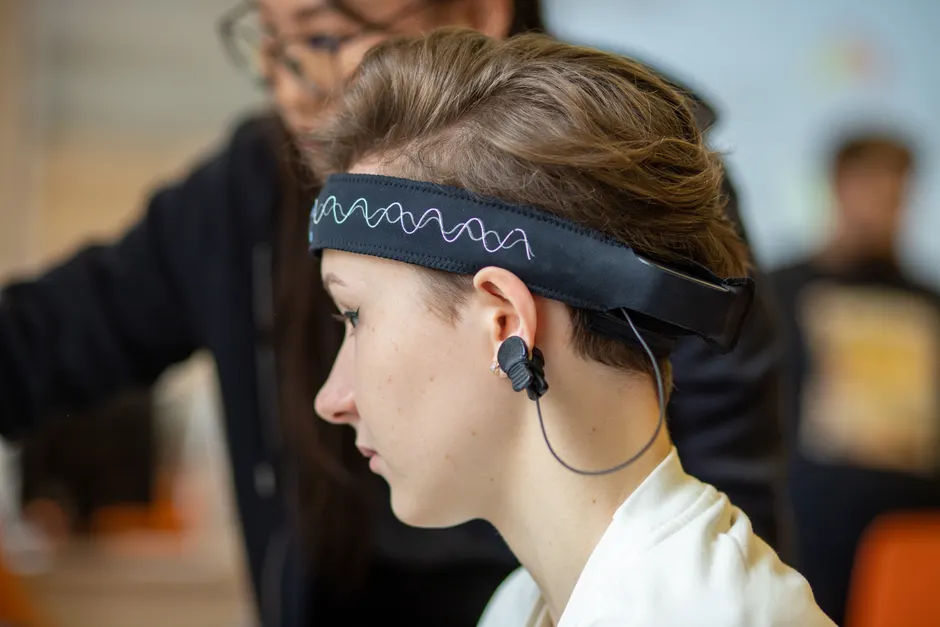
Meta's Brain2Qwerty v2 has decoded complete natural sentences from magnetoencephalography recordings of healthy volunteers with up to 78% word accuracy, according to research published by Meta AI on 29 June 2026.
The system is non-invasive — no electrodes implanted, no surgical procedure. Participants wore MEG sensor arrays while the system's deep learning pipeline translated the resulting brain activity signals into text. The underlying architecture, described in an earlier Meta AI publication from February 2025, is trained to decode from either EEG or MEG recordings, with MEG's superior spatial and temporal resolution making it the stronger signal source for sentence-level work.
The 78% word accuracy figure is worth situating carefully. Decoding isolated words from brain signals is a tractable problem that the field has been chipping away at for years. Decoding continuous sentences — where phonological and syntactic context propagates across the signal in real time — is substantially harder. The jump to v2 appears to have targeted exactly that generalization challenge.
MEG is a demanding modality to build around. The machines are large, expensive, and sensitive enough to require magnetically shielded rooms. This is not hardware that will reach a consumer wearable in any near-term product cycle. The practical near-term addressable population is clinical: people with severe motor impairments — locked-in syndrome, ALS, late-stage spinal injury — for whom even a constrained, lab-based communication channel would be meaningful.
The field has a parallel track worth keeping in view: invasive brain-computer interfaces, most visibly Neuralink's electrode arrays, have demonstrated higher raw throughput precisely because implanted electrodes sit closer to the signal source. The Brain2Qwerty line is making a different engineering bet — that non-invasive signal capture, combined with sufficiently powerful learned decoding models, can close enough of that gap to be clinically useful without the surgical risk and ethical complexity that implantation carries.
Looking at what 78% word accuracy actually means in practice: it is high enough to be useful with a post-processing layer — a language model prior correcting likely errors in context — but it also means roughly one word in five is wrong before any such correction. For fluent communication, the error rate still matters. The question the research now needs to answer is how accuracy degrades as vocabulary and domain vary, and how much of the current number is attributable to constrained sentence structures in the experimental protocol.
Meta's involvement here is worth noting without overstating. The company has been investing in non-invasive BCI research for several years, motivated partly by its AR/VR roadmap — the idea that future headset interaction might bypass hand controllers altogether. The scientific outputs from that investment, including Brain2Qwerty, are being published openly. Whether the research trajectory bends toward a product or remains in the lab depends on factors — regulatory, clinical, commercial — that are well beyond where the current accuracy numbers sit.
The broader landscape of non-invasive neural decoding is moving. Several academic groups and startups are pursuing similar EEG and fNIRS-based approaches. What differentiates the Meta work is the scale of the deep learning models being brought to bear on the decoding problem, and the deliberate focus on sentence-level output rather than discrete word or phoneme classification. Whether 78% is an inflection point or a waystation toward something clinically deployable is a question the next version will have to answer.


