Blind Woman Turned Away From Hartlepool Wetherspoons Over Guide Dog 'ID' Demand
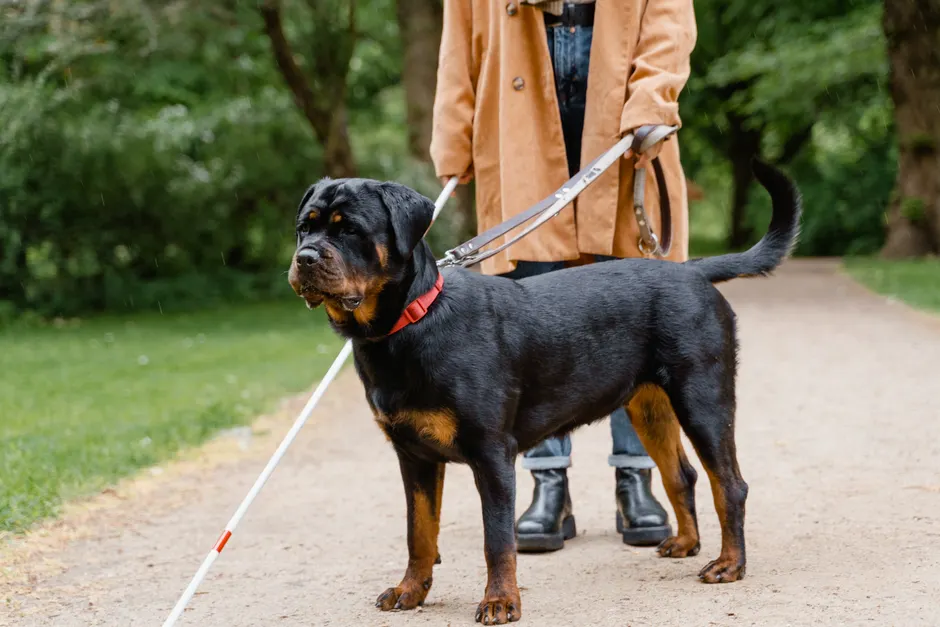
A Wetherspoons pub in Hartlepool asked a blind woman to leave in June 2026 after staff insisted she produce identification for her guide dog before they would serve her. Joanne Hewitson, 31, was told by a staff member at the Ward Jackson pub that company policy required an ID card for her guide dog Rosie, despite the dog wearing a harness bearing a nationally recognised logo at the time Guardian.
Hewitson had brought Rosie, her guide dog of roughly five years, to the pub with her partner, Craig Grager Gazette Live. The Ward Jackson sits in Hartlepool, County Durham, part of the Wetherspoons chain's large national estate. When staff refused service without documentation that does not, in fact, exist as a legal requirement for assistance dogs in the UK, the couple left rather than continue the confrontation. Hewitson described herself afterward as "livid" and "shaking."
The outing carried weight beyond the immediate slight. It was Hewitson's first time out since she fractured her back in January 2026, a detail that sharpens the account: months of recovery, then a return to ordinary life, disrupted within the first attempt at normality by a policy that no UK pub is entitled to enforce.
Under the Equality Act 2010, assistance dogs — guide dogs among them — must be admitted to premises serving the public without a requirement for certification, ID cards, or proof of training beyond what is reasonably observable, such as a harness or jacket bearing an established logo. Guide Dogs UK and other assistance-dog charities have long stressed that no such national ID card scheme exists for the public to demand. Refusing service on that basis exposes an operator to discrimination claims, regardless of internal policy documents that individual staff may cite in good faith.
Wetherspoons responded with an apology. Company spokesperson Eddie Gershon said "guide dogs are welcome into our pubs, without the need for documentation" and that "an error was made on this occasion," a formulation that concedes the policy failure without detailing how it arose at floor level Guardian. The pub's area manager was scheduled to meet Hewitson in person to apologise directly, a step beyond the standard corporate statement and one that signals the chain treats the incident as more than a routine customer-service complaint.
Hewitson posted about the encounter on Instagram and reported it to Guide Dogs UK, the charity that trains and certifies assistance dogs across Britain. The response to her post points to a pattern rather than an isolated lapse: she said multiple assistance-dog owners commented that they had faced the same demand for documentation that does not exist. That detail matters more than the single Hartlepool incident. If staff at other venues, within the same chain or beyond it, are independently reaching for an "ID card" requirement that has no basis in law or in national assistance-dog schemes, the failure sits at the level of training and induction rather than one branch's judgment call.
For a company the size of Wetherspoons, with pubs across the UK operating under devolved local management, consistency of front-line training on disability access is an operational challenge distinct from the written policy itself. A head-office statement of welcome does little if it is not reinforced at shift level, particularly in venues with high staff turnover, a known feature of pub and hospitality work. The gap between stated policy and enforced practice is where these incidents tend to originate, and it is a gap regulators and disability charities have flagged before across the hospitality sector generally, not this chain specifically.
The reputational calculus for Wetherspoons is straightforward enough: a swift public apology, a named spokesperson, and a face-to-face meeting are the standard playbook for containing a story that touches disability rights, an area where public sympathy is sharp and consumer patience for corporate deflection is short. Whether the company follows through with retraining across its estate, rather than treating Hartlepool as a contained public-relations episode, is the detail worth watching. Hewitson's account of other assistance-dog owners recognising the same experience suggests the underlying question extends past one pub in County Durham.