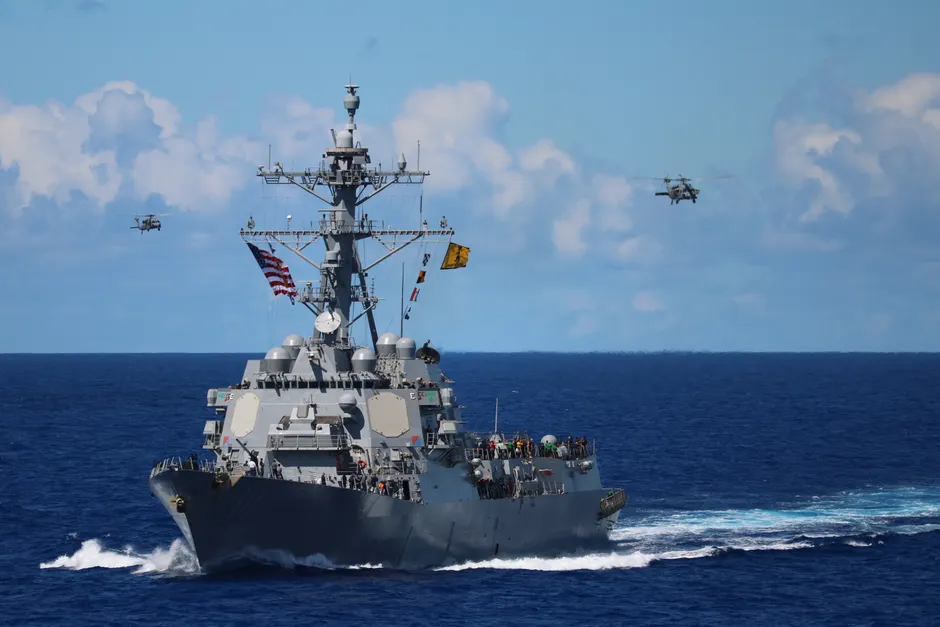
Iran Strikes Ships in Strait of Hormuz; U.S. Revokes Oil License, Hits Targets Inside Iran

Iran fired missiles at three commercial vessels transiting the Strait of Hormuz on July 7, 2026, prompting the United States to revoke a sanctions-relief license on Iranian oil sales and to strike targets inside Iran within hours Reuters, Yahoo Finance. A Qatari LNG carrier was left at risk of explosion and a Saudi crude tanker sustained damage in the attack, according to Axios reporting relayed by Reuters Reuters. A Singapore-flagged cargo vessel exiting the strait along the Omani coast was also targeted, per CENTCOM CENTCOM.
The strait's maritime risk rating jumped to "severe" after the strikes, according to shipping-security assessments cited by Reuters Reuters. Brent and U.S. crude futures both rose on the news CNBC. Roughly a fifth of global oil consumption transits Hormuz on any given day, so even a partial disruption moves benchmark prices quickly.
Washington's response came fast on two tracks. Treasury pulled a license that had permitted Iranian crude exports under a sanctions carve-out, a step Yahoo Finance linked directly to the attacks Yahoo Finance. CENTCOM then struck Iranian territory, hitting Sirik, Qeshm, and Bandar Abbas, according to Al Jazeera's live coverage dated July 8 Al Jazeera. CBS News reported the retaliatory strikes at 5:25 p.m. on July 7, citing CENTCOM as its source CBS News. CENTCOM's own release framed the action as a response to Iran's attack on a commercial vessel CENTCOM, and a follow-up release described additional strikes after Iran targeted a Panama-flagged tanker carrying more than two million barrels of crude near the strait CENTCOM. AP News reported that Bahrain and Kuwait were also drawn into the crisis, and that the U.S. military struck Iran early Wednesday local time following Tehran's attack on the three ships AP News.
Reuters reported that Iran's supreme leader said no talks would proceed unless Trump halted the campaign, even as Tehran organized mass demonstrations Reuters. That statement lands against a diplomatic track that had appeared, briefly, to be functioning: AP reported on July 1 that Washington and Tehran had agreed to keep talking, with Qatar hosting and mediating AP News. Qatar's role as mediator now sits awkwardly beside the reported targeting of a Qatari-flagged LNG tanker in the same strait its diplomats were working to stabilize.
A deteriorating maritime picture
The July 7 attacks did not emerge from a calm baseline. UKMTO's Joint Maritime Information Center had assessed the operating environment as stable as recently as its Update 067, covering through July 5, rating an attack "possible but not likely" at a SUBSTANTIAL risk level UKMTO. Update 068, covering through July 7 and published a day earlier in the document trail, flagged that "navigation interference and residual kinetic risk persist" while still assessing an attack as unlikely under prevailing conditions UKMTO. The gap between that assessment and the same-day missile strikes illustrates how quickly conditions in the strait can outrun formal risk models.
UKMTO's Warning 82-26, issued July 7 and addressed to military authorities, recorded an incident involving a tanker transiting the strait UKMTO. It followed an earlier advisory, 003-26/001, issued June 27 regarding a prior attack within the strait, and a British military report around June 25 of a vessel hit there, which led a UN agency to pause ship evacuations AP News. CENTCOM's own homepage had, as recently as June 20, carried an item titled "Commercial Vessels Flow Through Open Strait of Hormuz" — a snapshot of relative normalcy that the intervening weeks overtook CENTCOM.
Iran's joint military command had already warned, on July 3, that tankers must use its approved routes through the strait or face consequences AP News. CENTCOM had separately described enforcing blockade measures against an Iranian-flagged cargo vessel in the Arabian Sea while protecting U.S. warships transiting Hormuz CENTCOM, suggesting a naval posture already primed for confrontation before the July 7 missile strikes.
The broader picture that emerges from these overlapping timelines is one of a maritime chokepoint cycling between fragile recoveries and fresh escalation, with each side's declared "red lines" — Iran's approved shipping routes, Washington's sanctions licenses — functioning less as stabilizers than as triggers for the next round. The New York Times noted that the July 7 strikes threatened what had been a tentative recovery in oil and gas shipments through Hormuz New York Times. Whether the Treasury license revocation and CENTCOM's strikes on Sirik, Qeshm, and Bandar Abbas function as deterrence or as an accelerant for further Iranian action against shipping is, for now, an open question that markets are pricing in real time.