Western Europe's Hottest June on Record Leaves Thousands Dead as Heat Dome, Marine Heatwave Combine

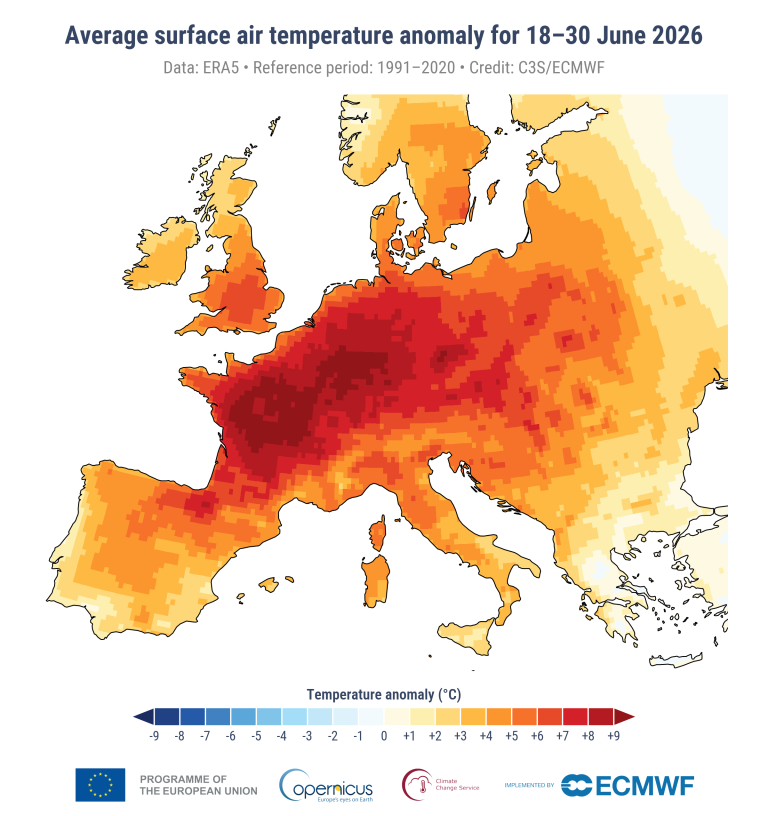
Western Europe recorded its hottest June since measurements began, with the regional average temperature reaching 20.74°C (69.33°F) — more than 3°C above the 1991–2020 reference period — according to the EU's Copernicus Climate Change Service (C3S) Al Jazeera. Globally, June 2026 ranked as the second-warmest June on record, with a planetary average of 16.54°C (61.77°F), 0.56°C above the 1991–2020 norm and 1.39°C above the estimated 1850–1900 pre-industrial baseline Copernicus Climate Change Service. Europe as a whole placed second-warmest for the month, behind only prior record years Copernicus.
The human toll has climbed steadily as national statistical agencies process mortality data. As of July 9, authorities in France, Belgium, Spain, and the Netherlands had tallied more than 4,700 excess deaths tied to the June heat episode, up from 3,700 reported just two days earlier — a figure officials had already flagged as preliminary and likely to rise Reuters. France's Santé publique France recorded more than 1,200 all-cause deaths on June 24 alone, and over 1,400 on both June 25 and 26, with weekly all-cause mortality for June 22–28 up nearly 30 percent nationally Santé publique France. In the Centre-Val de Loire region, the rise in deaths began June 24 and concentrated among older residents Santé publique France.
The event unfolded in stages. An early, unusually intense heatwave struck western Europe between May 21 and 30, with ERA5 reanalysis data showing daily average temperatures more than 10°C above normal across western France, England, and Wales Copernicus. May 2026 itself finished as the second-warmest May on record globally, across both land and sea surfaces Copernicus. The pattern persisted into June: Spain logged its hottest June days on record on the 23rd and 24th, part of a broader continental spike the World Meteorological Organization described as record-breaking WMO.
By June 22, temperatures had exceeded 40°C (104°F) across parts of the continent, and French authorities confirmed at least 18 deaths, including two children left in a hot vehicle Reuters. Drowning deaths in France, as people sought relief in rivers, lakes, and pools, rose from roughly 40 on June 23 to at least 48 by June 24, according to French officials Reuters Reuters. Power cuts compounded the strain on households already sweltering without reliable cooling. An AFP analysis found that more than two-thirds of Europeans — roughly 410 million people — experienced temperatures above 35°C (95°F) at some point during the event Al Jazeera.
Meteorologically, the heatwave was driven by a heat dome: a stationary high-pressure system that trapped hot air over the continent much as a lid holds heat in a pot, suppressing convection and precipitation while allowing surface temperatures to build day after day. Elevated humidity levels aggravated the effect, producing consecutive tropical nights — periods when overnight lows failed to drop enough to give bodies, buildings, and infrastructure any recovery window. That combination of daytime extremes and nighttime persistence is what distinguishes the physiological danger of this event from a conventional dry heat spike, and it tracks with the mortality curve Santé publique France documented, where deaths accumulated over consecutive days rather than spiking and receding.
The oceans registered their own record. Average sea surface temperature across non-polar waters hit 20.86°C (69.55°F) in June, the highest ever measured for the month, and the Mediterranean endured a marine heatwave described as record-breaking, with Atlantic coastal waters also running hot Al Jazeera. Warmer seas reduce the moderating effect coastlines normally provide and raise risks to marine ecosystems already under pressure from acidification and overfishing. On land, dry conditions elevated drought risk in Eastern Europe and fed wildfire activity across the Iberian Peninsula and southern France, stretching firefighting resources already committed to heat-response operations.
The WHO's early-July warning that Europe could face "more deadly weeks" as a fresh heatwave builds suggests June was not a discrete event but the opening phase of a longer season Reuters. That framing matters for how officials and the public interpret the numbers now emerging. Excess-mortality counts are inherently retrospective and revised upward as reporting lags close, which is why the jump from 3,700 to over 4,700 deaths in a matter of days is less an anomaly than a function of how this kind of data accumulates. Whether June 2026 stands as an outlier or as a preview of a recalibrated European summer baseline will depend on what the ECMWF-operated Copernicus service records through the rest of the season, and on whether the heat-health warning systems built after previous fatal summers hold up under a longer, wetter-humidity heat regime than the ones they were designed around.