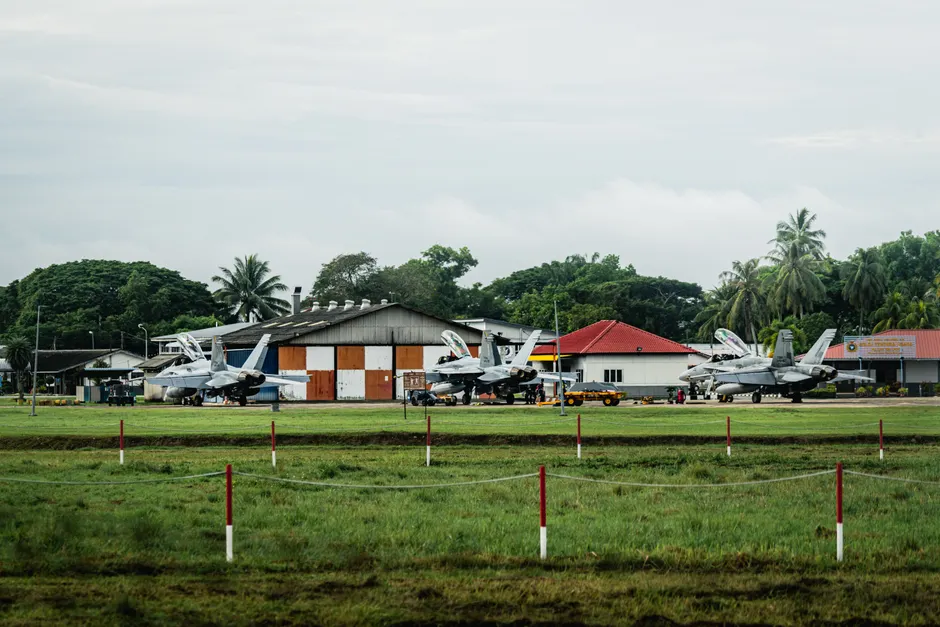
Iran Strikes US and Allied Bases Across Gulf as Hormuz Crisis Escalates

Iran Strikes US and Allied Bases Across the Gulf as Hormuz Escalation Widens
Iran's Islamic Revolutionary Guard Corps (IRGC) launched missile and drone strikes against US military installations in Bahrain, Jordan and Kuwait on Monday, July 13, in what it described as retaliation for expanded American attacks on Iranian territory. Al Jazeera reported that prospects for de-escalation are receding as both sides claim expanding target lists.
The IRGC said it struck US military infrastructure in Juffair, Bahrain, and hit "several facilities" at Sheikh Isa Air Base. In Jordan, the Guard claimed missiles and drones set fire to fuel depots and ammunition storage at Prince Hassan Air Base. In Kuwait, the IRGC said it destroyed two HIMARS launchers and missile-packed warehouses at a US surface-to-surface missile base. It also claimed to have destroyed an FPS long-range aerial radar and a vessel-detection radar in Oman — targets that, if confirmed, would degrade regional early-warning coverage over the Strait of Hormuz approaches.
Host-nation militaries confirmed active engagements rather than the full scope of Iranian claims. Jordan's armed forces said they intercepted and downed four missiles that crossed into its airspace from Iranian territory. Kuwait's Army General Staff said its air defense systems were engaging hostile aerial targets inside national airspace. Bahrain's Ministry of Interior sounded sirens and instructed residents to remain calm and move to the nearest safe location — standard civil-defense protocol rather than confirmation of impacts. IRNA also reported the IRGC's account of the strikes, framing them as a direct response to what Tehran calls illegal US action.
The exchange follows a claim a day earlier that a second vessel was hit in the Strait of Hormuz alongside a strike on a US base in Qatar. IRNA reported the IRGC's assertion on July 12. The same day, CENTCOM said it had struck 140 targets inside Iran, per IRNA's reporting — a scale that dwarfs the strikes CENTCOM disclosed in early June, when it said it had defeated seven ballistic missiles and four one-way attack drones fired toward Kuwait and Bahrain. CENTCOM documented that earlier intercept.
CENTCOM's own account of the July round says it hit dozens of targets across multiple locations "with precision munitions" to degrade Iran's capacity to threaten shipping through Hormuz, hitting air-defense systems, coastal radar sites, missile and drone infrastructure, and small boats. Notably, CENTCOM said it deployed fighter aircraft, naval vessels, one-way attack aerial drones and one-way attack sea drones together for the first time — an operational combination that signals an expanded strike architecture rather than a repeat of earlier retaliatory salvos. Al Jazeera detailed the CENTCOM statement.
Inside Iran, Valiollah Hayati, deputy governor for security in Khuzestan province, told ISNA that US forces struck at least eight locations across the province overnight. IRNA reported that one person was killed and four injured when a projectile hit an agricultural water-pumping station in Mahshahr. Tasnim reported a US-manufactured LUCAS suicide drone was shot down over Bandar Abbas, the port city that anchors Iran's side of the Strait. Iran's Foreign Ministry issued a statement condemning the US strikes on its territory.
The dispute over Hormuz transit has hardened into competing legal and operational claims. The Persian Gulf Strait Authority stated that transit through the strait was "not possible" because of what it called illegal US actions, according to IRNA. That statement sits awkwardly against President Trump's assertion, made during an appearance on NBC's Meet the Press, that the Strait of Hormuz remains open. Both claims cannot be fully reconciled without independent verification of transit volumes and insurance-market behavior, which typically lag official statements by days.
The current escalation traces back through a compressed sequence. Iran declared the strait closed on July 7, a day after three merchant ships were attacked in the waterway on July 6–7, according to NPR and Britannica's running account of the conflict. Reuters reported the US military resumed strikes on Iranian targets on July 8 in direct response. Two days before the tanker attacks, on July 9, Iran had already warned Washington over interference in the strait, declaring that "foreigners have no stake" in the waterway, per IRNA.
This sequence is a reversal of an arrangement the White House had presented as settled. In April, the administration said Trump had ordered a naval blockade specifically to counter Iranian aggression and restore safe passage through Hormuz. By June, the White House was crediting a bilateral memorandum of understanding with Iran for having "fully reopened" the strait. The gap between that June claim and July's mutual strikes, tanker attacks and closure declarations is stark enough that any account of the current crisis has to treat the MOU as a collapsed framework rather than an active one.
What distinguishes this phase from the intercepted-missile skirmishes of early June is the geographic spread. Strikes now touch Bahrain, Jordan, Kuwait, Oman and Qatar simultaneously, pulling in US basing arrangements across four Gulf Cooperation Council states plus a non-GCC US security partner. Whether host governments in Manama, Amman and Kuwait City calibrate their public responses toward de-escalation or toward matching US posture will likely shape how quickly — or whether — Hormuz transit data can be independently verified in the coming days.