Iran Strike on Jordan Base Kills Two U.S. Troops, Pushing Conflict Toward Wider War
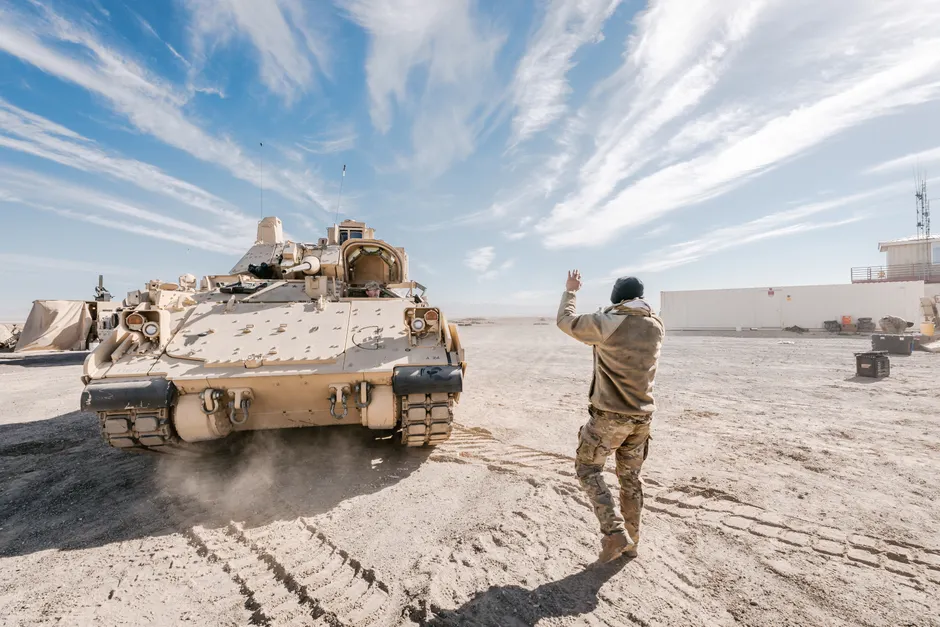
Iran struck a U.S. military base in Jordan on Friday, killing two American service members and moving the United States and Iran closer to a wider regional war (The New York Times). The attack, attributed to Iran's Islamic Revolutionary Guard Corps, drew an immediate vow of retaliation from President Trump, who ordered swift punishment of the IRGC forces responsible for the Jordan attack (The New York Times). The IRGC separately claimed it had struck a U.S. military target (Reuters).
The escalation follows months of tit-for-tat strikes centered on the Strait of Hormuz. Earlier U.S. military actions targeted Iran's capacity to threaten shipping through the strait (The New York Times). American airstrikes hit Bandar Khamir, a coastal city on the strait, where U.S. Central Command said it struck dozens of targets (AP News). The U.S. had imposed a naval blockade on ships transiting the strait, redirecting 100 vessels by May 23, 2026 (CENTCOM). Trump later announced on social media the immediate lifting of that blockade (Britannica).
Trump escalated rhetoric further, threatening to destroy civilian infrastructure inside Iran (The New York Times). The threat raises questions about targeting thresholds and the legal framework governing U.S. strikes, particularly given that Iranian forces have launched attack drones from crowded civilian areas in the cities of Dezful, Esfahan, and Shiraz. U.S. forces had previously issued a safety warning to Iranian civilians about those launch sites (CENTCOM).
The conflict has drawn in Gulf states. Iranian strikes were reported in Bahrain on or around July 18, 2026 (Reuters). U.S. and Qatari forces jointly defended against an Iranian ballistic missile attack, and CENTCOM forces defeated a separate wave of missiles and drones launched by Iran on June 5, 2026 (CENTCOM). A prior ceasefire arrangement collapsed: CENTCOM described an Iranian violation as "egregious" after Iranian forces launched five one-way attack drones (CENTCOM).
Iran has also employed unconventional intelligence methods. Iranian forces could use American service members' cellphone data to target them, a capability that likely informed the strike on the Jordan base (The New York Times). That vulnerability underscores the operational risk to forward-deployed U.S. personnel in the region.
CENTCOM has pushed back on at least one media report. In late March, the command refuted claims that the U.S. conducted strikes in Lamerd, Iran, and stated that video footage circulated by media outlets did not show a Precision Strike Missile (PrSM) (CENTCOM).
The broader context here is a conflict that has expanded on multiple fronts simultaneously: the Strait of Hormuz naval blockade and subsequent strikes, IRGC attacks on U.S. installations across Jordan and the Gulf states, drone launches from civilian population centers, and a collapsed ceasefire. The death of two U.S. service members marks the first confirmed American fatalities from an Iranian strike in this conflict, and Trump's threat to target civilian infrastructure signals a potential shift in the rules of engagement. If carried out, that threat would cross a threshold the U.S. has so far avoided, even as CENTCOM has taken care to warn Iranian civilians away from drone launch sites.
The lifting of the Hormuz blockade, announced the same week as the Jordan strike, further complicates the trajectory. Whether the blockade's removal represents a de-escalatory gesture or a recalibration of U.S. strategy toward direct retaliation rather than maritime interdiction is not yet clear. What is clear is that both sides have moved past the tit-for-tat phase of strikes and counter-strikes into a space where the triggering event for a full-scale regional war is no longer hypothetical.