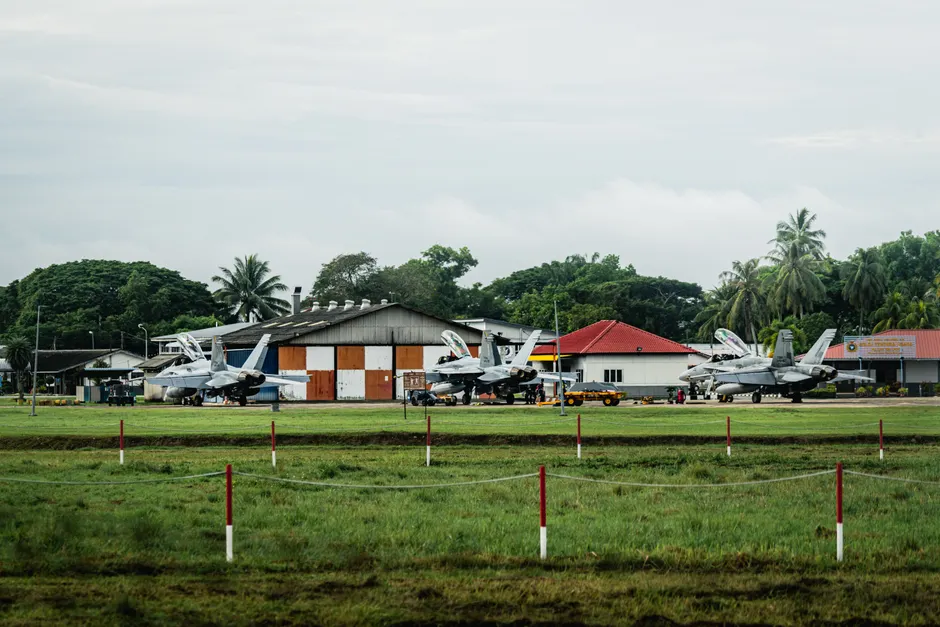
U.S. Deploys F-16s and F-35s to Middle East Amid Escalating Iran Conflict

The United States is sending Air Force F-16 fighter jets from Germany and F-35 stealth jets from Britain to the Middle East, according to U.S. officials cited by The New York Times on July 19, 2026. The deployments add to an already substantial American combat aircraft footprint in the region, which has grown steadily since the Israel-Iran war intensified in mid-2025.
The current reinforcements build on a pattern that began at least as far back as June 2025. On June 17, 2025, Reuters reported that the U.S. military was deploying additional F-16, F-22, and F-35 fighter jets to the Middle East amid the Israel-Iran war, citing an unnamed U.S. official. Days later, on June 21, American officials confirmed that F-22, F-16, and F-35 fighters from the United States had transited bases in the Middle East.
The latest moves also extend a military buildup near the Strait of Hormuz that the Department of Defense had publicly acknowledged years earlier. In July 2023, the Pentagon confirmed that the Secretary of Defense had ordered F-35 and F-16 fighters, along with the destroyer USS Thomas Hudner, to the region near Oman. That earlier deployment established a basing and force-rotation template that subsequent administrations have drawn on as tensions with Tehran have escalated.
The fighter deployments are occurring within the framework of Operation Epic Fury, a U.S. Central Command campaign described on CENTCOM's official website as striking targets to dismantle the Iranian regime's security apparatus. CENTCOM published details of the operation in April 2026. The Air Force's 158th Fighter Wing, equipped with F-35s, is participating in Operation Epic Fury. A U.S. base was supporting the operation as of April 2, 2026, according to the CENTCOM homepage. Alongside Epic Fury, CENTCOM is also conducting "Regional Cooperation 2026," an annual multinational exercise it sponsors, which was noted on the command's homepage as of May 13, 2026.
The escalation has not been cost-free for American forces. Around April 3, 2026, Reuters reported that two U.S. warplanes were downed over Iran and the Gulf. Two pilots were rescued; a third remained missing, according to Iranian and U.S. officials. The incident occurred as the United States vowed to target additional Iranian infrastructure and as multiple nations sought to keep the Strait of Hormuz open.
The strategic geography of these deployments matters. Routing F-16s from Germany and F-35s from Britain rather than from the continental United States reduces transit time and signals that European-based U.S. assets are being drawn down to reinforce the CENTCOM area of responsibility. The F-35s bring low-observable capabilities that are relevant for penetrating Iranian air defense networks, while the F-16s provide high-sortie-rate strike capacity. The F-22s transited in 2025 add an air-superiority dimension.
The broader context here is a multi-year, multi-administration trajectory of increasing U.S. military involvement in direct confrontation with Iran's security infrastructure. The 2023 deployments near Oman were framed around maritime security and deterrence. By 2026, the mission had evolved into active strike operations under Operation Epic Fury, with the stated objective of dismantling Tehran's security apparatus. The loss of two warplanes over Iranian territory in April 2026 marked an escalation from presence and deterrence to sustained combat operations with attrition.
The continued reinforcement of fighter aircraft in July 2026, drawing on airframes based in both Germany and Britain, suggests that earlier deployments have not achieved a stabilization of the operational environment. The combination of kinetic strikes under Epic Fury, multinational exercises under Regional Cooperation 2026, and the diplomatic push to keep the Strait of Hormuz open places these F-16 and F-35 movements within a multi-layered effort that spans combat operations, coalition management, and freedom-of-navigation concerns.
For regional actors and alliance partners, the practical question is whether additional aircraft rotations will alter Iran's calculus or further entrench the confrontation. The downing of two U.S. warplanes over Iran in April did not trigger a drawdown. Instead, the July deployments indicate a decision to sustain or increase pressure.