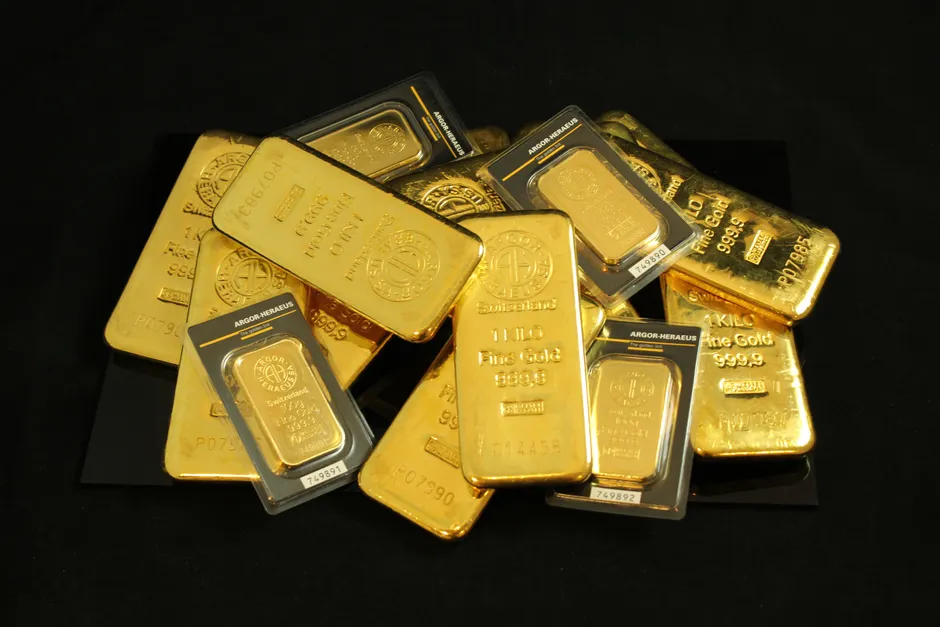
Gold's 2026 Slide From Record Highs: HSBC Cuts Forecasts as Fed Tilt and Geopolitics Pull in Opposite Directions
COMEX Gold August 2026 futures (GC.1) last traded at $4,018.80 on July 18, 2026, CNBC, a level that sits roughly 15% below the record spot high of $4,765.93 reached on January 20, 2026, Reuters. The pullback caps an extraordinary run: gold gained 64% in 2025 and was up 11% year-to-date by January 2026, Reuters, with spot prices crossing $4,800 per ounce for the first time that same month. Seven months later, gold is trading back near the $4,000 psychological level, caught between competing macro forces.
HSBC lowered its 2026 average gold price forecast to $4,560 per ounce from $4,864, and its 2027 forecast to $4,925 from $5,000, citing a hawkish Federal Reserve tilt, Reuters. The revision, published July 9, 2026, reflects the central bank's trajectory toward tighter or longer-held policy rates, which raises the opportunity cost of holding non-yielding bullion. When real rates rise, gold's zero-coupon profile becomes a liability rather than a hedge, and HSBC's trimmed numbers suggest the desk sees that drag persisting into 2027.
The price action on either side of HSBC's call has been volatile. On July 13, 2026, spot gold fell 3% to $3,996.76 per ounce, Reuters, as rising Middle East tensions fueled rate-hike concerns. That dynamic is worth noting for its contrarian texture: geopolitical risk typically bids gold higher through safe-haven demand, but when conflict threatens energy supply and feeds inflation expectations, the offsetting rate-hike trade can dominate. In this case, the rate channel won.
That July 13 selloff echoes an earlier episode. In late October 2025, COMEX gold futures settled 2.83% lower at $4,001.90, with gold falling 3% amid easing U.S.-China trade tensions, WSJ. The catalyst there was de-escalation rather than escalation: trade-deal optimism reduced the risk premium embedded in bullion, and cooler inflation signals did the rest. Both episodes illustrate how gold's direction in this cycle hinges less on the absolute level of rates and more on the marginal direction of risk pricing and policy expectations.
The broader context here is a market recalibrating from an extraordinary momentum phase. A 64% annual gain is not a normal regime; it reflected a confluence of trade-war escalation, central-bank accumulation, and real-rate compression that pushed spot prices through $4,800 in January. The subsequent drift toward $4,000 suggests at least partial mean reversion as those tailwinds fade or reverse. HSBC's revised 2026 average of $4,560 still implies a meaningful recovery from current spot levels, which suggests the bank's base case is not a sustained bear market but a range-bound consolidation before the next leg.
For institutional positioning, the tension is between the Fed channel and the geopolitical channel. A hawkish Fed caps upside; Middle East escalation or trade deterioration reopens it. The July 13 selloff showed that when both fire simultaneously in opposite directions, the rate channel has been dominant. Whether that hierarchy holds depends on the severity and persistence of the geopolitical shock relative to the Fed's inflation response function.
Gold's bounce to $4,018.80 in the July 18 futures session, off the July 13 spot low of $3,996.76, suggests the market is finding a floor near the $4,000 round number. But the distance between current levels and HSBC's revised 2026 average forecast of $4,560 is roughly 13%, a gap that requires either a dovish Fed pivot or a significant risk-off catalyst to close. Neither is currently in evidence. XS.com's market analysis desk continues to track these flows, XS.com.
For portfolio allocators, the practical question is whether gold's role as a hedge is degrading or simply being repriced. The metal's correlation with real rates has tightened as the Fed's policy path has become the dominant macro variable, which means gold's diversification value in a 60/40 framework may be lower in a hawkish regime than the 2025 rally suggested. HSBC's forecast cut is a signal that at least one major desk sees the hawkish regime persisting long enough to compress gold's expected return below prior assumptions through 2027.