Qobuz Overhauls Music Player, Adds Real-Time Lyrics in Broader App Redesign
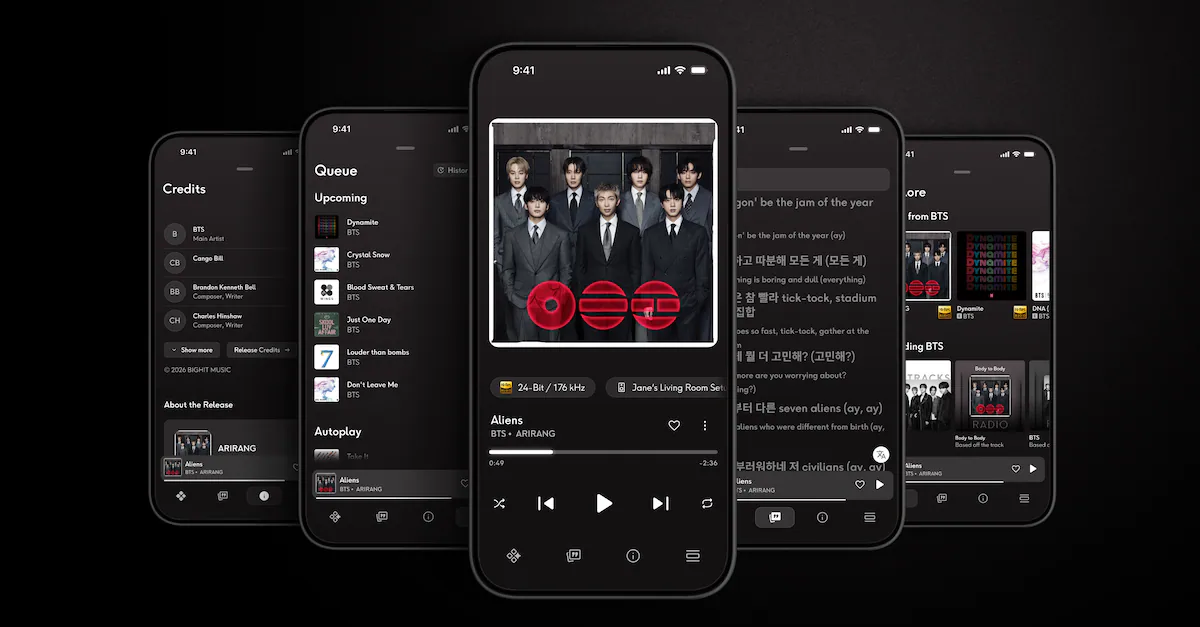
Qobuz has launched a comprehensive redesign of its music streaming player, headlined by the addition of real-time lyrics that scroll line by line and include translations. The update, announced on July 23, 2026, also introduces a redesigned player interface, a persistent miniplayer, an expanded play queue, a new Explore section, genre and label filtering, overhauled credits pages, and Siri voice integration. Engadget
The new player interface draws its visual palette from album artwork, adapting colors and aesthetic elements to the currently playing release. A persistent miniplayer now remains on screen as users navigate the app, providing continuous playback control without requiring a return to the now-playing view. The play queue has been updated with more granular control options, though Qobuz has not detailed the specific mechanics of those controls.
Real-time lyrics scroll in sync with playback and support translations, a feature that aligns Qobuz with capabilities already available on several competing streaming platforms. What distinguishes Qobuz's implementation, at least on paper, is the pairing of synced lyrics with the service's hi-res audio focus and its human-curation model, which the company has cited as a factor in its rapid subscriber growth. Digital Music News
A new Explore section surfaces similar albums, artists, radio stations, and playlists based on listening habits. This sits alongside new content filtering by genre or record label, giving users finer-grained discovery tools than the previous app version offered. The credits section has been redesigned to present information about works and artists more accessibly, and users can now follow affiliated artists or record labels directly from the credits page. For a service that has positioned itself around editorial depth, surfacing credits and label relationships as navigational paths is a meaningful structural choice.
Siri integration enables voice control of playback, though this feature is iOS-only. All other player updates are available on both iOS and Android. Engadget
As of May 2026, Qobuz was described as one of the fastest-growing music streaming platforms, with that growth partly attributed to an influx of former Spotify users. The platform emphasizes human curation over algorithmic recommendations as a core differentiator. Digital Music News Subscription pricing ranges from $12 to $15 per month depending on tier, with a free 30-day trial available. Qobuz reports a per-stream payout rate of $0.043 to artists, and allows users to purchase albums and songs directly through the app. Engadget
Looking at what this means in practice, the update is as much about closing UX gaps as it is about adding new functionality. Synced lyrics, persistent miniplayers, and richer discovery surfaces are table stakes in the streaming category at this point. Qobuz's challenge has never been audio quality, where it has competed aggressively on hi-res FLAC, but rather app experience. A listener who moved from Spotify to Qobuz for better sound and fairer artist payouts has, until now, accepted a comparatively spartan interface. This redesign narrows that gap considerably.
The credits redesign deserves specific attention. Making producer, engineer, and label credits navigable rather than buried metadata turns liner notes into a discovery surface. For listeners who care about who made a record, the ability to follow an engineer or a label from the credits page creates a discovery path that algorithmic recommendation engines do not replicate well. Whether Qobuz's human-curation model extends into these credit-driven discovery flows remains to be seen as users engage with the feature.
The Explore section's reliance on listening habits does introduce an algorithmic element into a platform that has built its identity on human editorial judgment. There is a productive tension here: Qobuz can offer algorithmic suggestions alongside curated recommendations without abandoning its editorial stance, provided the algorithmic surface does not crowd out the human one. How that balance is struck in practice will matter more than the feature's mere existence.
The $0.043 per-stream payout figure, combined with direct purchase options, positions Qobuz as a service where the buy-to-own model still exists alongside streaming access. In an industry where ownership has largely dissolved into subscription access, maintaining a purchase path is itself a differentiator. The redesigned credits and label-following features complement this, connecting listeners more directly to the economic ecosystem around the music they hear.
The broader question for Qobuz is whether improved UX converts trial users into retained subscribers at a rate that sustains its growth trajectory. The features announced today bring the app closer to parity with larger competitors on interface quality while preserving the audio and curation advantages that attracted users in the first place. For a platform whose growth has been fueled by Spotify defectors seeking something different, the redesign's success will hinge on whether it can offer familiarity of experience without sacrificing the qualities that made it different.