Granola Brings AI Meeting Transcription to Apple Watch
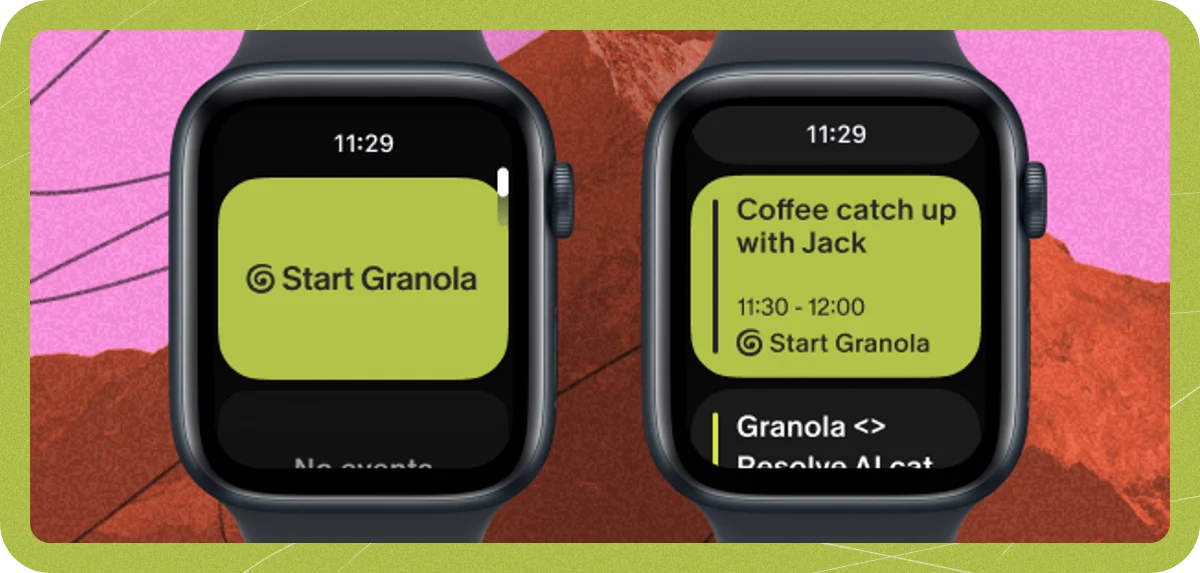
Granola launched an Apple Watch app on July 28, 2026, extending its AI note-taking platform to the wrist. The app requires an Apple Watch running watchOS 11 or later and pairs with Granola's existing iOS app, which debuted in 2025 (TechCrunch).
Users can set Granola as a watch face complication, allowing them to start transcribing at any time without opening a separate application. The watch face also surfaces reminders about upcoming meetings. During active transcription, audio recordings are captured locally on the Watch hardware itself (Granola Help Center).
Granola co-founder Chris Pedregal told TechCrunch the Apple Watch app is meant to capture in-person meetings without taking a phone out, such as during walking one-on-one meetings. The use case targets scenarios where pulling out a device is socially or physically inconvenient. Granola tested the app internally with employees who owned Apple Watches, and the company found that a large portion of their mobile usage shifted from iOS to the Watch. Granola considered it easier to develop an Apple Watch app than to integrate with another hardware product (TechCrunch).
The launch follows a period of rapid growth for the company. Granola became a unicorn in early 2026, raising a $125 million Series C round led by Index Ventures and reaching a $1.5 billion valuation. The platform is currently available for macOS, Windows, iOS, and Android, according to the company's official website (Granola).
The technical decision to capture audio on the Watch itself, rather than streaming it to the paired iPhone, is notable. Local capture reduces dependency on the Bluetooth tether and avoids the latency and reliability issues that can arise when shuttling audio between devices. It also means the Watch functions as a standalone recording device during the session, with transcription and note synthesis presumably handled downstream through Granola's existing cloud or on-device AI pipeline.
What is harder to assess from the outside is whether on-wrist transcription meaningfully changes user behavior or simply adds a convenience layer. Granola's internal data, where mobile usage shifted from iOS to the Watch, is suggestive. The wrist is a more natural interface for spontaneous, short interactions, and a walking meeting is exactly the kind of scenario where a phone is intrusive but a watch is unobtrusive. The question is whether that convenience holds up in noisier acoustic environments, where a watch microphone positioned on the wrist may pick up more ambient sound and arm movement artifact than a phone held closer to the speaker.
For professionals who already rely on Granola, the Apple Watch app removes a tangible friction point: the act of pulling out a phone, opening the app, and starting a recording before a conversation can organically begin. That startup latency, even if only a few seconds, can disrupt the social dynamic of a meeting. A watch face complication collapses that to a tap, or potentially a gesture if Granola expands interaction modes in future updates.
The competitive landscape for AI meeting notetakers is crowded, with multiple platforms vying for the same workflow integration point. Granola's move to the wrist does not by itself create a defensible moat, but it does establish the company in a form factor that most competitors have not prioritized. If on-wrist capture proves reliable enough for everyday use, it could shift user expectations about where meeting intelligence begins.
The broader context here is the slow but steady migration of AI inference and capture capabilities to edge devices. We have watched this progression from cloud-dependent voice assistants to on-device transcription and summarization, and the Apple Watch represents one of the most constrained environments for that stack. Battery life, thermal limits, and microphone quality all impose hard constraints. Granola's decision to capture locally on the Watch rather than lean on the iPhone's superior hardware suggests they have made trade-offs favoring independence and immediacy over raw audio fidelity. Whether that trade-off pays off in transcription accuracy at scale will be the thing to watch.


