Mount Etna Erupts, Forcing Arrival Suspensions at Catania Airport
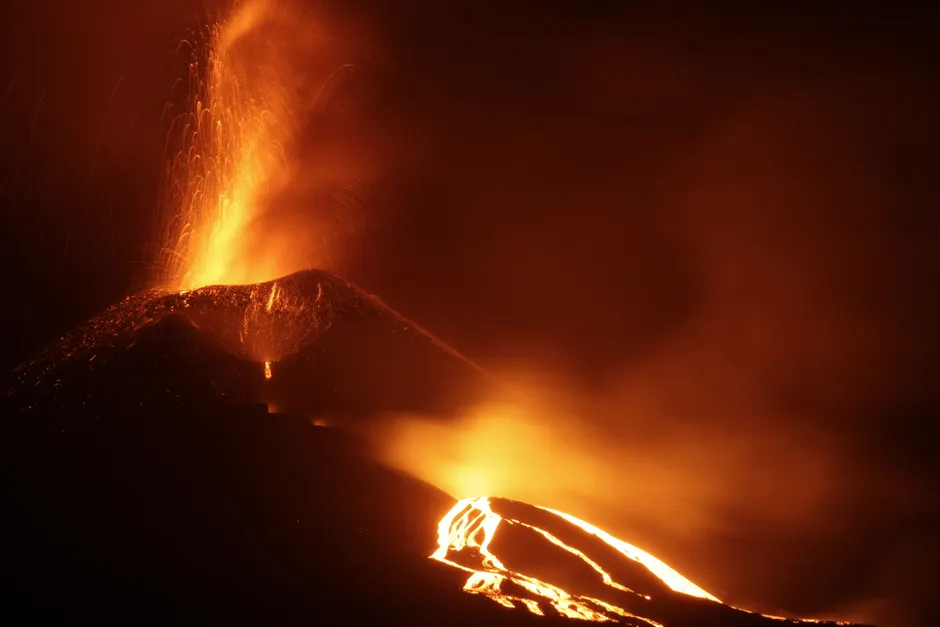
Mount Etna erupted on August 8, 2026, sending a plume of smoke and ash into the atmosphere and forcing the suspension of all arriving flights at Catania international airport in Sicily Al Jazeera. The airport closed the airspace corresponding to the volcanic ash cloud due to the eruptive activity. Arrivals were suspended until 12:00 local time (10:00 GMT), while departures of aircraft already at the airport continued operating normally.
Catania airport services the eastern part of Sicily, one of Italy's most popular tourist destinations. The disruption to arrivals during peak summer travel season adds pressure to an airport that has faced repeated volcanic closures in recent years.
Standing at 3,324 metres, Mount Etna is the tallest active volcano in Europe and has erupted frequently over the past half-million years. A plume of smoke was visible from the summit on a webcam operated by Italy's National Institute of Geophysics and Volcanology (INGV), which continuously monitors the volcano.
The August 8 eruption did not come without warning. INGV's Osservatorio Etneo (INGV-OE) had published a weekly Etna bulletin dated August 4, 2026, reporting eruptive activity at the Voragine (VOR) crater with very sustained Strombolian activity escalating to lava fountaining INGV. INGV-OE publishes weekly multidisciplinary monitoring bulletins for Italy's volcanoes, including Etna and Stromboli, tracking seismic, geochemical, and volcanic parameters.
Tough restrictions and ash advisories have been in place in the Catania area since July 2025 due to increasingly intense Etna eruption activity, leading to demonstrations by guides who take tourists up the mountain. In January 2026, authorities in the city of Catania suspended or restricted excursions to view Etna's lava flows, prompting guides to demonstrate for the first time in front of Mount Etna's lava flow gate. INGV confirmed in January 2026 that while eruptions were ongoing, the lava fronts were cooling and not advancing further.
Catania airport's volcanic disruptions follow a well-established pattern. In May 2023, a Mount Etna eruption halted flights to and from the airport until normal safety conditions could be guaranteed Reuters. In August 2023, another eruption disrupted operations, with flights suspended until the following Tuesday Reuters. On July 5, 2024, simultaneous eruptions at both Etna and Stromboli led the airport to suspend arrivals and departures, with operations due to resume at 13:00 GMT Reuters.
The broader context here is one of escalating volcanic risk management challenges for Sicily's infrastructure and tourism economy. The INGV-OE bulletins document a clear trajectory from sustained Strombolian activity to lava fountaining at the Voragine crater in the days preceding the August 8 eruption, giving civil aviation authorities a window of situational awareness. Yet the operational response at Catania continues to follow a reactive model: suspending arrivals after ash is already in the airspace, rather than preemptively throttling traffic based on crater-level escalation. For an airport that serves as the primary gateway to eastern Sicily, each closure carries cascading effects on tourism revenue, airline scheduling, and passenger confidence during the high season.
The distinction between the August 8 event and earlier disruptions is notable in its scope. Unlike the July 2024 episode, when both arrivals and departures were suspended due to simultaneous eruptions at Etna and Stromboli, today's disruption affected only arrivals, with departures continuing for aircraft already on the ground. That asymmetry suggests the ash cloud's trajectory was concentrated in arrival corridors, allowing partial operational continuity. Whether this reflects improved ash-cloud modeling, favorable wind patterns, or a more targeted closure protocol is not clear from the available information. What is evident is that Etna's eruptive cycle has intensified over the past thirteen months, and the economic friction between safety-driven access restrictions and local livelihoods, including the guide community's protests, remains unresolved.