Roman Shipwreck Loaded with Amphorae Discovered off Sicily
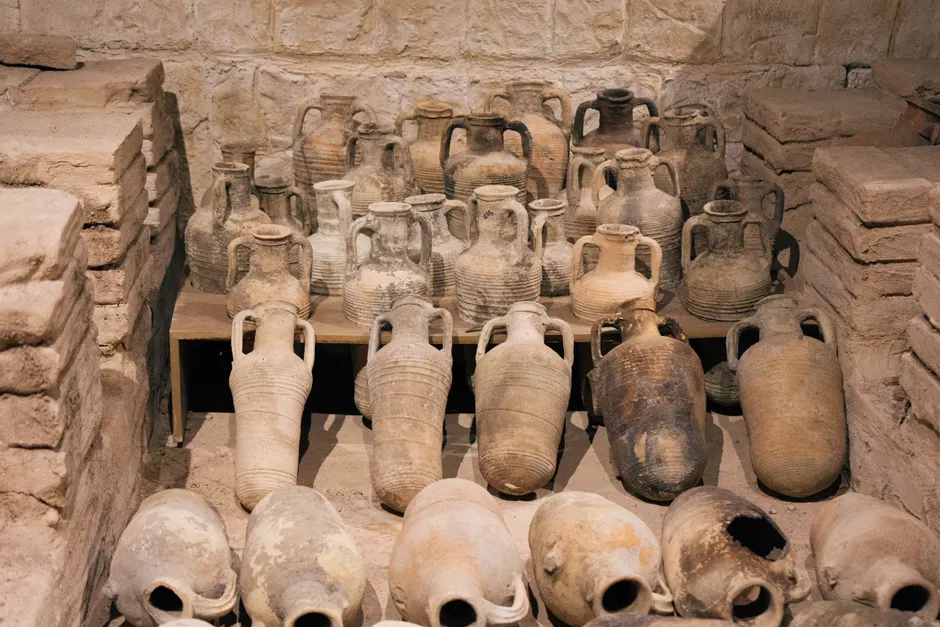
Italian specialist police divers have discovered an ancient Roman shipwreck some 46 metres (150 feet) beneath the Mediterranean off the coast of Sicily, resting on a seabed near Mazara del Vallo. Italy's culture ministry dates the vessel to the 2nd or 1st century BC, placing it at roughly 2,100 years old. The wreck sits piled with hundreds of well-preserved amphorae — ceramic containers used to transport goods such as wine and olive oil across the Roman maritime trade network. (BBC, Asharq Al-Awsat)
Culture Minister Alessandro Giuli called the find "one of the most important underwater archaeological discoveries of recent years." The wreck measures 21 metres (69 feet) in length and 6 metres (20 feet) in width, according to local media reports. (BBC)
The discovery traces back to a tip-off from fishermen. Giacomo De Mola, a fisherman and free-diver, described spotting what appeared to be a large rock on his scanner while surveying the seabed near Mazara del Vallo. He decided to dive and investigate. What he found was a Roman merchant vessel, its cargo largely intact beneath two millennia of sediment and seawater. De Mola described the find as "the most incredible discovery of my life." (BBC)
The location is not incidental. Mazara del Vallo sits on Sicily's western coast, along the narrow channel between the island and North Africa — one of the most heavily trafficked maritime corridors of the ancient Mediterranean. Roman merchant vessels traversed these waters carrying bulk commodities: wine, olive oil, garum, and grain. The volume and condition of the amphorae cargo on this wreck suggest a commercial vessel of considerable capacity, consistent with the large-scale redistributive economy of the late Republic, when Rome's naval infrastructure had largely supplanted earlier Punic and Greek trade networks in the western Mediterranean.
The involvement of Italy's specialist police diving units reflects a broader institutional framework. The Nucleo Subacquei of the Carabinieri and Guardia di Finanza routinely conduct underwater surveys and respond to reports from fishermen and recreational divers, part of Italy's effort to combat the illicit trafficking in antiquities drawn from its dense concentration of submerged archaeological sites. The Channel of Sicily alone has yielded multiple Roman and Punic wrecks in recent decades, making the area one of the richest underwater archaeological zones in the Mediterranean basin.
What sets this find apart, at least at first assessment, is the state of preservation. Amphorae cargoes are frequently found scattered or broken, their contents long dissolved, after centuries of trawling, currents, and bioerosion. A wreck "piled high" with hundreds of containers that remain intact enough to be described as well-preserved offers archaeologists an opportunity to study the vessel's cargo configuration, stowage methods, and possibly the origin of its contents through residue analysis and typological identification of the amphorae themselves. The breadth of the wreck — 21 by 6 metres — suggests a mid-sized Roman merchantman, large enough to carry substantial cargo but small enough to operate in coastal and inter-island trade lanes rather than the deep-water grain routes between Alexandria and Puteoli.
The broader context here matters for understanding why Italy's culture ministry moved quickly to publicise the find and assign it national significance. Italy has invested heavily in underwater cultural heritage protection over the past two decades, and high-profile discoveries serve both scholarly and political purposes: they reinforce Italy's claim to be a primary steward of Mediterranean antiquity and they support the case for expanded protections against bottom trawling and looting in archaeologically sensitive waters.
For the specialist community, the wreck's 2nd or 1st century BC date places it squarely in the transition between the late Republic and early Empire — a period of intensifying commercial integration across the Roman world. The cargo composition, once analysed, could help clarify which trade circuits this vessel operated within: western Sicilian routes connecting to North Africa and southern Iberia, or the more easterly networks linking the Tyrrhenian to the Aegean and the Levant.
The next phase will involve systematic archaeological documentation — photogrammetric survey, sampling, and likely recovery of selected artefacts. Given the depth, operations will require mixed-gas diving or remotely operated vehicles, and the timeline for full documentation will extend well beyond the initial announcement.


