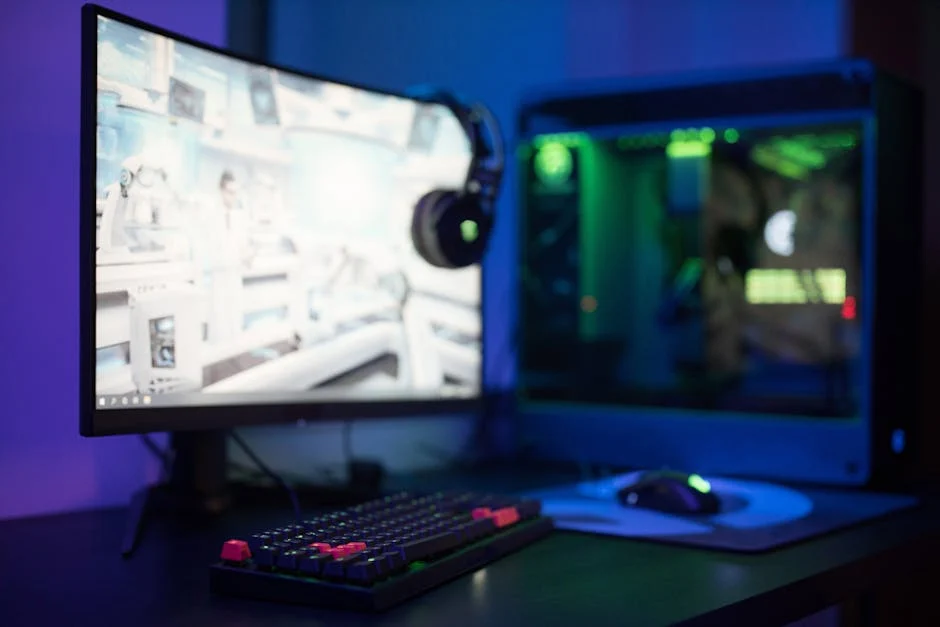
Samsung's New Gaming Monitors Can Refresh Over a Thousand Times Per Second

Samsung unveiled a new lineup of Odyssey gaming monitors at Gamescom 2026, and the headline model is a 27-inch screen the company calls the world's first 1,100Hz gaming monitor (Engadget).
A monitor's refresh rate is how many times per second it redraws its image. A typical screen does this 60 times per second (60Hz). The new Odyssey G6 does it 1,100 times per second, which means motion on screen looks far smoother — an advantage that matters most in competitive fast-paced games like first-person shooters. The G6 hits that 1,100Hz rate at 1080p resolution and has a 1ms response time. That figure is 60Hz higher than a prototype Samsung showed about a year earlier, meaning the technology went from a lab demo to a real product in roughly twelve months (Engadget). Samsung aimed the G6 at FPS players (Samsung Newsroom). It also has a Dual Mode that runs at 600Hz with a sharper image (1440p), trading some speed for more visual detail when you switch from competitive shooters to more visually rich games. The G6 goes on sale globally in the second half of 2026; pricing has not been disclosed (Engadget).
The Odyssey OLED G8 is a 32-inch 4K screen that lets you choose between image sharpness and smoothness. You can run it at 4K and 360Hz, 1440p and 520Hz, or 1080p and 680Hz. Think of it like a car's gear shift: lower resolution gives you more speed, higher resolution gives you more detail. It supports FreeSync Premium Pro and G-Sync, which are technologies that keep the monitor and graphics card in sync to prevent screen tearing, and it uses Samsung's Glare Free anti-reflection coating (Engadget).
The 49-inch Odyssey OLED G9 is a very wide 360Hz screen that Samsung calls a world first at that size. It uses a panel design called QD-OLED Penta Tandem, which stacks five layers of light-emitting material to reach a peak brightness of 1,300 nits. It can also lower its resolution to reach 720Hz (Engadget).
The Odyssey OLED G7 is a 42-inch curved screen with a standard 16:9 shape, which Samsung says is a world first for that combination. It offers 165Hz, a 4K resolution, and a 1000R curve (meaning the screen bends to match a circle with a 1,000-millimeter radius) (Engadget). Samsung positions the G7 as the entry-level model that completes the 2027 Odyssey range.
The pattern across the whole lineup is that every model lets you trade image sharpness for speed, or vice versa. The G6, G8, and G9 all follow this logic. Part of the reason may be practical: the cables that connect monitors to computers (DisplayPort 2.1 and HDMI 2.1) can only carry so much data. Running a 4K image at 1,100Hz would need more bandwidth than those cables can handle today. The switching modes let Samsung claim high refresh-rate numbers at lower resolutions while still offering sharp image options on the same screen.
The broader context here is one we have seen before. The jump from 60Hz to 144Hz, then to 240Hz and beyond, each started with competitive gamers before spreading to everyday users. A 1,100Hz screen at 1080p will not matter to most people, and whether the human eye can benefit from refresh rates beyond roughly 360–480Hz is still debated among engineers and researchers. What the G6 does show is that monitor makers have not hit a ceiling, and that the LCD-based technology used in the G6 (called IPS) continues to improve in ways that seemed unlikely a few years ago.
Pricing for the G6 has not been announced, and that will determine whether 1,100Hz stays a flagship feature or becomes something competitive players can actually afford. Samsung's history suggests the IPS-based G6 could be priced well below the OLED models, but the company has not confirmed that.
For the display industry, the Gamescom 2026 lineup brings together several trends at once: brighter OLED screens, LCD panels reaching four-digit refresh rates, and resolution-switching becoming a standard feature. Each model covers a different price and performance level, and together they suggest monitor makers are competing on flexible performance and panel design rather than fixed specifications.