Flipper One: A Pocket Computer With Two Brains
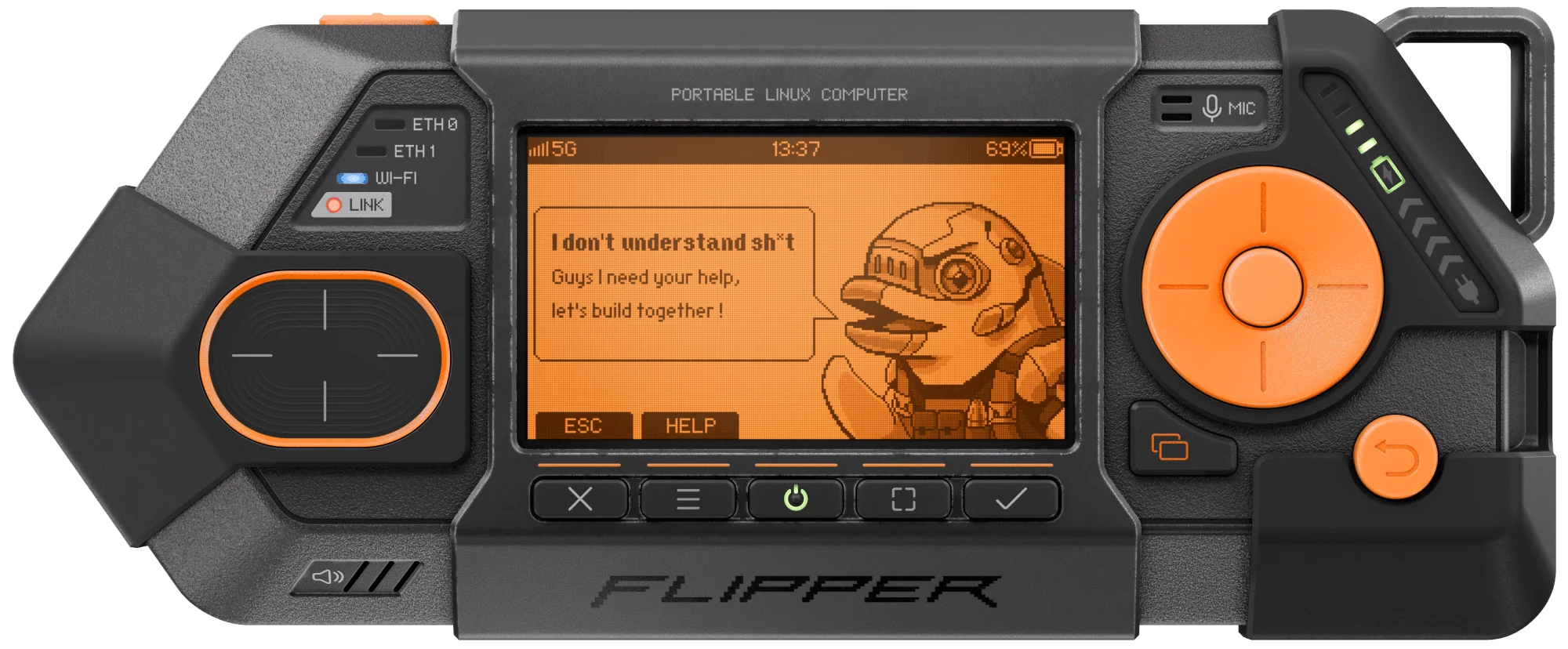
Flipper Devices has published a product page for the Flipper One, a pocket-sized computer that runs Linux, a free and open-source operating system. The product page, dated 3 November 2026, describes open-source software built on the main, shared version of Linux. The company's blog points readers to the page at r.flipper.net/one.
The most unusual part of the design is that it has two chips, and each one looks after different jobs.
The main chip is a Rockchip RK3576. It has eight processing cores and runs Linux. It also includes an NPU, a section built to speed up AI tasks, and a GPU, which handles graphics. The GPU sends images to a screen over HDMI and DisplayPort, the standard video connectors.
The second chip is a Raspberry Pi RP2350, which is a microcontroller. A microcontroller is a simpler chip built for a small set of fixed jobs. Here it runs the LCD screen, the physical buttons and the status lights. It also manages power. When Linux is switched off, it controls the settings used when Linux starts up.
Think of it as a doorman who stays awake all night while the rest of the building sleeps. The front panel and power controls keep working even when the main system is off.
Flipper says it worked with Collabora, a software company, to add support for the RK3576 to the mainline kernel. The kernel is the core of an operating system, the part that talks to the hardware. Mainline support means the code needed to run the chip is kept in the shared Linux project. It is not kept in a separate copy maintained only by the chip maker. Anyone who has had to keep custom chip code working through each new Linux release will recognize why that matters.
Connectivity runs through a single USB cable. That one port handles remote login, charging and data. A connected computer sees the device as a network adapter, a serial port and a storage drive at the same time.
Expansion happens through M.2 Key-B slots, small sockets for add-in cards of the kind found inside laptops. They come in sizes 2230 (with an extender), 2242, 3042 and 3052. The page lists compatible modules, including cellular or satellite modems, software-defined radio (SDR) receivers, AI accelerators, solid-state drives, and Wi-Fi cards that fit through adapters. Anyone planning to fit a module should check the Flipper documentation first, since Key-B slots are wired differently from Key-M slots.
Flipper's co-founder and CEO is Pavel Zhovner. In May 2026, The Verge described the Flipper One as a pocket-sized Linux computer. It reported that the company planned a Kickstarter campaign for the device, at a planned price of around $350. Kickstarter is a crowdfunding site where buyers pay before a product is made.
The company has crowdfunded before. The original Flipper Zero raised roughly $4.6 million on Kickstarter in 2022, according to The Verge's coverage of that campaign. TechCrunch reported in 2023 that Flipper had sold almost $5 million worth of products as Kickstarter preorders.
The broader context here is a change in what a handheld device can do. A pocket unit with a Linux main chip, an AI section, several radio options and a separate chip that runs the screen and power is closer to a portable work tool than to a single-purpose gadget. Developers will want to know how well the Linux support holds up over time, and how the two chips work together in practice.
In my view, the real test of the Flipper One will come from the add-ons people build for it. A device like this becomes useful when others make parts its maker never imagined. An open kernel, a documented USB connection and a standard M.2 slot give those builders the openings they need. Whether that community forms will shape how far the device reaches beyond its launch specifications.