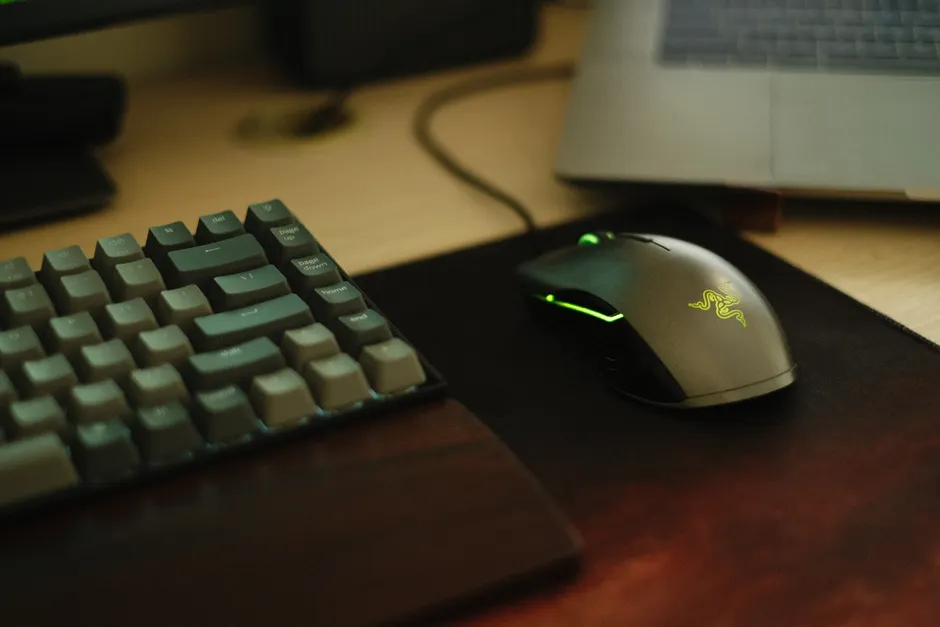
Corsair's New Budget Gaming Keyboard and Mouse: What You Get for $60–$70

Corsair has launched three new gaming peripherals: the Skiff 100 and Skiff 100 Plus keyboards and the Harpoon v2 wireless gaming mouse. Announced August 5, 2026, the keyboards come with a turning dial for adjusting volume and skipping tracks, and they work across multiple devices without extra software. The Harpoon mouse gets an updated sensor and a reshaped design Engadget.
The Skiff 100 and Skiff 100 Plus share several features: quiet keys, colorful lighting spread across ten zones, and a rubber-surfaced wrist rest that detaches. Both keyboards include a rotary dial for quick volume and track control, something more commonly found on keyboards designed for office work than for gaming. Corsair lists the Skiff 100 at $60 and the Skiff 100 Plus at $70. The extra $10 buys six programmable buttons on the Plus model that can be set up to run in-game commands or macros (shortcuts that trigger a sequence of actions with one press), bringing it closer to what pricier boards offer Corsair.
A notable design choice is that neither keyboard requires any software. Both work with PC, Mac, Xbox, and PlayStation straight out of the box. That is unusual for gaming peripherals, which typically ask you to install the manufacturer's app to set up lighting and custom buttons. The Skiff 100 Plus presumably stores its custom button settings on the keyboard itself rather than through an app, though Corsair has not explained exactly how that works without software.
The Harpoon v2 wireless mouse is an update to Corsair's entry-level wireless gaming mouse. It includes a high-precision sensor, six customizable buttons, and a shape designed to fit the hand more naturally. Battery life is rated at up to 140 hours per charge. Like the keyboards, it needs no software installation and works with PC and Mac. It costs $70, the same as the Skiff 100 Plus Corsair.
The keyboards use membrane keys, which use a rubber dome under each key instead of an individual mechanical switch. Membrane keys are quieter and cheaper to make but do not offer the tactile click that many keyboard enthusiasts prefer. The lighting setup splits the keyboard into ten separately lit zones, a middle ground between basic single-color lighting and the fully individual, per-key lighting found on premium boards.
The rotary dial is the most interesting inclusion. Putting a volume and track-control dial on a $60 keyboard brings a feature usually reserved for more expensive boards down to a lower price. For people who use their computer for both gaming and watching videos or listening to music, having a physical dial right on the keyboard means fewer trips to the screen or a separate device to adjust sound. Whether the dial can be customized beyond volume and track controls is not stated in the product information.
The wide platform support on the keyboards is worth noting. Not every console game supports keyboard input, but being able to move one keyboard between a PC and a console without reinstalling software is genuinely convenient for people who game on multiple devices. There is a slight gap in the lineup, though: the keyboards support consoles, but the Harpoon v2 mouse works only with PC and Mac.
Taken together, the three products fill out Corsair's lower-priced tier with a focus on simplicity. The Skiff 100, Skiff 100 Plus, and Harpoon v2 wireless mouse are all available now through Corsair's direct channels.