A Solar Eclipse, a Meteor Shower, and a Planet Parade — All in One Weekend
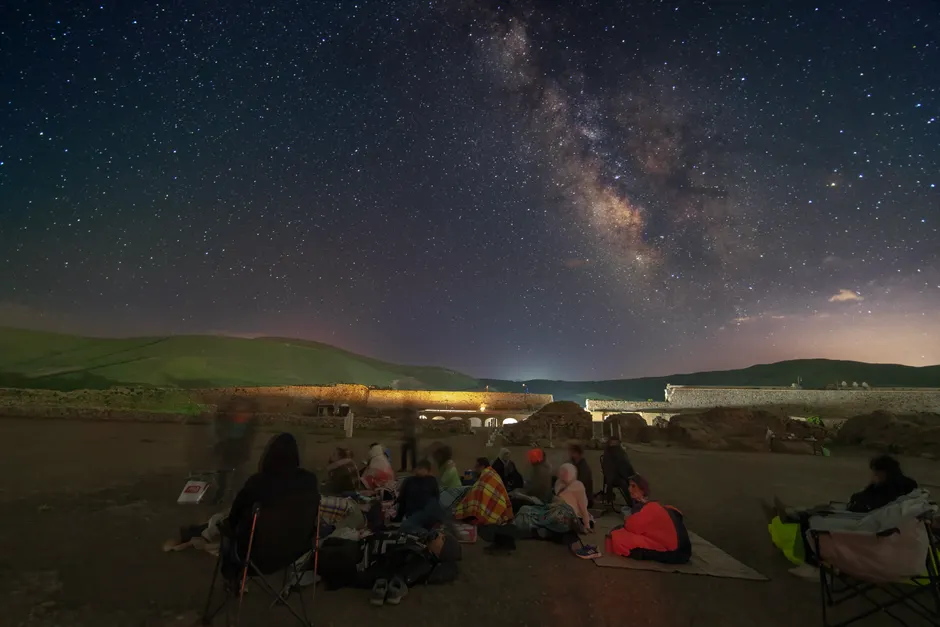
On the night of August 12 and into the morning of August 13, 2026, three things will happen in the sky at almost the same time: a meteor shower will reach its peak, the moon will completely block out the sun for some parts of the world, and six planets will line up in the night sky. Each of these events is special on its own. Having all three happen within about 48 hours is what makes this rare.
The Meteor Shower
A meteor shower happens when Earth passes through a trail of dust and tiny rocks left behind by a comet. As those bits hit our atmosphere at high speed, they burn up and create bright streaks of light across the sky. The Perseid meteor shower comes from a comet called Swift-Tuttle, which orbits the sun once every 133 years. It last came close to the sun in 1992 and will not return until 2125. Earth passes through its debris trail every year from July 17 to August 24, with the most activity in mid-August.
The predicted peak falls at 14:53 UTC on August 13, according to EarthSky. The best time to watch is between midnight and dawn. Under ideal dark-sky conditions, NASA estimates 50 to 100 meteors per hour may be visible, as The Guardian reports. The American Meteor Society offers a more conservative projection of 30 to 50 per hour from rural US locations, while the Planetary Society places the expected rate at 50 to 75 per hour at peak.
A big reason 2026 will be a great year for watching the Perseids is the moon. During the peak, the moon will be in its new moon phase, meaning the side of the moon facing Earth is not lit up by the sun. With no bright moonlight in the sky, fainter meteors that would normally be hidden remain visible. Moonlight has washed out some of the show in recent years, so the 2026 conditions are especially good.
NASA describes the Perseids as the best meteor shower of the year. People have been watching this shower for more than 2,000 years, making it one of the oldest recorded astronomical events.
The Solar Eclipse
Also on August 12, 2026, a total solar eclipse will take place. A solar eclipse happens when the moon moves between Earth and the sun and blocks the sun's light. In a total solar eclipse, the sun is fully covered for people standing in a specific path on Earth's surface.
The path where the sun is fully blocked crosses Greenland, Iceland, northern Russia, the Atlantic Ocean, Spain, and a small area of Portugal, as NASA has confirmed. A partial eclipse, where only part of the sun is covered, will be visible across broader parts of the Northern Hemisphere.
NASA has announced it will provide coverage of the event and has indicated that some of the best views will come from an altitude of 50,000 feet, where there is less atmosphere in the way and the eclipse's shadow can be studied more clearly.
The Planet Parade
The third event is a six-planet parade, where multiple planets appear lined up in the night sky at the same time. While planets lining up is not extremely rare, seeing six at once is uncommon enough to get attention alongside the eclipse and the meteor shower.
Why These Events Happen Together
The broader context here is that these three events are each driven by different cycles, and their overlap is a coincidence. Meteor showers happen every year as Earth follows its orbit around the sun. Solar eclipses follow their own repeating pattern based on the movement of the sun, moon, and Earth. Planetary alignments depend on how long each planet takes to orbit the sun. All three falling within the same 48-hour window in 2026 is simply a case of these independent cycles arriving at the same point at the same time.
There is one connection worth knowing: the new moon that makes meteor watching so good is also the reason the solar eclipse can happen. Eclipses can only occur during a new moon, because that is when the moon sits between Earth and the sun and its shadow can reach us.
How to Plan Your Viewing
The eclipse on August 12 happens during daylight, especially for people in or near the path across Greenland, Iceland, and Spain. The meteor shower peak follows that night into the early morning hours of August 13. The planet parade stretches across both time periods, though how well you can see it depends on your local horizon and which planets are involved.
If you are planning to go out and watch, there are a few practical things to keep in mind. The best spots for both the eclipse and the meteor shower overlap in the North Atlantic region, but weather in Greenland and Iceland in August can be unpredictable. Spain is a more reliable choice for eclipse viewing. The meteor shower is visible across the Northern Hemisphere wherever the sky is clear and far from city lights. The 50,000-foot viewing platform NASA mentioned likely involves specialized research aircraft, not something the public can book.
Having a total solar eclipse, a meteor shower peak under new moon conditions, and a six-planet parade all within 48 hours is uncommon, though not entirely without precedent in history. What sets August 2026 apart is how good the meteor shower viewing will be: a dark sky with no moonlight, a shower known as one of the year's best, and rates that could reach 50 to 100 meteors per hour under the right conditions. For anyone along the eclipse path, the weekend offers a daylight-to-darkness sky show that few years can match.


