NVIDIA Brings AI Models to Your Desktop and Workstation

NVIDIA Brings AI Models to Your Desktop and Workstation
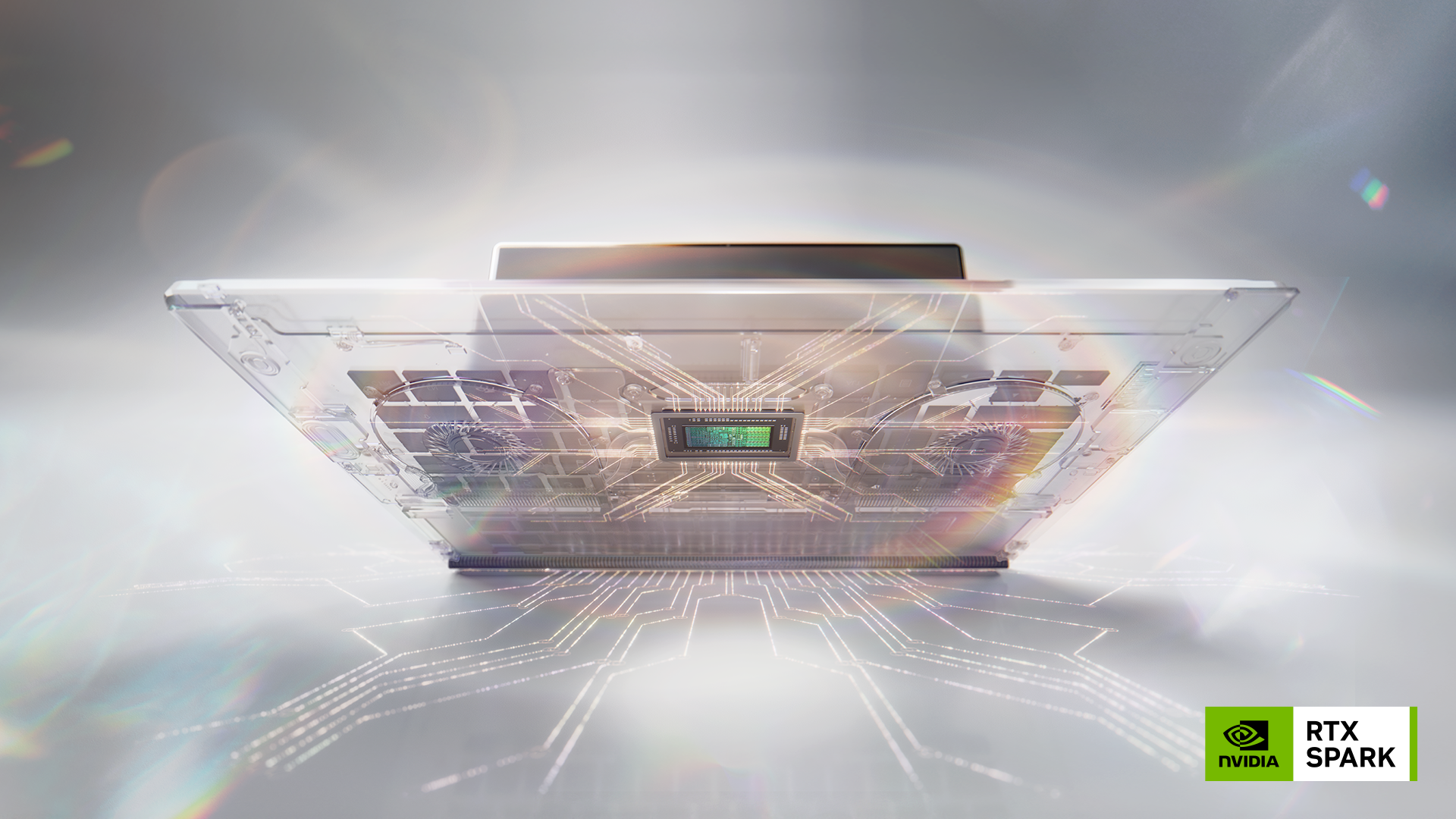
NVIDIA has announced two new products designed to let people run advanced AI models directly on their computers, rather than sending all work to distant data centers. The first is the RTX Spark, a chip co-developed with Microsoft for the next generation of Windows laptops and desktops. The second is the DGX Station for Windows, a high-end workstation that can run some of the largest AI models available, right on your desk.
Both products were shown at Computex in Taiwan. They represent NVIDIA's effort to extend its dominance in data-center AI chips — the company is currently the world's most valuable by market capitalization, largely because of its AI chip lead — down to personal computers and smaller office systems.
RTX Spark: One Chip for Your AI Assistant
The RTX Spark is a single chip that combines a processor (CPU) and graphics processor (GPU) in one package, designed for Windows laptops and desktops. NVIDIA and Microsoft announced that the chip can perform 1 petaflop of AI calculations — one quadrillion basic math operations per second. It also includes up to 128 GB of unified memory, a shared pool of memory that both the CPU and GPU can access together without the speed delays that normally come from shuttling data between separate computer components.
New laptops and desktops with RTX Spark will arrive in fall 2026 from manufacturers like Dell and Microsoft.
What does a petaflop really mean. At the precision level used for most inference work, that's roughly enough raw power to smoothly run AI models with 7 billion to 13 billion parameters — think of parameters as the fundamental building blocks of how an AI model thinks. With further compression tricks, it can stretch into the 30 billion to 70 billion range. The 128 GB memory limit is the more important constraint: it determines how large a model can fit on your machine without spilling onto the slower storage of your hard drive.
NVIDIA is positioning RTX Spark as the engine for personal AI agents — persistent software assistants that stay aware of your files, emails, and calendar without having to send everything to the cloud. That makes sense because cloud services charge per request and add delays; if an AI agent is checking your calendar and emails constantly in the background, it is far cheaper and faster to keep that running locally.
DGX Station for Windows: Industrial-Strength AI on Your Desk
The DGX Station for Windows is a different beast altogether. Built on NVIDIA's advanced Grace Blackwell hardware — cutting-edge processor technology combining CPUs and GPUs — it can run AI models up to one trillion parameters locally. To put that in perspective, that is the same scale of model that most companies currently run only on large, expensive clusters of multiple machines in a data center.
Grace Blackwell works by connecting NVIDIA's GPUs with Arm-based CPUs using a very fast internal connection called NVLink. This link moves data so quickly that the GPU and CPU memory act as one unified pool, rather than forcing the system to break up the model across separate memory spaces — a trick that makes trillion-parameter models practical in a single desktop-sized machine.
For companies running their own specialized or proprietary AI models — especially when cloud delays, data privacy concerns, or the per-query costs of cloud APIs make remote inference impractical — the DGX Station for Windows offers a path that did not exist before at this capability level.
One practical detail: earlier DGX Station versions ran Linux, an operating system common in data centers but different from Windows. This new version uses Windows natively, which means it fits directly into how most offices manage computers through Active Directory and existing Windows management tools. That removes a significant headache for IT departments.
Why This Shift Is Happening Now
This compression of computing power from data centers to desktops is not new; we have seen it happen repeatedly over the past two decades. In the early 2000s, computer graphics rendering farms — which required expensive specialized machines — became possible on ordinary workstations within a decade, then on laptop GPUs years later. Gene sequencing, physics simulation, and the machine learning training that took weeks on specialized clusters in 2018 can now run on ordinary hardware. Each cycle has moved faster than the last.
Large AI model inference is following the same pattern. NVIDIA is not creating this shift; it is building products to serve a transition already underway. Breakthroughs in model compression — quantization (storing numbers with less precision), sparse attention (ignoring irrelevant data), and speculative decoding (predicting answers faster) — have reduced how much computing power and memory models actually need. Those improvements are happening faster than most experts predicted even three years ago.
What This Means for Organizations
The two products fill different niches. RTX Spark is aimed at individual developers and power users who want personal AI assistants baked into their work — tools that can scan your local files and emails without sending information to the cloud. The 128 GB memory and petaflop rating can handle most production-grade open AI models up to around 70 billion parameters at practical speeds.
DGX Station for Windows is for organizations that need to run the largest models — models with 100 billion parameters or more, including new designs that only activate parts of their parameters at a time to run more efficiently — without paying for expensive cloud services or maintaining a dedicated server room on-premises. It is also practical for fine-tuning and customizing smaller models, not just running pre-built ones.
There is an important detail worth noting: at the time these were announced, NVIDIA had not yet published pricing or detailed information about power consumption and cooling needs. For the DGX Station, this matters quite a bit. Advanced chips like Grace Blackwell draw several kilowatts of power in data center configurations, and whether the desk-side version requires special cooling or uses less power at lower performance is a genuine question that will determine whether companies can actually put one next to their employees' desks.
Where This Goes
RTX Spark-based laptops will arrive in late 2026, giving software makers about a quarter-year to write applications that take full advantage of the unified memory design. Microsoft, which helped design RTX Spark, will likely optimize its AI assistant software for it, but whether smaller software companies using standard tools like ONNX Runtime or llama.cpp can unlock the full memory potential remains to be tested once real hardware ships.
The broader direction is clear: AI inference is spreading out from cloud data centers toward a mixed approach where local machines handle work that is time-sensitive, privacy-sensitive, or expensive to run remotely, while the cloud handles occasional surge capacity and the largest training operations. NVIDIA is placing its chips everywhere that matters in this shift — and given its current dominance, it is better positioned than any other company to shape how this transition actually plays out.