Record Rainfall Triggers Historic Evacuation in Japan's Chiba Prefecture

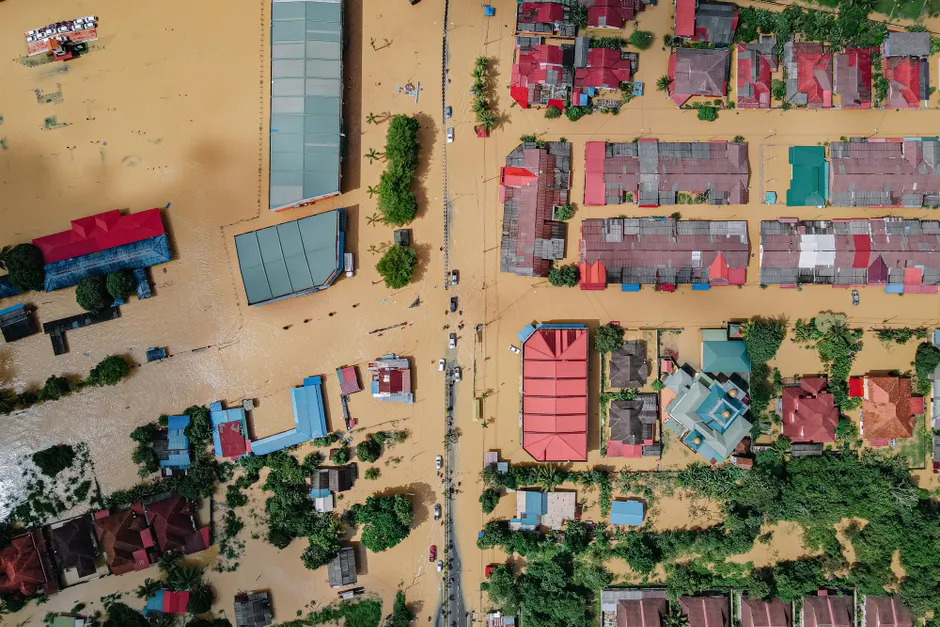
At least four people died in eastern Japan after unprecedented heavy rain struck Chiba prefecture, east of Tokyo, on the night of August 13, 2026. The Japan Meteorological Agency (JMA) issued its highest-level warning for the first time in the prefecture's history, and more than 400,000 residents were ordered to evacuate across Chiba and surrounding areas.
The rain fell at a rate of 115mm per hour — roughly the amount Chiba normally receives in the entire month of August. It was the first time the JMA deployed a Level 5 warning, the top tier on Japan's five-stage disaster alert scale, for heavy rains and landslides in Chiba (The Guardian). Chiba governor Toshihito Kumagai described the situation as "extremely unusual."
Chiba had already activated its disaster response framework before the crisis peaked. The prefecture issued a Level 4 evacuation order at 18:40 on August 13, covering 2,931 households comprising 6,446 people, with an additional 2,419 households included in the directive (Chiba Prefecture Disaster Information). The first meeting of the prefectural disaster countermeasures headquarters convened that evening, reviewing damage assessments and earlier evacuation orders issued at 17:10 and 18:40. The Disaster Relief Act — a Japanese law that unlocks national government resources for emergency response — was subsequently applied to Chiba.
The human toll was concentrated among those caught in vehicles. A 66-year-old woman was killed when her car became trapped in flood waters in Sakura City. Two other people died after being unable to escape from their cars during the flooding. The body of a man believed to be in his 60s or 70s was found floating on a flooded road in Ichikawa City (The Guardian). Soldiers were dispatched to the area to assist with relief operations.
The flooding also disrupted critical transport infrastructure. Nearly 7,000 people were stranded at Tokyo's Narita Airport, with approximately that many passengers spending the night there. Many South Korean travelers were among those stranded (Asia Economy). About 45,000 homes across Chiba lost power. NHK footage captured water erupting from what appeared to be a maintenance hole in Chiba's central ward, reaching a height exceeding that of a nearby five-storey building. A further 1,700 people sought shelter at the Chiba prefectural government building.
Chiba's disaster-preparedness framework had undergone a significant operational shift earlier in 2026. Starting May 29, the prefecture's disaster-prevention meteorological information — covering river flooding, heavy rain, sediment disasters, and storm surge — has been announced in alignment with the five-level warning system, following a major revision in how meteorological warnings are structured (Chiba Prefecture). That revision meant that Thursday's Level 5 alert carried a streamlined, pre-established pathway from JMA observation to prefectural evacuation order.
By Friday, August 14, rain had eased, but authorities continued to warn of flooding dangers. Kazuhito Shimamoto of Japan's ministry of land, infrastructure, transport and tourism urged residents to protect their lives and check evacuation advisories. The JMA also reported that it had scrutinized and corrected precipitation observation data for August 11, 2026, suggesting the rainfall event may have been preceded by anomalous readings that required post-hoc verification.
Meteorologists in Japan attribute the increasing frequency and intensity of extreme weather events to climate breakdown, a pattern that places mounting pressure on Japan's multi-layered early-warning architecture. Chiba, situated on the Boso Peninsula east of Tokyo Bay, has limited natural drainage in its low-lying urban corridors, and the 115mm-per-hour intensity overwhelmed both surface infrastructure and subsurface systems — as the dramatic maintenance-hole geysers in the central ward made viscerally apparent.
The broader context here is one of accelerating strain on Japan's disaster management systems. The Disaster Relief Act's application in Chiba signals that the event exceeded local response capacity, requiring national-level mobilization. The deployment of military personnel for relief further indicates the scale of need. For a prefecture that revised its warning-to-evacuation pipeline just months earlier, the speed at which a Level 5 alert was issued — and the fact that fatalities still occurred — will likely prompt scrutiny of whether the new five-level framework translates into measurably faster protective action by residents, or whether the gap between institutional alerting and individual behavior remains the binding constraint in sudden-onset flooding scenarios. The fact that three of the four confirmed deaths involved vehicles trapped in flood waters raises a particular concern: evacuation protocols designed primarily for stationary populations have only partially addressed the vulnerability of drivers during sudden-onset urban flooding.