Federal Charges Filed in World War II Memorial Vandalism Case
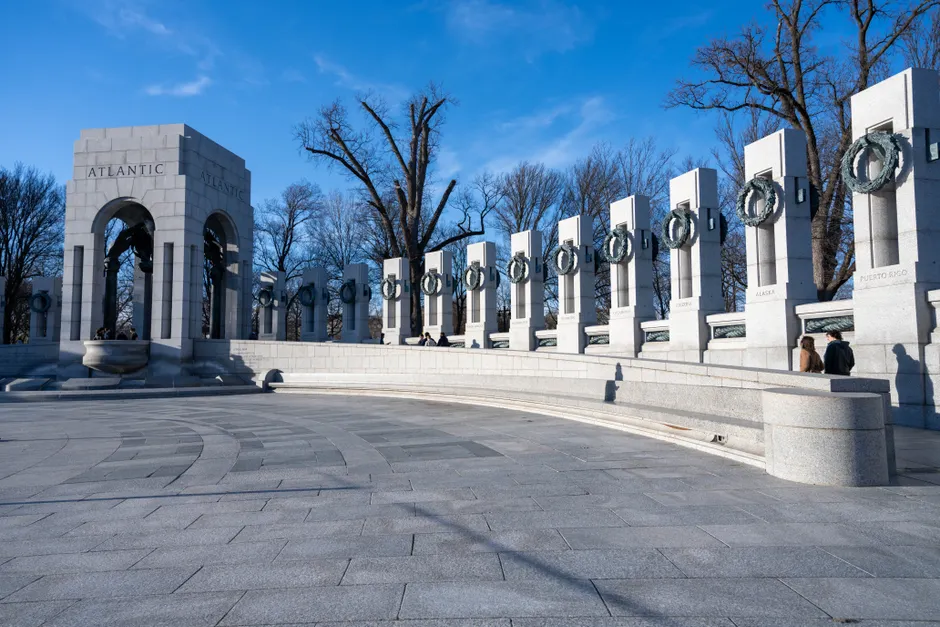
A woman was arrested Friday morning in connection with the vandalism of the World War II Memorial on the National Mall in Washington, DC, and charged with two federal felony counts that carry penalties of up to ten years in prison. The Guardian
Jeanine Pirro, the US attorney for the District of Columbia, announced the arrest and the federal charges. The suspect, identified as Melissa L Farris, faces one count of Depredation Against Property of the United States and one count of Destruction of Veterans' Memorials. Both are federal felonies. The Guardian
The vandalism occurred on Thursday, when red graffiti reading "Clean hands dirty $" was scrawled across the memorial and soapy bubbles filled the memorial fountain. The combination of painted messaging and fountain pollution triggered a multi-agency response involving US Park Police, which led the investigation, and the US Interior Department, which said the person responsible would be found. The Guardian
Pirro noted a personal dimension in her announcement, stating that her father and grandfather were among the Americans honored by the World War II Memorial. Her framing positioned the prosecution not only as a law-enforcement action but as a defense of a site with deep familial and national significance. The Guardian
The reaction from veterans' organizations and memorial stewards was swift. The Veterans of Foreign Wars called the vandalism "an act of profound disrespect." The nonprofit Friends of the National World War II Memorial said the memorial should not be used for political expression, pushing back against any reading of the act as protected protest. The Guardian
The graffiti itself, "Clean hands dirty $," could be read as a protest message about money and moral compromise, though the facts available do not establish the suspect's motive. What is clear is the legal framework being applied. Destruction of Veterans' Memorials is a specific federal statute, meaning a law passed by Congress, designed to impose stiffer penalties for defacing monuments dedicated to military service members. Its use here signals federal prosecutors' intent to treat the incident as more than routine property damage.
The broader context involves the legal architecture protecting federal monuments on the National Mall. The National Mall is administered by the National Park Service, a bureau of the Interior Department, which means acts of vandalism there fall under federal rather than local jurisdiction. Think of it this way: just as a crime committed on a military base is handled by military authorities, a crime on Park Service land in the capital is handled through the federal system. US Park Police, the oldest federal law enforcement agency in the country, functions as the primary investigative body for crimes committed on Park Service land in the capital. The involvement of the US Attorney's Office for DC rather than the DC Metropolitan Police confirms that prosecutorial authority runs through the federal system.
Federal prosecution of memorial vandalism carries distinct implications. Local property crime charges in the District are typically handled by the DC Office of the Attorney General or the federal US Attorney's Office, depending on the classification. The decision to charge under federal depredation and veterans' memorial destruction statutes, rather than seeking lesser District-level charges, carries the potential for substantially longer sentences and places the case within a prosecutorial posture that treats monuments as protected federal assets. With penalties of up to ten years per count, the charging decisions themselves communicate how seriously the government is treating the incident.
What remains unknown from the available facts is whether additional defendants or charges are anticipated, and whether the suspect's legal team will contest the charges or mount a First Amendment defense. The tension between the Friends of the National World War II Memorial's position that the site should not host political expression and any potential free-speech argument from the defense is the fault line most likely to define the case as it moves through the courts.


