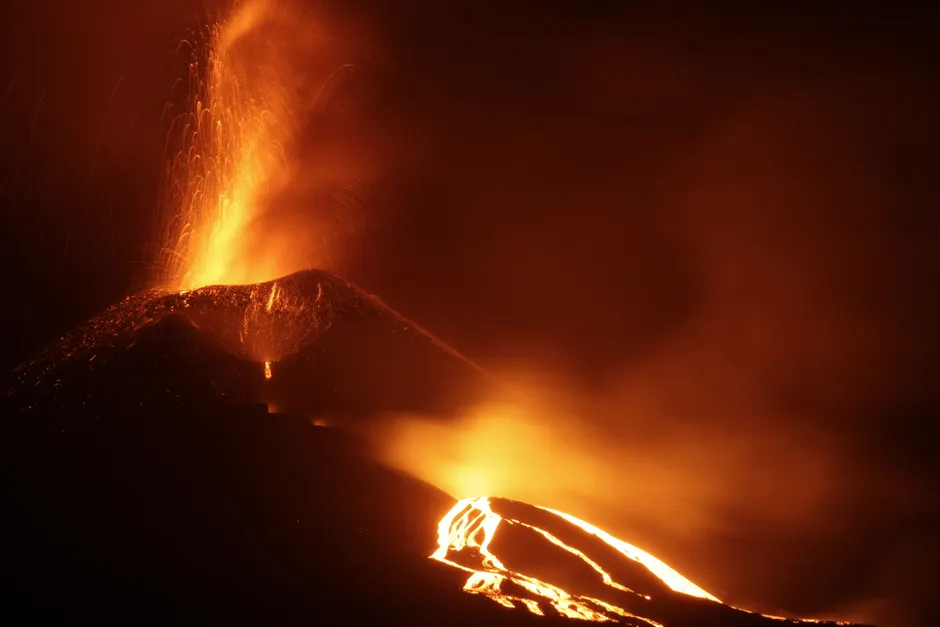
American Hiker Dies in Lightning Strike on Mount Etna's Closed Summit Zone

A 30-year-old American man died after being struck by lightning while hiking Mount Etna on August 17, 2026. He was in a restricted area of the volcano that had been closed to the public due to ongoing eruptive activity (Sky TG24).
The rescue alarm was first raised on the evening of August 16, 2026, according to Il Sole 24 Ore. The man had been climbing toward the summit crater area — the highest and most hazardous part of the volcano — when the lightning strike occurred. The zone he entered was closed because the volcano was actively erupting at the time (Sky TG24).
Mount Etna, Europe's most active stratovolcano (a steep-sided volcano built from alternating layers of lava and ash), sits on the eastern coast of Sicily. It rises over 3,300 metres, and its upper slopes are routinely closed to visitors during eruptive phases. Two Italian agencies — the Civil Protection Department and the INGV (Istituto Nazionale di Geofisica e Vulcanologia, Italy's national institute for geophysics and volcanology) — monitor the volcano and decide when summit-area closures are needed.
These restrictions carry the force of law. Entering a closed zone violates public safety ordinances, and hikers who do so expose themselves not only to volcanic hazards like lava flows and toxic gases but to rapidly changing alpine weather. Thunderstorms can sweep the upper mountain with little warning, and a hiker caught above the treeline on an exposed ridge has few options for safe shelter.
The specific weather conditions that produced the fatal lightning strike on August 16–17 have not been detailed in the available reporting. What is clear is that the man was in a prohibited area when the strike happened, meaning he had bypassed or ignored the closure in place due to the eruption. Whether he was hiking alone or with a group is not specified in the verified sources, and the precise circumstances of the rescue response have not been reported beyond the initial alarm.
The broader context here involves the recurring tension between volcano tourism and access management on Etna. The volcano draws tens of thousands of hikers and guided-tour participants annually, and its accessibility is part of its appeal. During active phases, the contrast between the well-regulated lower slopes (where guided excursions continue under controlled conditions) and the forbidden upper zones becomes starker. Enforcement of summit closures relies on signage, physical barriers, and patrols by the Corpo Forestale (Italy's forestry corps) and the Guardia Finanza. But the volcano's sheer size and the number of approach routes make comprehensive coverage difficult. Hikers determined to reach summit craters during eruptions have periodically done so, sometimes with fatal consequences from gas exposure, unstable lava fields, or, as in this case, a weather hazard compounding the volcanic risk.
Lightning fatalities on Etna are not routine, but the conditions that produce them are not unusual either. Thunderstorms frequently form over the volcano's summit, particularly in late summer when convective activity — the upward movement of warm, moist air that builds storms — intensifies. The restricted-zone closure, while primarily motivated by eruptive hazards, also functions as an indirect safeguard against these weather risks.
No information has been released in the verified sources regarding the man's identity, the composition of his hiking party, or the specific rescue operations mounted. The investigation into the circumstances of his presence in the closed zone would fall to Italian authorities with jurisdiction over the protected area.
The death illustrates a regulatory challenge that Italian authorities have faced repeatedly on Etna: the gap between formal closure and physical enforcement on a large, porous volcanic massif. The ordinances are clear, but compliance depends on individual decisions that are difficult to prevent in real time.