Death By Audio and Rainger FX Build a Real Amplifier Into a Guitar Pedal
Death By Audio and Rainger FX have released the Amp Crash, a 3-watt guitar amplifier built into a standard guitar-pedal enclosure with a built-in 2-inch speaker. The product uses an original analog amplifier circuit, not a digital emulation of a classic amp like a Fender or Marshall (The Verge).
That distinction is worth unpacking. Most modern amp-in-a-pedal products rely on DSP, or digital signal processing, to recreate the sound of vintage amplifiers mathematically. The Amp Crash instead produces its tone through a physical amplifier circuit driving an actual speaker cone. The 2-inch speaker keeps the enclosure small enough to fit on a pedalboard, and the unit also has an output for connecting a larger external speaker cabinet when more volume is needed (The Verge).
A built-in microphone captures the sound coming from the Amp Crash's own speaker and can route that signal into a digital audio workstation, or DAW, or feed it into a second amplifier. This turns the pedal into a capture-and-re-amp device: the particular sound of that small speaker, including its limited frequency range and the way it distorts at higher volumes, becomes a recordable signal or a link in a longer effects chain rather than just a standalone endpoint (The Verge).
The Amp Crash also includes a small effects module offering reverb, echo, and chorus. These effects are digital and deliberately lo-fi, controlled by just two knobs: depth and time. Pairing an analog amplifier section with a low-resolution digital effects block fits the design philosophy both companies have pursued in prior products (The Verge).
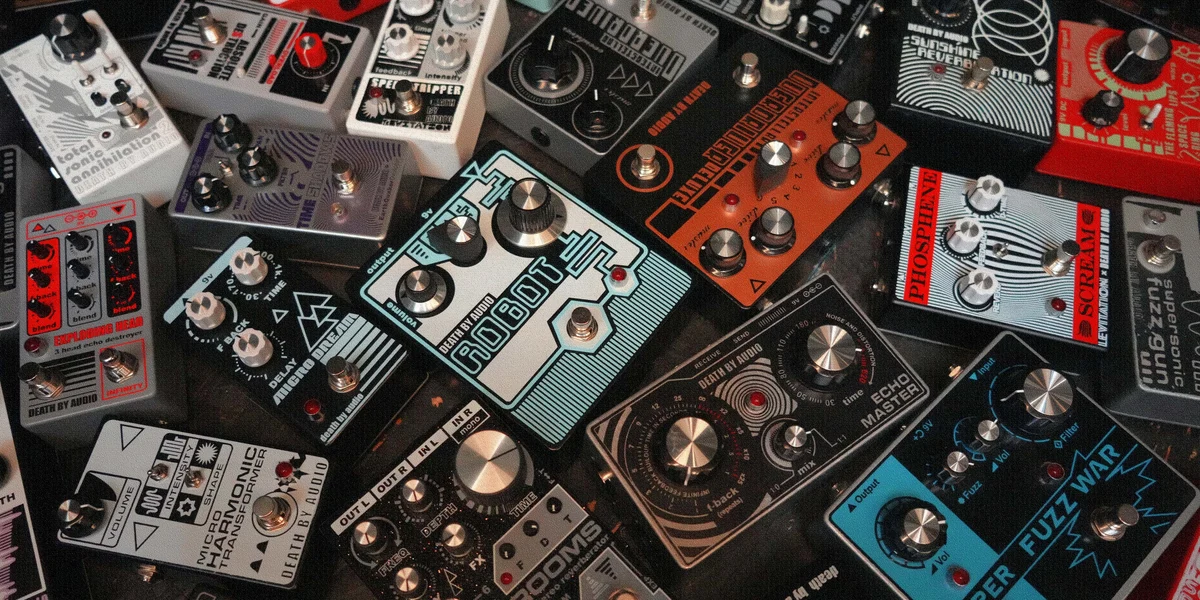
Death By Audio is the creation of Oliver Ackermann, guitarist in the noise-rock band A Place to Bury Strangers. The company hand-builds its effects pedals in New York City, and its catalog includes the Fuzz War, Bass War, Echo Master, Crossover Fuzz, Disturbance, Rooms, and Space Bender (Death By Audio). DBA also produces the Reverberation Machine, a synthetic atmosphere generator that simulates spring reverb units and can produce a blooming distorted reverb at higher settings (Death By Audio). The company's accessory lineup extends to the Raw Power power supply, a Photo Modulator pedal that controls expression parameters via light, a Mic Stand Clip Backplate for mounting vocal pedals to a microphone stand, glow-in-the-dark guitar picks, and cables from TourGear Designs (Death By Audio).
Rainger FX, the London-based builder partnering on the Amp Crash, released the Break Box Distortion pedal in November 2022. That pedal featured active sustaining chorus and vinyl scratch effects (GuitarPedalX).
The collaboration between these two builders is notable for what it leaves out. There is no app, no Bluetooth, no firmware updates, no impulse-response library (pre-recorded speaker profiles used to simulate specific cabinets), and no USB interface for loading third-party cabinet simulations. The signal chain is straightforward: analog amplification into a physical speaker, with a lo-fi digital effects layer and a microphone output for capturing the result. In a product category where competitors increasingly ship with companion mobile apps and cloud-connected preset sharing, the Amp Crash is an exercise in constraint.
The built-in microphone routing is the design decision that lifts the product above novelty practice-amp territory. By making the speaker's own sound available as a line-level signal, the Amp Crash functions as a character generator within a larger signal chain. A producer can record the 2-inch speaker's compressed, bandwidth-limited output directly into a DAW, then layer it beneath a full-range cabinet recording. A guitarist can feed it into a larger amp's front end, using the Amp Crash as a preamp and tone-shaping stage with its own distinctive, non-modelled coloration.
The lo-fi effects block reinforces this character-first approach. With only depth and time controls across reverb, echo, and chorus modes, the effects are designed to degrade and color the signal rather than provide transparent, studio-grade processing. The combination of a physically small speaker driver, an original analog amp circuit, and deliberately low-resolution digital effects produces a sound that is difficult to replicate with software alone, which is the core value proposition.
Whether the market for a pedal-sized amplifier with a 2-inch speaker is large enough to sustain this kind of product is a separate question from whether the design is interesting. The amp-in-a-pedal form factor has been explored by other builders, but most have opted either for digital modelling or for higher-wattage class-D amplifier designs with larger drivers. The Amp Crash occupies a narrow niche: analog amplification, minimal speaker surface area, and a microphone output that makes the limitations of that small speaker a feature rather than a flaw.
The broader context here is about who benefits. For studio producers and sound designers who already think of small speakers as tone-shaping tools rather than playback devices, the Amp Crash formalizes a workflow that previously required jury-rigging a practice amp with a contact mic or a small-diaphragm condenser microphone. For gigging guitarists, it offers a character stage that can sit on a pedalboard and feed a larger rig. The product's appeal depends almost entirely on whether that character is distinctive enough to justify the board real estate, but the design decisions are coherent and the signal-routing flexibility is genuinely useful for anyone who treats amp coloration as a creative tool rather than a transparent utility.


