Myanmar Military Bombs Buddhist Monastery, Killing 14 in Sagaing Region
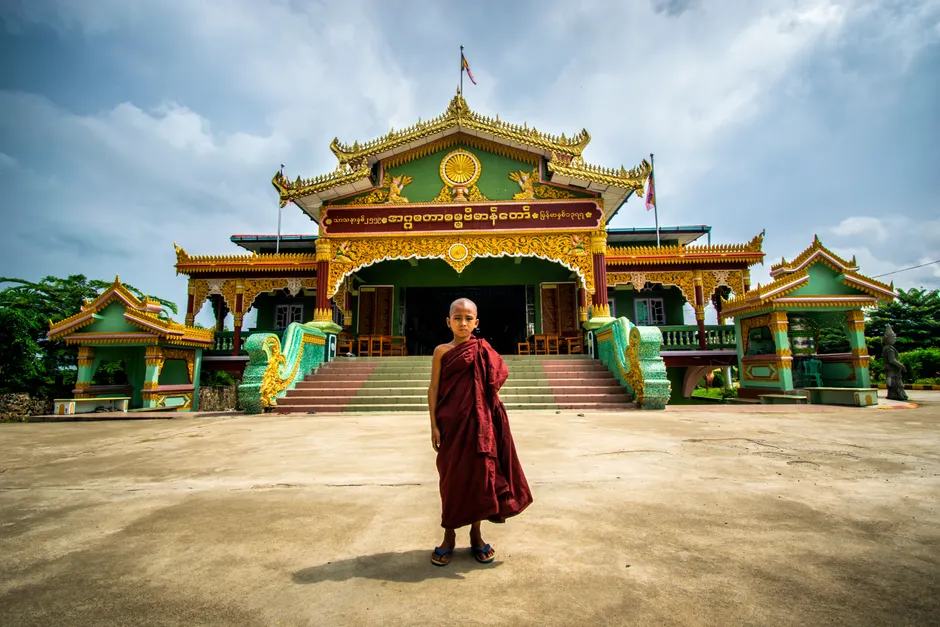
A Myanmar military fighter jet bombed a Buddhist monastery compound in Swel Le Oh village, Myaung township, on August 21, 2026, killing 14 people and injuring 20 more during a weeklong Buddhist Lent retreat. The strike hit at approximately 9 a.m. local time, according to The Economic Times.
Nway Oo, spokesperson for the Civil Defense and Security Organization of Myaung Township (CDSOM), reported that the dead included three women. The Irrawaddy identified the victims as 11 men and 3 women, most of them senior citizens staying in dormitories for meditators. More than 100 people were staying in and around the monastery at the time of the attack.
A local villager, speaking anonymously to The Associated Press, said the aircraft dropped two bombs on the village 15 minutes apart. The villager confirmed CDSOM's death toll of 14 and said his mother-in-law was among those killed. BBC's Burmese Service and other local media outlets reported the death toll at between 10 and 14. The Myanmar military did not immediately comment on the strike.
Swel Le Oh village sits in Myaung township, Sagaing region, roughly 75 kilometres west of Mandalay. Sagaing has been a stronghold of armed resistance against the military government since the February 2021 coup, when the military, known as the Tatmadaw, seized power from the elected civilian government. The township has seen repeated counterinsurgency operations by the Tatmadaw, including sustained aerial bombardment campaigns targeting villages suspected of sheltering People's Defence Force fighters — the armed wing of the pro-democracy movement that formed in response to the coup.
The monastery bombing follows a pattern that the United Nations-established Independent Investigative Mechanism for Myanmar (IIMM) flagged in August 2026. The IIMM said it observed a notable escalation in aerial attacks preceding elections held in December and January, and that those attacks continued unabated afterwards. Myanmar's Ministry of Foreign Affairs rejected the IIMM report, saying the military only targets "terrorists" and that security forces exercise maximum restraint to avoid civilian harm.
That assertion sits uneasily alongside the broader casualty record. Since July 10, Myanmar regime airstrikes across Rakhine and Paletwa have killed 45 civilians, injured 101, and destroyed or damaged 64 homes, according to The Irrawaddy. The targeting of religious sites, civilian gatherings, and meditators during a period of religious observance raises direct questions about the proportionality and discrimination standards that international humanitarian law requires of combatant forces — the principle that military action must be proportionate to the military advantage gained and must distinguish between combatants and civilians.
The broader context here is the junta's increasing reliance on air power as ground control fractures. The military government has lost territory across multiple fronts to a constellation of ethnic armed organizations and pro-democracy People's Defence Forces units. Aerial bombardment allows the Tatmadaw to project force into areas it can no longer hold with infantry, but the tactic almost invariably produces civilian casualties when strikes hit populated villages with no distinguishable military infrastructure. The IIMM's observation that airstrikes escalated around the December-January election period suggests the campaign is both strategic and sustained, not a series of tactical errors.
What remains unclear is whether international accountability mechanisms can translate documentation into consequences. The IIMM collects evidence, but it has no prosecutorial authority of its own; any formal charges would require referral to a court with jurisdiction — a politically fraught proposition given the geopolitical divisions within the Association of Southeast Asian Nations (ASEAN) and the UN Security Council. Myanmar's rejection of the IIMM findings follows a familiar template: deny civilian targeting, label all opponents as terrorists, and characterize military operations as restrained counterterrorism. Each new strike that kills civilians in a monastery, a school, or a village marketplace chips away at the credibility of that framing, but the gap between documented violations and accountability mechanisms remains wide. For the residents of Sagaing, that gap is measured in lives.


