China's Humanoid Robot Games Shatter Records and Signal a Rapidly Maturing Field

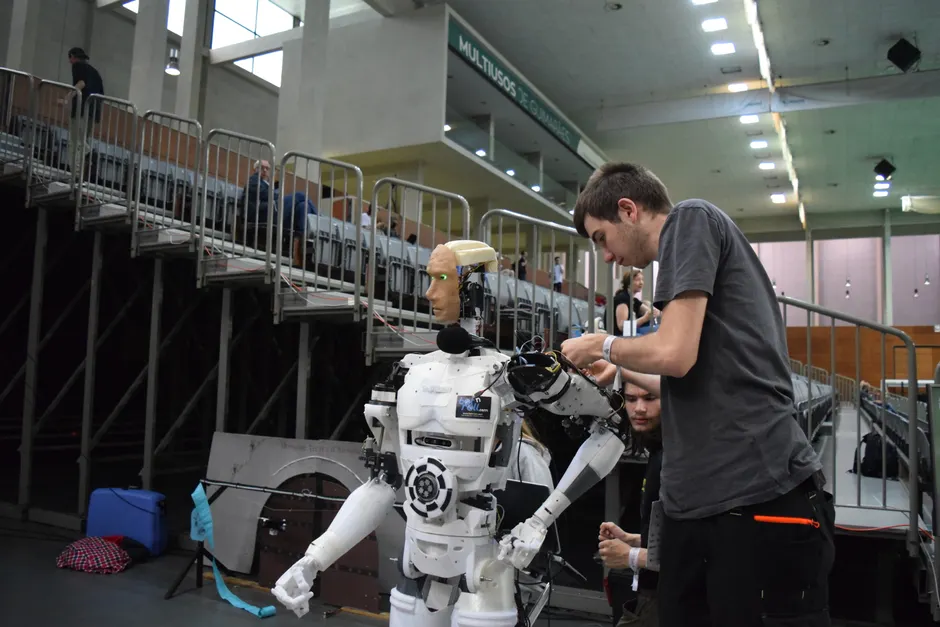
The second World Humanoid Robot Games opened on August 22, 2026, at Beijing's National Speed Skating Oval — known as the Ice Ribbon — with 666 teams from 16 countries across six continents fielding 2,056 robots across 51 events over five days. Team entries grew 138% from the inaugural edition, while the number of robots quadrupled. The Games run through August 26 Beijing Municipal Government, Aug. 23.
The opening ceremony, which drew roughly one thousand humanoid robots, set the tone. Eighty Booster T2 units used cluster control — a technique that lets a single operator coordinate many robots at once — to form the Games' emblem and, during the athletes' entrance, reconfigure into the letters "BEIJING." Thirty-six Lingxinshou Linkerbot robots played the electronic pipe, piano, drums, marimba, and guitar alongside human artists. The Games' flag was carried by a four-legged Dajia robot horse bearing a Tiangong humanoid. An "energy relay" had passed through Milan, Fujian, Sichuan, and Xinjiang before returning to Beijing, where the "Zhixin" (intelligent core) device — symbolizing the Games' torch — was lit to formally open proceedings. Referee representative Li Guisen and athlete representative robot "Lightning" took the oath Beijing Municipal Government, Aug. 23.
The most striking results came on the track and in the field. A robot from the Tianzhuo team, developed by the Beijing Innovation Centre of Humanoid Robotics, ran the 100-metre preliminary in 9.39 seconds — breaking Usain Bolt's 9.58-second human world record and outpacing two other China-made robots in the sprint final Al Jazeera, Aug. 23. The result is even more dramatic against the first edition's best 100m time of 21.50 seconds, set barely a year earlier Beijing Municipal Government, Aug. 23. Beijing's Tiangong Ultra robot cleared 2.8843 metres in the standing high jump, surpassing the human record; the previous year's winning mark was 95.641 centimetres Beijing Municipal Government, Aug. 23. A Chinese humanoid robot named Flash broke the half-marathon world record ABC News, Aug. 22.
Beyond athletics, robots competed in boxing, table tennis, and other track-and-field events. At the opening ceremony, robots played tennis against former professional Zheng Jie, table tennis against Olympic champion Ding Ning, and a shooting contest against footballer Yang Chen. A robot also performed Cristiano Ronaldo's "Siuuu" celebration on the football pitch BBC News. The 2026 programme included 21 scenario events covering nine fields — among them home, hotel, and logistics — with 1,301 matches in total across the 51-event schedule Beijing Municipal Government, Aug. 23; Beijing Economic-Technological Development Area, Aug. 14.
The scale of public engagement was notable. Beijing's Olympic Central Area Management Committee imposed temporary road traffic controls around the Ice Ribbon for the duration. Metro Line 8's Linqiao station extended operating hours to midnight on August 22 to disperse the opening-ceremony crowd Beijing Municipal Government, Aug. 22. Tickets for the opening ceremony were sold at two price tiers: 598 yuan and 128 yuan Beijing Municipal Government, Aug. 5.
The Games are jointly organized by the Beijing Municipal People's Government, China Media Group, the World Robot Cooperation Organization, and the Asia-Pacific Robot Cup International Council. The Beijing Humanoid Robot Innovation Center alone fielded 50 Tiangong embodied-intelligence 3.0 robots and 25 Galbot G1 wheeled robots at the opening ceremony — a deployment that reflects the institutional infrastructure now surrounding China's humanoid robotics sector Beijing Municipal Government, Aug. 23.
The first World Humanoid Robot Games opened on August 14, 2025, and concluded with 26 champions appearing collectively. At that inaugural event, four organizations jointly initiated the establishment of the World Humanoid Robot Sports Federation Beijing Municipal Government, Aug. 18, 2025.
The trajectory between the two editions is where the significance lies. The 100m time dropped from 21.50 to 9.39 seconds in one year. The high jump went from under a metre to nearly three. These are not incremental gains. Whether the figures translate to real-world locomotion competence under unstructured conditions — uneven terrain, dynamic obstacles, non-cooperative surfaces — is a separate question from what a controlled-track preliminary shows. The scenario events covering logistics, hospitality, and domestic tasks are closer to the use cases that would matter commercially, and the expansion from the first edition's scope to 21 scenario events suggests the organizers are calibrating the programme toward applied benchmarks rather than pure spectacle.
The broader context here is that the Games also function as a soft-power vehicle — a way for a country to build goodwill and influence through cultural and technological showcases rather than military or economic pressure. The energy relay through Milan, the participation of teams from 16 countries across six continents, the institutional co-sponsorship with international bodies, and the heavy state media involvement all position this as an exercise in technology diplomacy as much as engineering competition. The fact that municipal authorities treated it with the infrastructure of a major sporting event — traffic controls, extended transit, ticketed ceremonies — signals that Beijing is institutionalizing humanoid robotics as a public-facing national narrative, not merely an industrial policy.
Whether other governments respond with comparable showcases or treat this as a purely domestic Chinese affair will be one indicator of how seriously the field is being taken at the state level elsewhere. For now, the numbers — 666 teams, 2,056 robots, 51 events, five days — are the most concrete measure of how quickly this domain is consolidating.