Keenable Exits Stealth With $26M Seed, Building Web Search Index for AI Agents
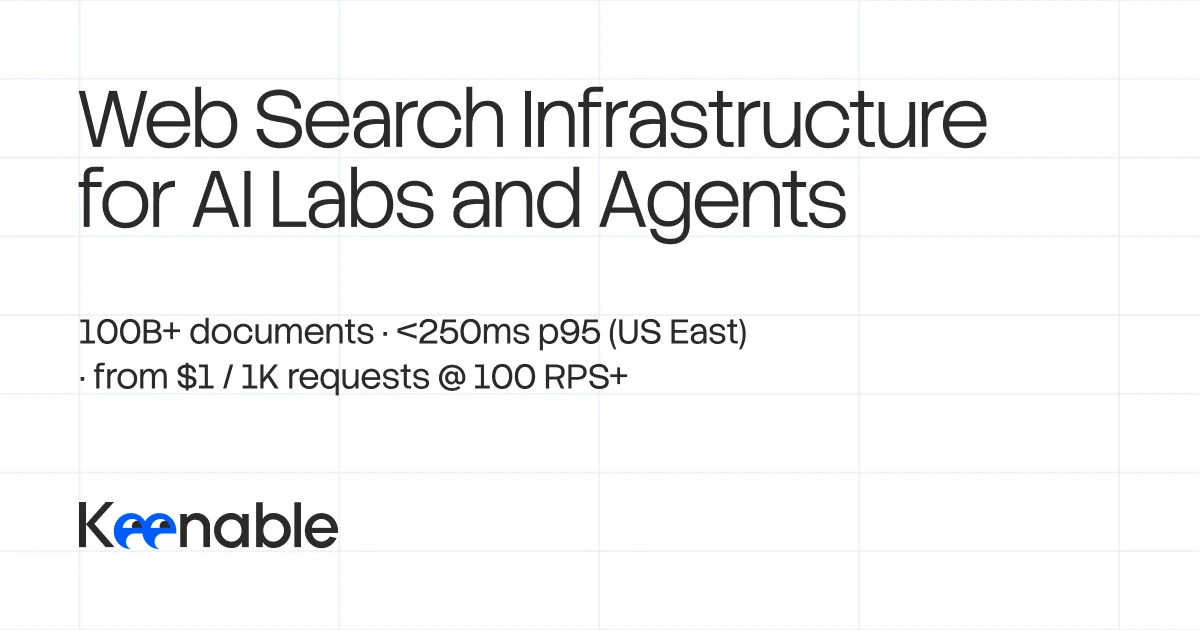
AI search infrastructure startup Keenable emerged from stealth on August 25, 2026, backed by a $26 million seed round led by Accel, with participation from Conviction Partners and a group of business angels (TechCrunch). Accel partner Zhenya Loginov led the firm's investment. The round is dated November 5, 2025 in Pitchbook's company profile, indicating the funding closed months before the public launch.
Keenable describes itself as a research-driven AI infrastructure company focused on web search and knowledge access for large-scale AI applications (Keenable). The company is building a web search index exceeding 100 billion documents and offers web search and page retrieval for AI agents through an API, an MCP server, and a command-line tool accessible with a single key (TechCrunch; Keenable).
The founding team pairs deep search engineering with academic AI research. Co-founder Andrey Styskin previously led the search, AI, and cloud division at Yandex, the Russian search giant. Co-founder Matthias Petri is a German AI scientist (TechCrunch).
Keenable's infrastructure is already running in production. Its API is in use at several AI labs and inference providers, serving both training-time and runtime retrieval needs. The company also recently struck a partnership with voice AI company Gradium to support live information retrieval in conversational systems (TechCrunch; Keenable Blog).
One differentiating capability is temporal search. Keenable allows users to query either the live web or the web index as it stood at any point in time (Keenable). That matters for AI agents evaluating time-sensitive information or verifying claims against a historical state of the web, not just current pages.
On the product roadmap is WebQueryLanguage, an upcoming system designed to help AI systems answer questions by combining information from various web sources (TechCrunch). The name signals an intent to move beyond keyword retrieval toward structured, multi-source query composition for agentic workflows — that is, AI systems that plan and execute multi-step tasks on their own.
The broader context here is that web search infrastructure purpose-built for AI consumption has become a distinct market layer. Large language models and agentic frameworks need retrieval that differs from what consumer search engines optimize for: machine-readable results, consistent formatting, low-latency API access, and the ability to serve both training pipelines and real-time inference. Search indexes built for human clicks and ad monetization are not the same artifact as indexes built for tokenized retrieval at scale — think of the difference between a library card catalog designed for browsing humans versus a structured database designed for automated lookups. Keenable is entering a space where incumbents like Google and Bing have legacy architectures optimized for browser-based consumption, and where newer entrants are building from the API outward.
The Styskin pedigree is worth noting. Running search, AI, and cloud at Yandex means operating a full-stack crawler, indexer, and ranker at national scale under demanding latency constraints. That skill set maps directly onto the problem of building a 100-billion-document index optimized for machine queries rather than human page renders. The combination of that operational experience with Petri's research background gives the team a credible foundation for the infrastructure they are attempting.
The delivery surface is also worth flagging. Shipping an MCP server — a tool interface built to the Model Context Protocol, an emerging standard that lets AI agents dynamically discover and call external tools — alongside a conventional API and CLI signals that Keenable is building for that ecosystem. MCP adoption is still early, but supporting it from day one positions the product for agentic frameworks that rely on standardized tool interfaces rather than bespoke integrations.
What remains unverified from public sources is the scale of current usage, the specific AI labs and inference providers in production, and the performance characteristics of the index under load. The $26 million seed, the production deployments, and the Gradium partnership all point to a company that has been operating quietly rather than building in pure stealth. The November 2025 funding date with an August 2026 public reveal suggests roughly nine months of quiet build time financed at a level that supports serious infrastructure investment.
Looking at what this enables: if Keenable's 100-billion-document index performs as described, AI agents gain a retrieval substrate that is purpose-built for their consumption patterns rather than adapted from consumer search. The temporal search capability adds a dimension that consumer search engines do not prioritize. And WebQueryLanguage, if it delivers on its premise, could give agentic systems a more structured way to compose multi-source answers than current prompt-based retrieval approaches allow.
The risks are structural. Building and maintaining a web-scale index is capital-intensive, and competing against well-funded incumbents with their own crawler infrastructure is not trivial. The competitive moat, if one exists, will likely come from optimization for machine-readable retrieval and the MCP-native delivery model rather than from index size alone.
For technology professionals building agentic systems, the practical takeaway is that a new retrieval infrastructure layer has entered the market with production traction, credible search engineering leadership, and delivery surfaces designed for AI-native consumption rather than browser intermediation.


