BenQ's ScreenBar Max Brings Dual-Monitor Lighting and Radar Presence Sensing to the Desk
BenQ has launched the ScreenBar Max, the first monitor light bar built specifically for dual-monitor setups, priced at $289 with an optional stand at an additional $39. The product arrives alongside a second new light bar, the iScreenBar, which BenQ describes as the first monitor light bar designed for the iMac. Engadget PR Newswire via Morningstar
The ScreenBar Max is wide enough to span two monitors and serves double duty as both a bias light (a light that sits behind or around your screen to reduce the contrast between a bright display and a dark room, which helps reduce eye fatigue) and a desk lamp. It uses BenQ's ASYM-Light optical technology, an asymmetric design the company has deployed across its monitor lighting lineup that directs light down onto the desk surface while keeping glare and reflection off the screen itself. Engadget YouTube
A notable hardware addition is presence sensing via a high-frequency mmWave sensor. mmWave (millimeter-wave) radar detects when a user sits down at the workstation and turns the lamp on automatically. This type of presence detection has been making its way into consumer peripherals over the past couple of years. It is preferred over older PIR (passive infrared) sensors because it can detect small movements and even someone sitting still, without needing a direct line of sight to the person. In a desk-lamp context, the appeal is straightforward: the light turns on when you sit down and off when you leave, so you never have to think about a switch.
At $289 (plus $39 for the optional stand), the ScreenBar Max is the most expensive ScreenBar product BenQ has released to date. Engadget
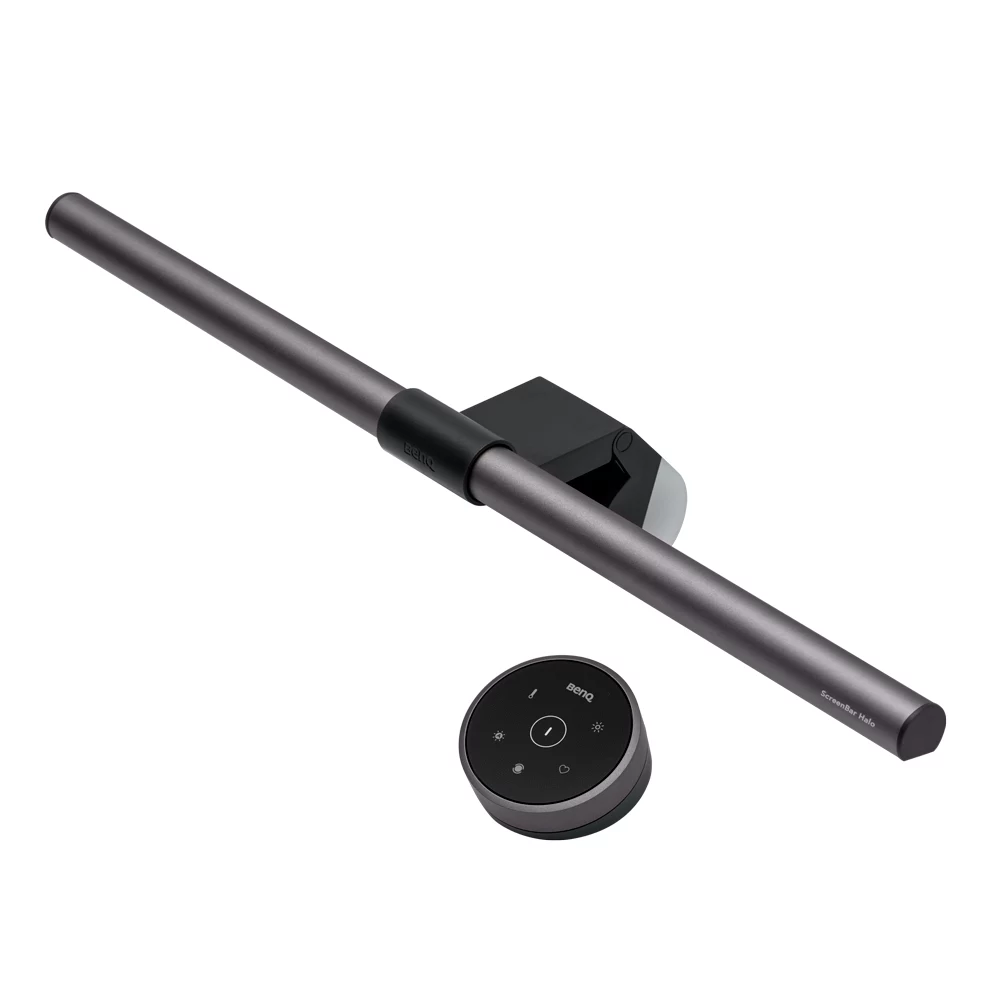
BenQ created the monitor light bar category in 2017 with the original ScreenBar. The lineup has since expanded to include the ScreenBar Plus, which adds a built-in ambient sensor that reads surrounding light levels and automatically adjusts illumination to a target of 500 lux (a standard unit for measuring light intensity); the ScreenBar Halo, a curved variant designed to reduce eye strain with a wireless controller; and the ScreenBar Pro, a dual-monitor light bar with adjustable brightness and color temperature. BenQ BenQ BenQ BenQ
The dual-monitor form factor addresses a real gap. Multi-monitor setups have become the default for knowledge workers, developers, traders, and creative professionals, and BenQ's prior ScreenBar models were sized for a single display. Users with two monitors either ran two separate light bars or went without. The ScreenBar Max combines bias lighting and task lighting into one unit wide enough to cover both screens.
The iScreenBar, launching alongside the Max, targets a different niche. BenQ positions it as the first monitor light bar designed specifically for the iMac, whose all-in-one design does not work with the clip-on mounting approach used on most standalone monitors. PR Newswire via Morningstar
The price trajectory is worth pausing on. The ScreenBar line has steadily moved upstream from its original entry point, and the Max at $289 (potentially $328 with the stand) sits well above what most consumers would consider spending on a desk accessory. The target buyer is a professional who has already invested in a dual-monitor workstation and is willing to pay for integrated presence sensing, optical quality, and a form factor that matches their setup. Whether that audience is large enough to sustain the pricing is a question the market will answer.
The broader context is that monitor bias lighting has moved from an enthusiast tweak to a standardized productivity accessory. Bias lighting reduces perceived eye fatigue by lowering the contrast between a bright screen and a dark surrounding environment, and task lighting directed at the desk surface improves readability of physical documents without creating screen glare. BenQ's ASYM-Light approach addresses both needs in one fixture. The ScreenBar Max extends that proposition to the dual-monitor configuration that now defines many professional workstations.
BenQ's lighting division has a track record of category creation that predates the ScreenBar. The company's treVolo, described as the world's first portable electrostatic speaker, won the Best Choice Award at Computex 2015. BenQ
For technology professionals who have adopted dual-monitor setups as their default working configuration, the ScreenBar Max is a purpose-built lighting solution that matches the physical footprint of their workspace. The mmWave presence sensing, in particular, is a meaningful integration of a sensor technology that has proven its reliability in adjacent product categories, and its appearance in a desk lamp signals how thoroughly that technology has moved down the cost curve. Whether that justifies the premium price will depend on how much the buyer values automatic operation and a single-unit aesthetic over two less expensive light bars running independently.


