Kew Gardens to Renovate Its Victorian Palm House — and Save Its Rarest Plants in the Process

Kew Gardens is preparing to renovate its Victorian-era Palm House glasshouse, with work set to begin in 2027 provided the necessary funds are raised in time, according to The Guardian. The project was first announced when Kew submitted planning permission in July 2025 for a once-in-a-generation renovation of both the Palm House and the adjacent Waterlily House. The need is urgent: the Palm House's ornate ironwork is rusted, and its 16,000 panes of glass are warped and damaged.
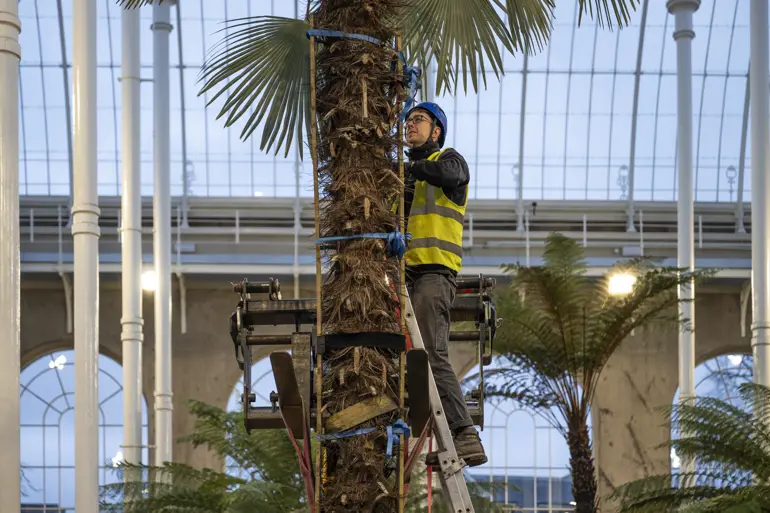
The Palm House contains around 1,000 plants, and relocating them is the central logistical challenge of the renovation. Some specimens will be felled because they cannot be moved, including giant palm trees whose fronds reach the roof. The Palm House has undergone two previous renovations in its history, and this third campaign will require cleaning up hundreds of tonnes of iron, according to BBC News. Earlier reporting put the number of plants to be moved at 1,300; the more recent Guardian figure of around 1,000 reflects the current state of the collection. The Palm House will remain open to visitors throughout the renovation.
Plants removed from the glasshouse have been transferred to a behind-the-scenes greenhouse called the tropical nursery. Will Spoelstra, manager of the Palm House, is overseeing the horticultural side of the operation. Tom Pickering, head of glasshouses at Kew, has overall responsibility for the living collection's welfare during the works.
The most consequential conservation thread concerns Ravenea moorei, a palm native to the Comoros islands off the southeast African coast. The Kew specimen is male, meaning it cannot produce seed without a female, and it cannot be moved due to its size — it must be cut down. At the time of Kew's November 2025 press release, the tree was thought to be the only one of its kind in cultivation anywhere in the world. However, Kew researchers subsequently found a wild population of Ravenea moorei in the Comoros, which made propagation (the process of growing new plants from seeds, cuttings, or other plant material) possible. That discovery, which also involved habitat protection work in the Comoros, has yielded 10 young plants now growing in Kew's tropical nursery, ensuring the species will persist at Kew after the original specimen is lost.
A second propagation success involves Aiphanes eggersii, a plant covered in large spikes that makes relocation perilous. Kew has successfully sown seeds from it for the first time, offering a propagation pathway that sidesteps the risks of physically moving the specimen.
For the plants that can be relocated, Kew has enlisted specialist movers who normally work with rare and fragile works of art. Among the specimens entrusted to them is the Eastern Cape giant cycad, the oldest pot plant in the world, which has been growing at Kew since 1775. Kew scientists are also collecting seeds and cuttings from Palm House plants across the collection to propagate replacements that will eventually refill the greenhouse.
The broader context here is one that botanic gardens navigate with increasing frequency: heritage infrastructure and living collections are on conflicting maintenance cycles. A glasshouse built to Victorian engineering tolerances degrades on a timeline that does not align with the growth rates of tropical plants, some of which have spent decades or centuries outgrowing the spaces designed to contain them. When renovation becomes unavoidable, the collection itself becomes the obstacle. Specimens too large to extract through existing doors, or too fragile to transplant, must be sacrificed. The institution's recourse is what botanists call ex situ propagation — growing the species elsewhere, in a controlled setting, the botanic equivalent of backing up a database before decommissioning the server.
The Ravenea moorei case sharpens the stakes. Without the field expedition to the Comoros, felling the Kew specimen would have meant losing the species from cultivation entirely. The fact that a viable wild population was found, and that propagation has succeeded, converts a net loss into a managed transition. But the outcome hinged on a field discovery that could easily have gone the other way. For institutions holding single-specimen or single-sex representatives of rare species, the Kew renovation is a concrete illustration of how infrastructure decisions can ripple into conservation outcomes that are difficult to reverse.
Kew Gardens, meanwhile, continues its public programming through the lead-up to the renovation. The site is currently hosting "Tom Gates EPIC Adventure" through 31 August 2026, with "Christmas at Kew" scheduled for selected dates from 13 November 2026 to 3 January 2027. Wakehurst, Kew's 500-acre wild botanic garden in Sussex and home to the world's largest seed conservation project, is hosting the "Henry Moore and more" exhibition through 23 May 2027 and "Glow Wild" from 26 November 2026 to 2 January 2027. Kew's "State of the World's Plants and Fungi 2026" report, titled "Is technology nature's ally?", adds a research dimension to a year in which the institution is simultaneously managing its most significant infrastructure project in a generation.