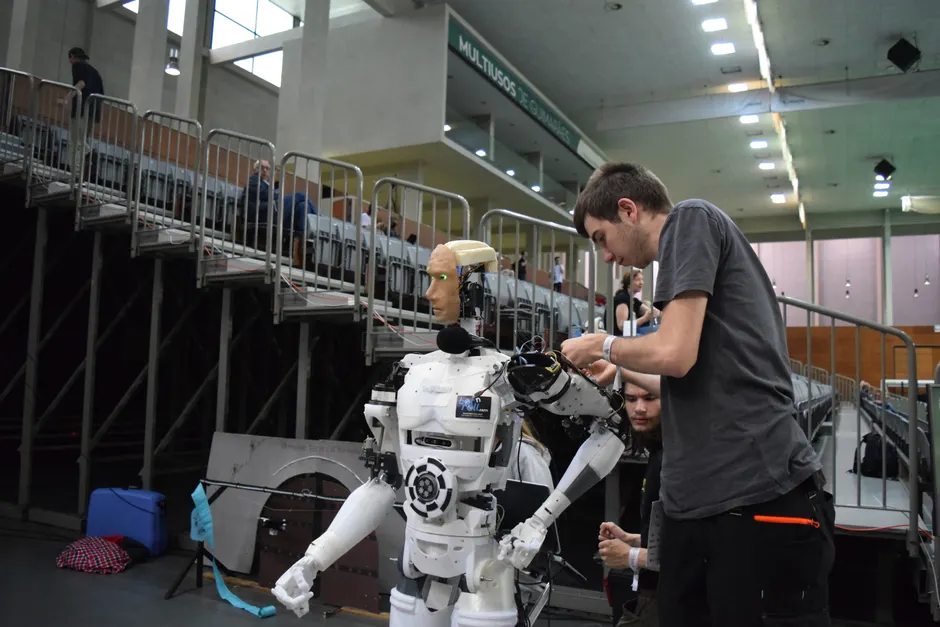
China's Tiangong Ultra Humanoid Runs 100 Meters in 8.64 Seconds, Beating Bolt's Record

China's Tiangong Ultra humanoid robot ran 100 meters in 8.64 seconds on August 25, 2026, finishing faster than Usain Bolt's 9.58-second human world record at the second World Humanoid Robot Games in Beijing Reuters. The five-day event, held August 22–26 at the National Speed Skating Oval, drew 2,056 robots from 666 teams across Olympic-style and practical-skill competitions Forbes.
The Games paired athletic events — sprinting, football, boxing, and weightlifting — with utility tasks such as bed-making, parcel delivery, shelf stacking, clothes folding, hammering nails, and even a firefighting contest The Verge. The 2026 edition added a dexterous-hand challenge judging robots on speed and accuracy in precision manipulation tasks Reuters.
Athletic results improved sharply over the inaugural 2025 Games. That first edition's winning 100-meter sprint time was 21.50 seconds; the best standing high jump cleared 0.95 meters The Verge. Tiangong Ultra's 8.64-second sprint this year is roughly a 60 percent reduction in elapsed time over a single edition. No biological athlete population improves at that rate.
For all the headline numbers, the event also surfaced how far humanoid platforms remain from reliable operation under real-world conditions. A robot built by smartphone maker Honor lost a leg mid-sprint. During the weightlifting event, a competitor lost balance and toppled into the judges' table. Robotic cheerleaders tumbled and stumbled through routines. One sprint finisher ran into a crash mat, bounced off it, and burst into flames The Verge.
These failures fit the current state of bipedal locomotion under perturbation — that is, two-legged robots trying to stay upright when something unexpected pushes them off balance. The core challenges are motor power density (how much force a motor can deliver relative to its size), how quickly actuators can respond to changes, and real-time balance recovery. Running a straight-line sprint on a controlled surface is a fundamentally different control problem from absorbing an unexpected sideways push while carrying an uneven load. The weightlifting incident is an instructive case: a robot that can stand still with a barbell overhead has solved the easier problem of holding a steady pose, but the transition through the lift's dynamic phase — where the center of mass shifts rapidly relative to the robot's supporting footprint — remains genuinely difficult.
The competitive and utility event mix also reveals what the organizers are benchmarking. Sprinting, jumping, and boxing test locomotion, power, and reactive balance. Bed-making, clothes folding, and shelf stacking test fine manipulation, spatial reasoning, and force-position hybrid control, the same capabilities Unitree advertises for its G1 platform, which the company describes as having flexibility beyond a normal human Unitree. The hand-focused challenge added in 2026 extends that manipulation baseline. The firefighting contest adds a multi-modal perception and navigation layer, requiring the robot to locate a hazard, navigate to it across an unstructured environment, and apply a corrective action, all under time pressure.
China's humanoid robotics ecosystem has been building toward events like this for over a year. In April 2025, 21 humanoid robots joined thousands of human runners at the Yizhuang half-marathon in Beijing, the first time such machines participated in the event Reuters. By April 2026, plans called for more than 300 humanoid robots to run a 21 km half-marathon as a showcase of technical progress Reuters. The BBC published an analysis in April 2026 concluding that China had established superiority over the US in AI "bodies" — the physical robotic platforms, as distinct from the AI software that drives them BBC.
The hardware landscape that produced the 2026 Games' competitors is increasingly accessible. Unitree's H1, billed as the first full-size universal humanoid robot capable of running in China Unitree, has now been joined by the H2, a 180 cm humanoid platform priced at $29,900 Unitree. A sub-$30,000 price point for a full-size humanoid places these platforms within reach of university labs, mid-size companies, and independent research teams, not just state-backed giants. More entrants mean more teams finding edge cases, more actuators failing under load, and faster iteration on the control problems that the Games' more chaotic moments exposed.
The broader context here is that the juxtaposition of record-breaking sprints and literal combustion is not a contradiction but a snapshot of where the technology sits. Straight-line speed on a known surface is a solvable problem when you can throw enough motor torque at it. Recovery from unexpected perturbation, thermal management under sustained load, and graceful degradation when a joint fails are harder, less glamorous, and not solved. The Games' format, mixing athletic spectacle with prosaic utility tasks, effectively maps the gap between what performs well in a demo and what works in an unstructured environment.
The competitive framework also matters beyond engineering. Foreign Policy noted that the 100-meter preliminaries were held on August 22, 2026, and situated the Games within the context of US restrictions and bans on Chinese robotics technology Foreign Policy. An event that puts 2,000-plus humanoid robots in a former Olympic venue is as much a signal of industrial capacity and supply-chain maturity as it is an engineering benchmark. The message to a domestic audience is that the ecosystem can field thousands of platforms; the message to an international one is that the gap between Chinese humanoid hardware and everyone else's may be widening rather than narrowing.
The trajectory from 2025's 21.50-second sprint to 2026's 8.64-second sprint is steep. Whether that rate of improvement sustains, and whether the manipulation and robustness problems close as quickly as the locomotion ones, will be visible at the next edition. The crashes, fires, and fallen legs will matter less than whether the teams that experienced them show up with fixes.