A Strong El Niño Is Forming — and It Could Be the Most Powerful in 70 Years
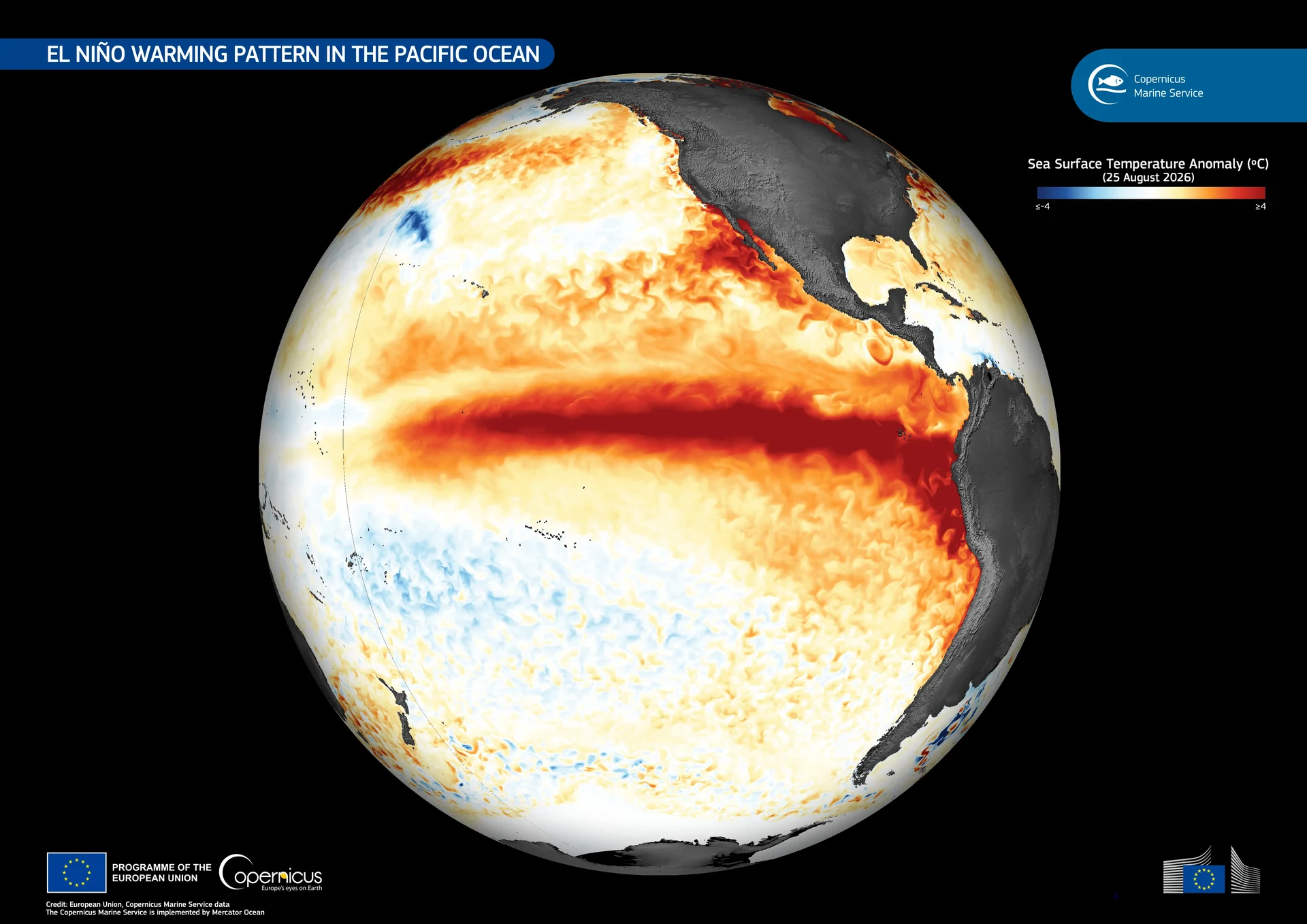
The World Meteorological Organization (WMO) says a strong El Niño event is rapidly developing during July–September 2026, with the pattern expected to persist into early 2027. El Niño is a natural climate cycle in which Pacific Ocean surface temperatures rise above normal, disrupting weather patterns worldwide. The WMO published its initial news release on 3 July 2026, followed by subsequent reports on 31 July and 12 August confirming a strong El Niño expected to intensify amid record-breaking heat and extreme weather. WMO Secretary-General Celeste Saulo leads the agency as it tracks the developing event.
Carbon Brief's Daily Briefing, published 3 September 2026, reports the developing El Niño could be the strongest in more than 70 years and last until at least February 2027. The Jerusalem Post reported on 16 June 2026 that the El Niño forming in the Pacific could become the strongest in 70 years and threatens food supplies.
The WMO's current forecast builds on historical precedent. The 2023–24 El Niño peaked as one of the five strongest events on record before gradually weakening while continuing to affect conditions. The prior La Niña — the cooling phase of the same Pacific cycle — peaked in October–November as a moderate-strength event, with a 65% likelihood of persisting through February.
The intensifying El Niño is expected to suppress tropical cyclone activity. The U.S. National Oceanic and Atmospheric Administration (NOAA) forecasts a below-average hurricane season, with El Niño developing and intensifying during the hurricane season to support fewer tropical storms and hurricanes.
Agricultural and food security risks are substantial. The Food and Agriculture Organization (FAO) warned that El Niño-linked drought is most likely to damage crops and pasturelands, raising risks for farming-dependent livelihoods and food security. The risk of agricultural drought is highest along the Dry Corridor — a stretch of Central American farmland prone to chronic dry spells — as well as in Colombia, Venezuela, Cuba, the Dominican Republic, and Haiti. The outlook for 2026 rice and maize crops is more uncertain, with main and secondary production seasons extending from June 2026 to early 2027.
The FAO–WFP Joint Anticipatory Action Appeal, covering June 2026 through March 2027, states that developing strong El Niño conditions are set to intensify droughts and floods across Africa, Asia and the Pacific, and Latin America and the Caribbean. On 19 August 2026, the WMO reported El Niño impacts on the Greater Horn of Africa. The WMO also reported that Western Europe had its hottest June on record and published findings on ocean warming, marine heatwaves, and sea-level rise. A flood tragedy in Nepal highlighted cross-border and cascading risks.
For agricultural adaptation, FAO advises that when heat forecasts exceed 38°C in an El Niño year, alerts recommend shading vegetables, storing extra water, shifting irrigation to cooler hours, and keeping produce cool. Mongabay reports that El Niño-strengthened weather can damage critical infrastructure, disrupt agriculture and fisheries, and degrade long-term public health.
The commodity-market implications are tangible. Rice and maize production seasons spanning June 2026 into early 2027 will unfold under El Niño conditions that the FAO assesses as elevating drought and flood risk across major producing regions. Soft commodity volatility — price swings in agricultural goods like grains and oilseeds — historically correlates with the intensity of ENSO phases (the broader Pacific temperature cycle that includes both El Niño and La Niña). The WMO's trajectory toward a potentially record-strength event introduces pricing asymmetry for agribusiness exposure in the Americas, Africa, and Asia-Pacific.
The broader context here is that a potentially record-strength El Niño arriving on top of already record-breaking global temperatures compounds the pressure on food systems, supply chains, and disaster budgets. The pricing risk skews upward: a bad harvest in one region can ripple through global commodity prices, hitting import-dependent countries hardest. Whether this event fully matches or exceeds the historic five strongest on record is a factual question the data will answer over the coming months, but the precautionary signals from the FAO and WFP are already in place.
The WMO's upcoming schedule reflects institutional prioritization of the event. The ITU-WMO Global Seminar on the Use of Radio Spectrum for Weather, Climate, and Water is scheduled for 28–30 September 2026 in Switzerland. The WMO High-level Dialogue on Climate Science Information for Climate Finance and the 53rd Senior Official Field Exchange Workshop follows on 14–18 September 2026. The WWRP Conference 2027, 'Advancing Weather Science for Resilient Societies,' is scheduled for 23–25 August 2027 in Nanjing, China.


