Gaza's Dead Still Await Burial as Recovery Teams Work Against Time and Ruin

Palestinians in northern Gaza held funeral ceremonies on Sunday for approximately 100 people, including 60 children, whose remains were recovered from the rubble of destroyed buildings in Gaza City's Zeitoun neighbourhood. Family members carried the remains from Zeitoun to al-Ma'madani cemetery in central Gaza City for burial, according to Al Jazeera correspondent Ghazi al-Aloul (Al Jazeera).
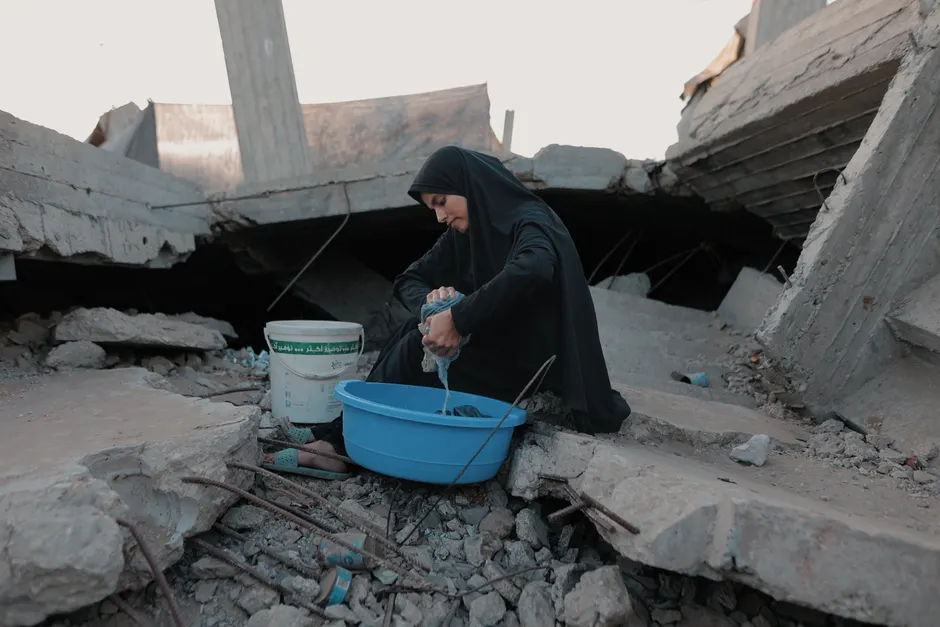
Many of the recovered victims belonged to the extended Malaka family, which alone lost 55 members. The September 6 burial follows a separate recovery reported a day earlier, when Gaza teams retrieved the remains of 55 people from a single family sheltering in their home when it was struck by Israel (Al Jazeera). Civil defence crews — essentially Gaza's emergency rescue service — and family members had spent weeks digging through the ruins of homes hit during Israel's war against Palestinians in Gaza, which began in October 2023.
The recovered remains were often only fragments, wrapped in shrouds to resemble intact bodies. Al-Aloul reported that no complete bodies had been recovered from the site. He also said families had waited a long time to bury their loved ones in known, proper cemeteries, noting that Israeli forces had destroyed and dug up cemeteries elsewhere in Gaza during the war (Al Jazeera).
Raed al-Dahshan, head of Gaza's civil defence service, said an estimated 8,000 bodies still believed to be under rubble could be recovered in about 90 days with proper equipment. The work is being held back by a shortage of heavy machinery and protective equipment. The second phase of Gaza's body-recovery project covers 147 destroyed homes with an estimated 1,072 bodies still beneath the rubble; crews had recovered around 333 bodies as of September 6 (Al Jazeera; TRT World).
Ajith Sunghay, head of the UN human rights office in the occupied Palestinian territories, said some of the recovered remains dated back to November 2023 and that thousands of people were still under rubble in areas that may be under Israeli military control, covering 70 percent of Gaza (Al Jazeera).
These recoveries are the latest in a pattern stretching back months. On August 4, 2026, Gaza held a mass funeral for 112 people killed in Israel's 2023 Sabra attack, with thousands joining to bury remains recovered from the rubble of destroyed homes. Reuters reported that the decomposed remains of the Al-Hassayna clan were laid on stretchers shrouded in flags (Reuters; Al Jazeera). On August 8, crews recovered 19 bodies from the rubble of a destroyed building, with more than 8,000 people reported missing at the time (Al Jazeera). On August 20, the remains of 50 Palestinians killed in the early months of the war were buried in a mass burial (TRT World).
Rights groups cited by Al Jazeera in August 2026 reported that Israel trucks out Gaza's rubble to destroy war crimes evidence and make the landscape unliveable (Al Jazeera). In January 2026, Al Jazeera reported that Israel razed 200 graves to recover the body of a final Israeli captive while thousands of Palestinians killed remained lost and unidentified under rubble (Al Jazeera).
The broader context here is a recovery effort shaped by several overlapping constraints: a lack of heavy machinery and protective equipment, Israeli military control over 70 percent of Gaza's territory where many remains are believed to lie, and the physical destruction of cemeteries that would ordinarily serve as burial sites. Al-Dahshan's 90-day estimate for recovering the remaining 8,000 bodies depends on equipment that has not materialized, meaning the timeline is aspirational rather than operational. The fact that remains dating to November 2023 are still being recovered in September 2026, nearly three years later, shows that the gap between the violence and the ability to bury its victims has been measured in years, not weeks.
For families, the delay carries a specific cultural dimension: Islamic burial practice emphasizes prompt interment, and the protracted inability to recover, identify, and bury the dead compounds the humanitarian toll in ways that are both measurable, in the thousands still beneath rubble, and intangible, in the denial of mourning rites that families have waited years to perform. The shrouding of fragmentary remains to resemble intact bodies, as al-Aloul described, is a practice born of necessity when recovery yields only partial remains from collapsed structures subjected to sustained bombardment.
The second-phase recovery figures, 333 bodies recovered against an estimated 1,072 still beneath 147 destroyed homes, put the completion rate at roughly 31 percent. Extrapolated against the 8,000-body estimate across all of Gaza, the civil defence service faces a recovery operation whose scale exceeds its current capacity by orders of magnitude, and whose timeline depends on conditions, equipment access, and territorial control that remain in flux.