UK Pay Growth Slows to 3.9% as Hiring Fades
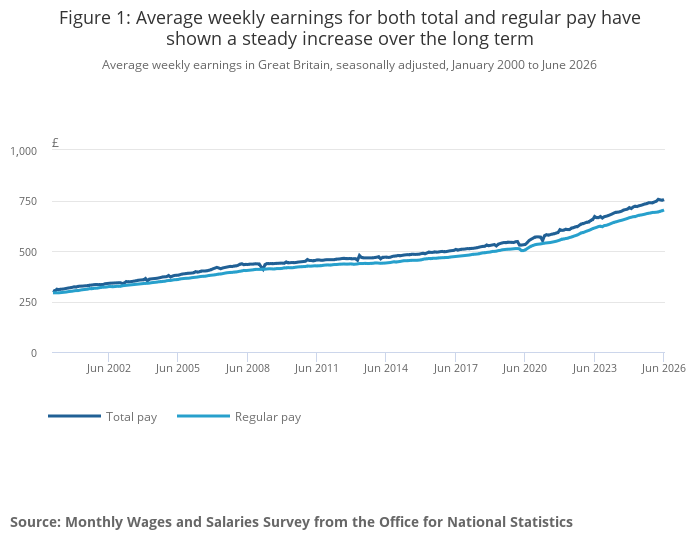
UK total earnings including bonuses grew 3.9% a year in the three months to July 2026, down from 4.1% in the three months to June 2026. The data come from the latest Office for National Statistics snapshot reported on 15 September 2026. The Guardian
Growth without bonuses, known as regular pay, was unchanged at 3.5%. The 3.9% headline matched forecasts from City economists. The pay figures cover Great Britain for average weekly earnings and the UK for headline labour-market status.
The headline unemployment rate held steady at 4.9%. The number of workers on company payrolls edged down, led by fewer jobs in retail and hospitality. Think of vacancies as a count of help-wanted signs. ONS director of economic statistics Liz McKeown said vacancies remain at their lowest level outside the pandemic period for more than a decade.
Payrolled employees stood at 30.2 million, after generally falling over the last two years, with a further fall in the three months to July 2026. ONS The flash estimate for August 2026 showed a monthly fall of 26,000, or 0.1%. ONS said Real Time Information, payroll tax data sent by employers, currently provides the most reliable measure of employees.
A survey-based measure points to a less weak picture. Labour Force Survey employees numbered 29.8 million in May to July 2026, up 111,000 on the year. The Labour Force Survey is a large household survey, different from the tax records. ONS plans to publish new research linking RTI data to the Labour Force Survey on 28 September 2026. The next Workforce Jobs benchmarking exercise is due in December 2026.
The slowdown has built over time. In March 2026, average earnings in Great Britain grew 3.8% for regular pay and 3.9% for total pay. In May 2026, growth was 3.4% for regular pay and 4.1% for total pay. Private-sector regular pay growth slowed to 2.8% in the second quarter of 2026. Reuters Job vacancies fell to 707,000 in the three months to July 2026, the lowest since 2021. Earlier, regular pay growth slowed to 4.7% in the three months to August 2025, then the lowest since 2022, when the headline unemployment rate rose to 4.8% in data reported in October 2025. Regular pay growth had slowed to 5.2% in data reported in June 2025, down from 5.5%. In the three months to January 2024, regular pay growth was 6.1%, down from 6.2%.
City investors expect the Bank of England to keep its base rate, its main interest rate, on hold at 3.75% at its meeting on Thursday. Bank of England The Bank lists 17 September 2026 as the date for its September Monetary Policy Committee summary and minutes. Oil prices have risen above $107 a barrel. Under the triple lock, the rule that sets the yearly increase, the state pension rises each year by 2.5%, inflation, or average wage growth, whichever is highest.
The broader context here is a jobs market sending two signals at once. Pay pressure has eased enough to keep future rate cuts in view, but it has not collapsed, while demand for new hires is fading. Steady 4.9% unemployment alongside falling payrolls and decade-low vacancies outside the pandemic points to softer demand for labour rather than a shortage of workers. For public finances, the 3.9% total-pay figure matters because the triple-lock calculation is linked to average earnings.
Looking at what this means for the next steps, the near-term questions are narrow. Whether August payrolls confirm the 26,000 flash fall, whether private-sector regular pay holds near 2.8%, and whether energy costs feed into inflation expectations will shape the debate after the 17 September decision. The ONS work on RTI and Labour Force Survey coherence, due 28 September, will also affect how much weight policymakers place on each jobs signal.


