Breville Eye Q: A Toaster That Stops by Shade, Not Time
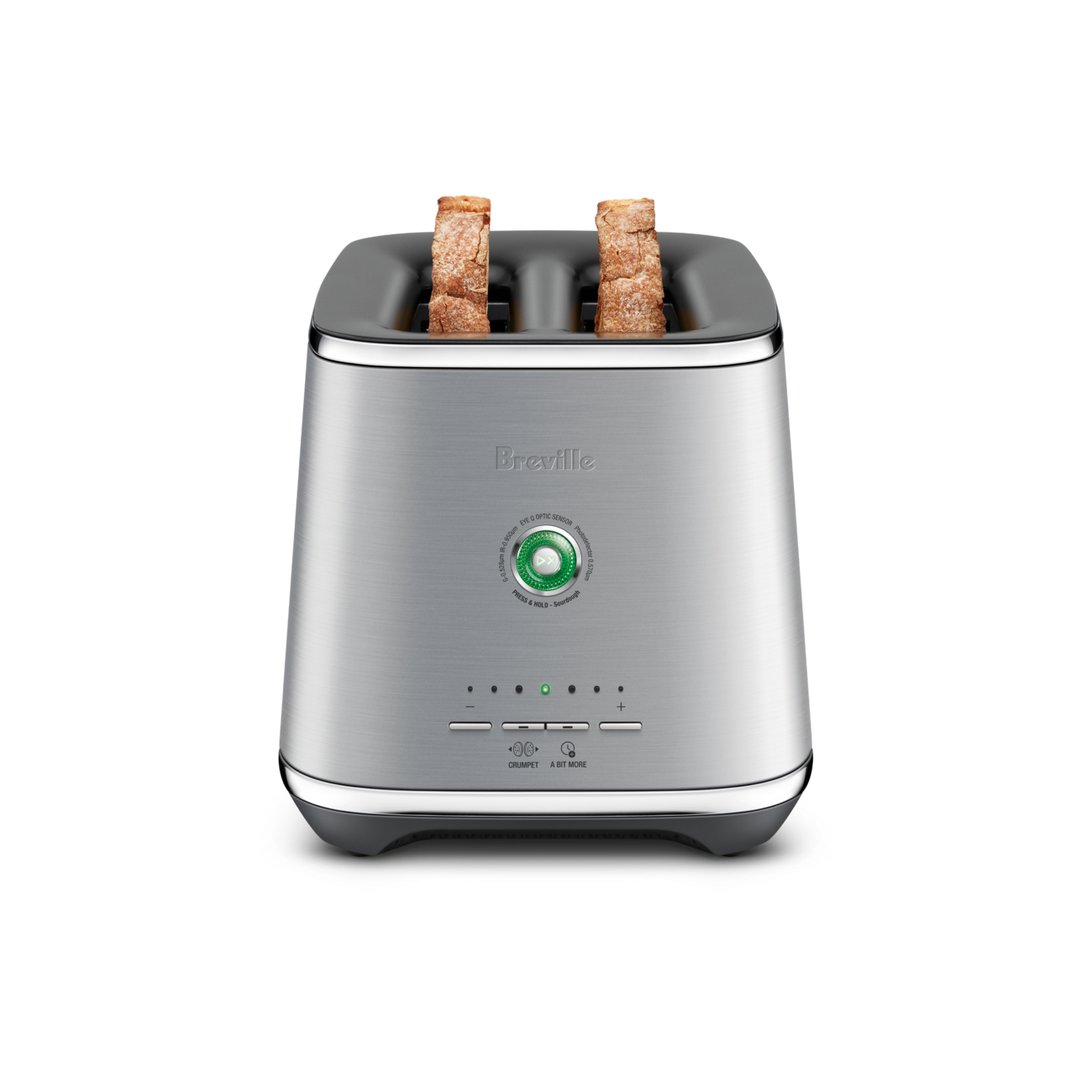
Breville's $300 Eye Q toaster decides when toast is done by color, not by timer. Engadget described it as the world's first toaster that works on color instead of time.
The system uses built-in optical sensors to check toast color 10 times per second. Breville calls the platform Sensability Technology. The company describes the hardware as a patented optic sensor and says its Eye Q toasters stop precisely at the chosen shade.
The hardware centers on two optical sensors built inside the shell. They sit between one side of the toaster and the heating element. Fast Company detailed that placement and the 10-year development effort behind it. The sensor is heat-resistant, a necessary property given that location, as noted in review coverage. The Guardian called the product a 'revolutionary device'.
Control is closed loop. That means the toaster measures the result during the cycle, more like a thermostat than a kitchen timer. The user selects from seven color options. The toaster monitors the slice during the cycle and ends heating when the target is reached. That differs from conventional timer control, which applies fixed power for a fixed duration regardless of starting conditions.
Mechanical operation is automated. Built-in motors clamp and lower bread instead of a spring-loaded lever. The interface includes a dedicated bagel button and an "A bit more" button for a short additional browning pass. The approach removes manual lever timing from the result.
Breville sells the range as the Eye Q 850 Auto, a 2-slice toaster under model number BTA850, and the Eye Q 870 Auto, a 4-slice toaster under model number BTA870. Breville lists the 850 Auto 2 Slice at $219.95 with a progress indicator. Breville It also lists Sourdough Mode and Timer Mode for that 2-slice model. The 4-slice 870 Auto is listed with one-touch automatic operation. The Guardian lists the Eye Q Auto 4 Slice at $400.
Geography matters for branding. In the United Kingdom and Europe, the Breville brand is not owned or operated by Breville Group Limited. Products there are offered by Newell Brands, a separately owned and managed company with a different product range than Breville in other parts of the world.
The broader context here is a shift from open-loop timing to direct measurement of the variable the user specifies. Toast color is the output. Time and heater power are only proxies. Sampling color repeatedly during browning narrows the gap between setting and result, especially across differences in bread type, moisture, thickness and starting temperature where a fixed timer drifts.
Looking at the engineering challenge, the hard problems appear to be optical stability and mechanical repeatability. A sensor that lives beside a heating element must hold calibration through repeated thermal cycling. Motorized clamping and lowering give the sensor a consistent view of the slice on each run. Modes for sourdough and timed operation suggest recognition that pure color tracking still needs overrides for dense loaves, frozen product or user habit.
In my view, the optimism is warranted but narrow. This does not change how heating works. It changes how stopping is decided. That is a smaller claim than the early superlatives suggest, yet it is the kind of smaller claim that tends to survive daily use. If closed-loop browning proves reliable over thousands of cycles, expect the same sensing logic to spread to other countertop heating tasks where surface color is the specification.