Treble Raises $18 Million to Test Voice AI in Virtual Rooms
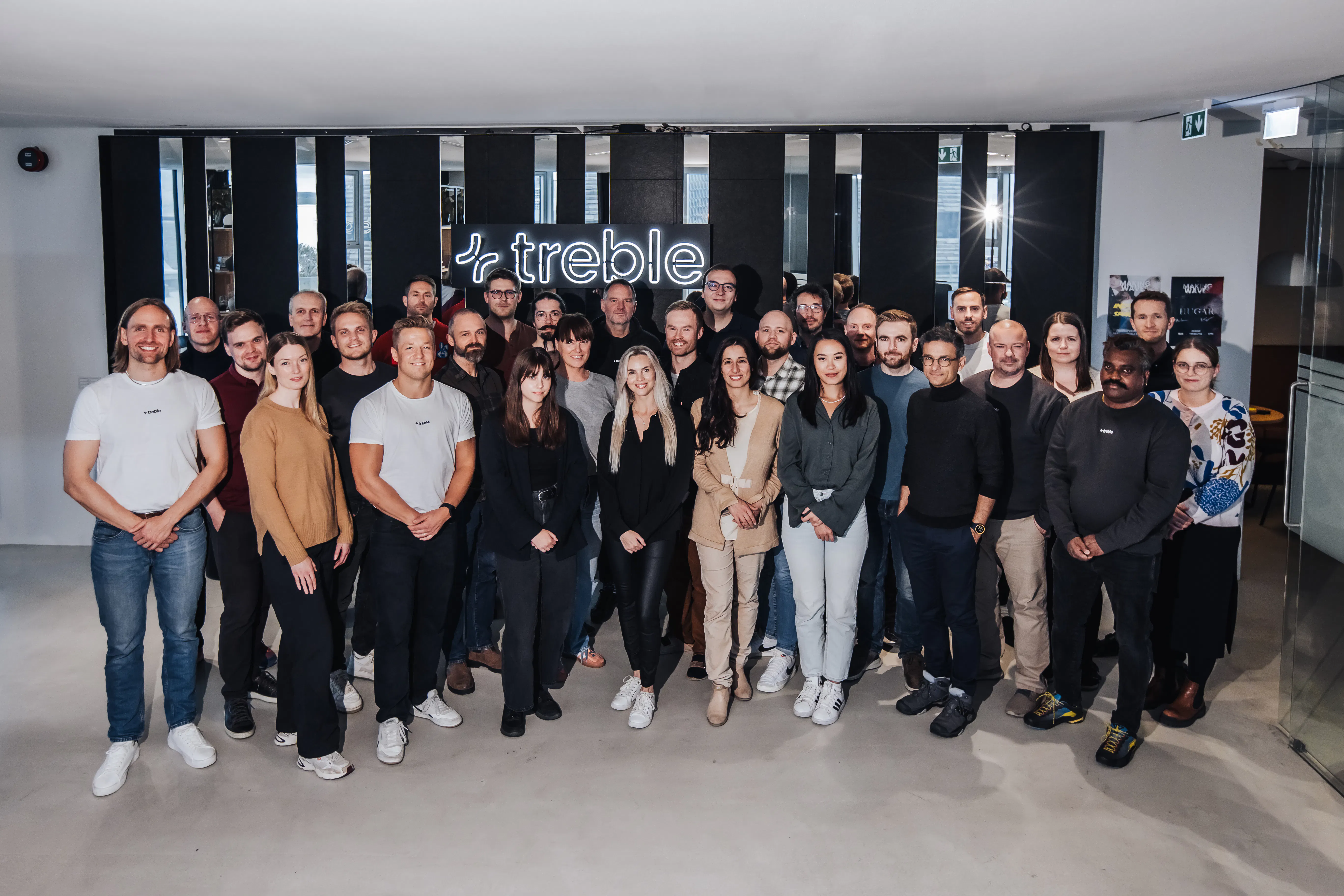
Treble has raised $18 million as an extension of its Series A funding. The round was led by Paladin Capital Group. TechCrunch reported the financing with details from the company.
The round included KOMPAS VC, Frumtak Ventures, EIC and Omega ehf. Total funding now exceeds $40 million. That follows a $12 million investment in 2024.
Treble had previously described that 2024 financing as an €11 million Series A, announced on Sept. 3, 2024. The dollar figure is now the authoritative total for that earlier round in current reporting, with the euro figure retained as company background at the time.
Treble is based in Iceland. It was founded in 2020 by Finnur Pind and Jesper Pedersen. Both founders are acoustic engineers, specialists in how sound moves in rooms and devices. The company describes itself as a sound simulation and synthetic audio data generation technology company.
Its simulation platform is aimed at model makers, robotics companies and consumer hardware makers. The stated use is synthetic data generation, or computer-created audio for training, for speech enhancement, cleaning up spoken voice, noise suppression, removing unwanted background sound, and model training. It is built for engineering and training workflows, not as a consumer audio product.
Treble also evaluates voice AI models in different conditions to provide feedback to labs. In that role, it partnered with Hugging Face to launch a benchmark, a standard test, for speech recognition models across realistic conditions. Named customers include Amazon and Logitech.
The broader context here is familiar to anyone who has worked with microphones, speakers and rooms. Physical acoustic testing is slow. It requires special chambers, hardware prototypes and repeated recordings. It is difficult to reproduce exactly.
In my view, that is why simulation and synthetic data have earned attention from teams building voice interfaces. A controllable acoustic model lets engineers vary a room, a device placement or a noise source without rebuilding a physical setup. For training and for testing, repeatability has practical value. It shortens iteration cycles and makes failures easier to diagnose.
Worth flagging for a technical reader is the split in what Treble is offering. One part is generation. Synthetic utterances and noise conditions can supplement recorded datasets for speech enhancement and noise suppression. The other part is evaluation. Running a voice model through defined conditions and returning feedback to labs is a separate workflow, closer to continuous software testing for audio than to dataset supply.
Looking at what this means for builders, the Hugging Face benchmark is notable. Shared evaluation across realistic conditions gives model makers and hardware teams a common reference. It does not settle which model is best for every deployment. It gives teams a way to compare behavior under stress before committing to hardware tuning or field collection.
In the long arc, tools of this kind tend to lower the cost of getting audio right. My own children grew up talking to speakers and phones that often misheard them in kitchens and cars. Better handling of those ordinary, noisy rooms is unglamorous work. It is also the work that determines whether voice interaction is trusted. If simulation helps more teams test those conditions early, that is a quiet gain for users.


